

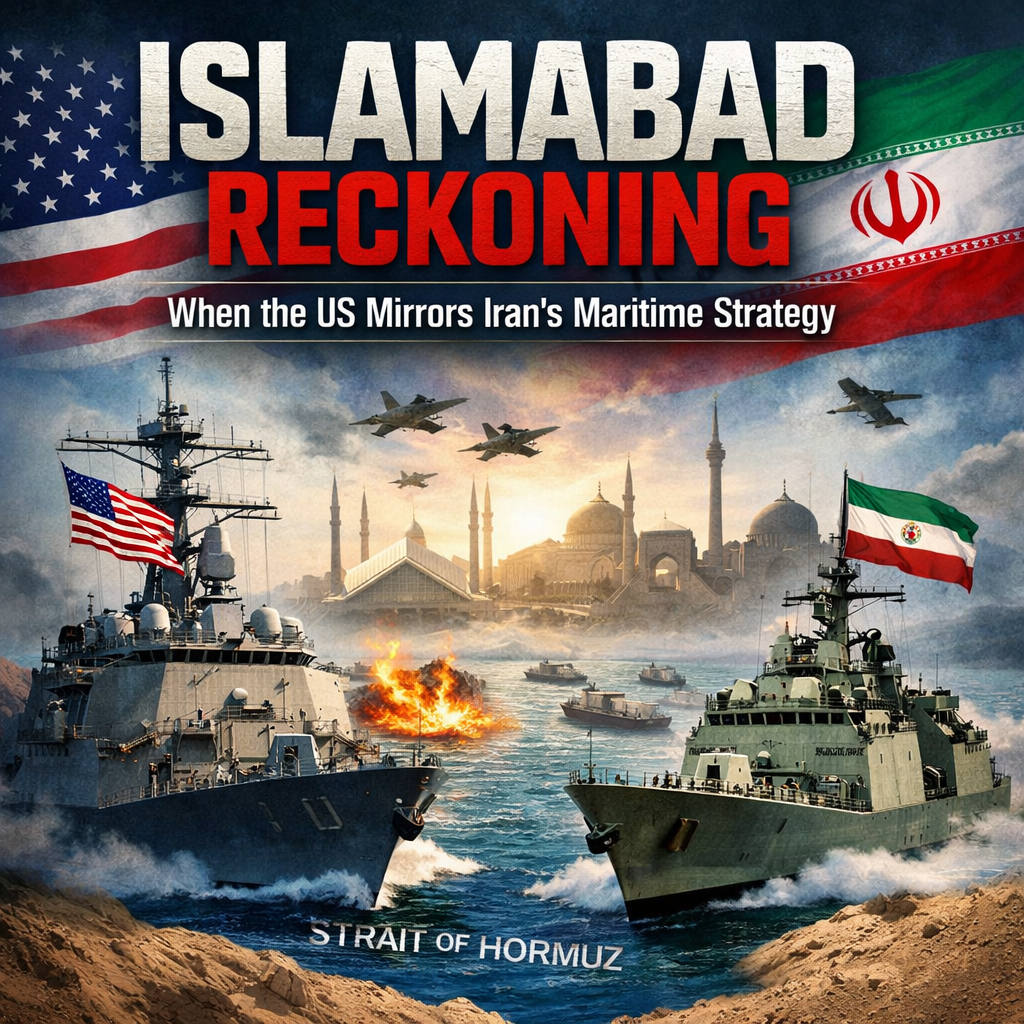
Islamabad Reckoning: A Reckoning of West Asia’s Endless War (36)
Part 35 of the West Asia’s Endless War Series
भारत / GB
The Talks Failed on Two Points. The Response Revealed That Washington Has Become the Student of the Strategy It Went to War to Destroy.
Before examining Africa specifically, the scale of the doctrine must be stated. Since the formation of the United Nations in 1945 — the institution created to end precisely this kind of behaviour — the United States has, by various tallies of military engagements and interventions, been involved in armed actions in over 70 of the 193 UN-recognised nations. Blog 34 established the Manufactured Stability Reckoning — the Gulf’s dominance was never organic stability but a 50-year American military subsidy disguised as diplomatic partnership, built on a powder keg in 1974, maintained by a Praetorian Guard in 1990, and now collapsing as that guard receives its eviction notice. Blog 35 returns to the present moment: the Islamabad talks failure and Washington’s response. The Islamabad Reckoning is not an update. It is the vindication arc’s final confirmation — the moment Washington demonstrated that it has no answer to Iran’s strategy except to adopt it.
Islamabad Reckoning: What Happened in 21 Hours
Islamabad Reckoning: 21 hours. No deal. Then Washington adopted Iran’s own strategy — without Iran’s legal standing or civilisational patience. The talks at Islamabad’s Serena Hotel on April 11-12 were the highest-level direct engagement between the United States and Iran since the Islamic Revolution of 1979. The 300-member US delegation was led by Vice President JD Vance alongside special envoys Steve Witkoff and Jared Kushner. The 70-member Iranian delegation was led by parliamentary speaker Mohammad Bagher Ghalibaf and Foreign Minister Abbas Araghchi. Pakistan moderated. Three rounds of talks — the first indirect, the second and third direct — ran through the night.
Agreement was reached on a range of issues — sanctions architecture, reparations framework, regional security principles, and the ceasefire’s general terms. Two points remained unresolved: Iran’s refusal to terminate uranium enrichment and relinquish its highly enriched uranium stockpile, and Iran’s insistence on continued coordination of Hormuz transit — including the toll mechanism. On those two points, 21 hours of the most intensive US-Iran engagement since 1979 produced no movement. Vance emerged to declare: “The bad news is that we have not reached an agreement. And I think that’s bad news for Iran much more than it’s bad news for the US.” He boarded Air Force Two. Iran’s Foreign Minister Araghchi said the two sides had come within inches of a memorandum of understanding — and that Washington’s maximalism had pulled the deal back at the last moment. “Zero lessons earned,” Araghchi posted. “Good will begets good will. Enmity begets enmity.” This is true for both parties, though as both have displayed the enmity attitude.
The Three-Layer Islamabad Reckoning
Layer one: Iran’s legal position on Hormuz is defensible. Washington’s was not.
The Strait of Hormuz passes through Iranian and Omani territorial waters. Iran’s parliament legislated the transit fee framework explicitly as a sovereignty assertion — not a wartime emergency measure. Iran has long insisted on its sovereign right to administer the strait, a position that is arguable in international law given the corridor’s geography. Washington knew this — which is why, during the ceasefire, it participated in the transit fee arrangement rather than simply declaring it illegal. The US Navy transited Hormuz by coordinating with Iranian armed forces. Trump described Iran’s 10-point proposal — which included Iranian Hormuz coordination — as “a workable basis on which to negotiate.” Washington accepted the toll booth’s operational reality, and, even desired to have a cut in the toll, before it called the toll booth extortion.
The causal transmission from legal acceptance to legal reversal is the Islamabad Reckoning’s first layer: a state that participates in an arrangement cannot retroactively declare that arrangement criminal without exposing its own bad faith. Washington accepted the toll, coordinated with Iranian forces, and sent its Navy through the corridor — then announced it would interdict vessels that had done exactly what its own Navy had done.
Layer two: The blockade targets friends more than foes.
📌 The Toll Booth This Blockade Cannot Demolish
Iran’s maritime sovereignty claim, the transit fee architecture, and why the ceasefire institutionalised what the war was launched to prevent — the argument the Islamabad talks confirmed.
Islamabad Reckoning: The Student Has Adopted the Teacher’s Method
The Islamabad Reckoning’s deepest argument is not legal. It is strategic. The Islamabad Reckoning’s deepest argument is not legal. It is strategic. Washington went to war against Iran’s maritime strategy — the use of Hormuz as an instrument of economic coercion. Washington spent forty-seven years insisting that Hormuz was an international waterway that no single state could control and declared Iran’s selective blockade the proximate cause of Operation Epic Fury. Washington spent forty-seven years insisting that Hormuz was an international waterway that no single state could control. Washington declared Iran’s selective blockade of Hormuz the proximate cause of Operation Epic Fury. Washington launched the most intense American air campaign since Iraq to demonstrate that no state could weaponise the world’s most important energy chokepoint.
After the talks, President Trump announced that the US Navy would begin blockading ships entering or leaving Iranian ports and interdict vessels in international waters that had paid a toll to Iran. This interprets as Washington reproducing key elements of the very maritime economic pressure tool it went to war to dismantle. The instrument and mechanism of selective maritime closure appear functionally mirrored, though the legal and temporal contexts differ sharply. The mechanism is identical. The objective — force the adversary to concede by making its maritime access economically untenable — is identical. The CFR’s assessment seemed to be precise: Vance had gone to Islamabad “hoping to accept Iran’s surrender and not walk back US demands.” The surrender did not come. Washington was left with Iran’s own tool to use their own friends.
The differences between the two approaches are threefold. Iran’s measures operated in a corridor passing through its own territorial waters.
Washington’s announced actions target traffic to and from Iranian ports, extending to international waters.
Iran’s strategy was executed with civilisational patience built over forty-seven years of sanctions, covert operations, and military pressure. Washington’s blockade was announced hours after a failed negotiating session, as a reaction to humiliation rather than as a calculated long-term strategy that is likely to inflate the humanitarian problems faced by the global south. Iran’s position enjoys the legal arguability of territorial sovereignty. Washington’s position, as Blog 28 documented, has none of its declared war objectives in the ceasefire terms as binding settled outcomes but flexing of its power muscle.
The Islamabad Reckoning confirms what the series has argued from Blog 1: the blockade is another deadline in a sequence of deadlines that Washington cannot sustain. A second round of Islamabad talks was already being arranged as of April 17— because Washington knows, as Pakistan’s mediators know, that the blockade is a negotiating posture, not a strategy. Iran will not blink because Iran is not fighting on Washington’s timeline. The political clock runs out for Washington long before the civilisational clock runs out for Iran. Iran will wait it out. It has waited out everything else. The student has adopted the teacher’s method. The teacher is not impressed. The Islamabad Reckoning will not be the last entry in this series on the talks — the second round, when it happens, will be Blog 34‘s sequel.
📌 The Political Clock That Made This Outcome Inevitable
Ninety minutes before its own deadline, Washington accepted Iran’s framework. The Islamabad collapse is the same clock running its second visible cycle.
Next: EU Mediator Vacuum — Blog 36 in West Asia’s Endless War examines why Europe — JCPOA co-signatory, Hormuz LNG importer, self-declared defender of the rules-based order — could not insert itself into the ceasefire negotiations that Pakistan brokered or the Islamabad talks that Pakistan hosted. The EU convened 41 countries. Washington and Tehran met face to face for the first time since 1979 in a city Europe did not propose, moderated by a state Europe did not coordinate with. The mediator vacuum reveals what the rules-based order looks like without an enforcement mechanism independent of Washington. Part of the West Asia’s Endless War Series on hinduinfopedia.com.
Feature Image: Click here to view the image.
Videos
Glossary of Terms
- Islamabad Reckoning: A term used in this series to describe the strategic and diplomatic consequences of the failed US–Iran talks in Islamabad, marking a turning point in maritime power dynamics.
- Manufactured Stability Reckoning: A coined concept referring to the argument that Gulf stability was artificially sustained through long-term American military presence rather than organic regional balance.
- Praetorian Guard (Geopolitical Context): A metaphor describing US military protection of Gulf regimes, analogous to elite guards sustaining political order.
- Hormuz Transit Fee Framework: Iran’s policy of charging vessels for passage through the Strait of Hormuz, framed as a sovereign economic mechanism.
- Selective Blockade: A maritime strategy where access is restricted not universally but selectively to exert economic or political pressure.
- Operation Epic Fury: A referenced military campaign used in the blog to describe US escalation against Iran’s maritime strategy.
- Maximalism (Diplomatic Context): A negotiation stance where one party insists on extreme or non-compromising demands, often leading to deadlock.
- Maritime Economic Coercion: The use of control over sea routes or chokepoints to exert financial and strategic pressure on other nations.
- Strait of Hormuz: A critical global energy chokepoint through which a significant portion of the world’s oil supply passes.
- Ceasefire Institutionalisation: The process by which temporary wartime arrangements become structured and normalized frameworks post-conflict.
- Civilisational Patience: A coined phrase describing long-term strategic endurance, attributed in the blog to Iran’s geopolitical approach.
- Political Clock vs Civilisational Clock: A conceptual contrast between short-term political pressures and long-term strategic timelines in international relations.
- Mediator Vacuum: A situation where traditional diplomatic actors (like the EU) fail to participate or influence negotiations, creating a leadership gap.
- Transit Sovereignty Assertion: The claim by a state to regulate and control passage through waterways within or adjacent to its territory.
- Blockade of Partners Paradox: A coined concept describing how US actions targeted nations dependent on Hormuz transit, including its own allies.
#Geopolitics #Iran #USA #Hormuz #Oil #War #Diplomacy #Blockade #Strategy #GlobalPolitics #MiddleEast #Conflict #HinduinfoPedia
West Asia’s Endless War: Why This Series Exists
[…] भारत / GB […]
[…] 34, 35, and 36 established a trilogy: the Gulf’s stability was manufactured by American military force, […]
[…] Islamabad Reckoning: A Reckoning of West Asia’s Endless War (36) https://hinduinfopedia.com/islamabad-reckoning-a-reckoning-of-west-asias-endless-war-36/ […]
[…] इसे लागू करने हेतु समर्थन नहीं दिया। इस्लामाबाद विश्लेषण ने नाकेबंदी की व्यावसायिक असंगति […]
[…] killed 13 people, injured 224, and slumped oil production about 44% to 1.9 million barrels per day. The Islamabad Reckoning documented UAE’s conditions for any normalisation: Anwar Gargash stated that any deal with […]
[…] Read […]