

EU Mediator Vacuum: West Asia’s Endless War Decoded (38)
Part 38 of the West Asia’s Endless War Series
भारत / GB
The JCPOA Co-Author Could Not Mediate the War It Co-Signed the Agreement to Prevent
Blog 37 established the Petrodollar Duress Reckoning — the 1974 deal was Washington’s fallback after its invasion plan failed, signed under the shadow of a demonstrated willingness to use force. Blog 38 moves to the present mediator vacuum: Europe spent seven years maintaining the JCPOA after Washington abandoned it, watched the UK convene 41 countries in early April 2026 to press Iran to reopen the Strait of Hormuz, and watched Pakistan broker the ceasefire and host the Islamabad talks without European involvement. The EU Mediator Vacuum is not an institutional failure. It is a structural revelation — the rules-based order has no enforcement mechanism that operates independently of Washington.
EU Mediator Vacuum: What Europe Had Built and What It Could Not Use
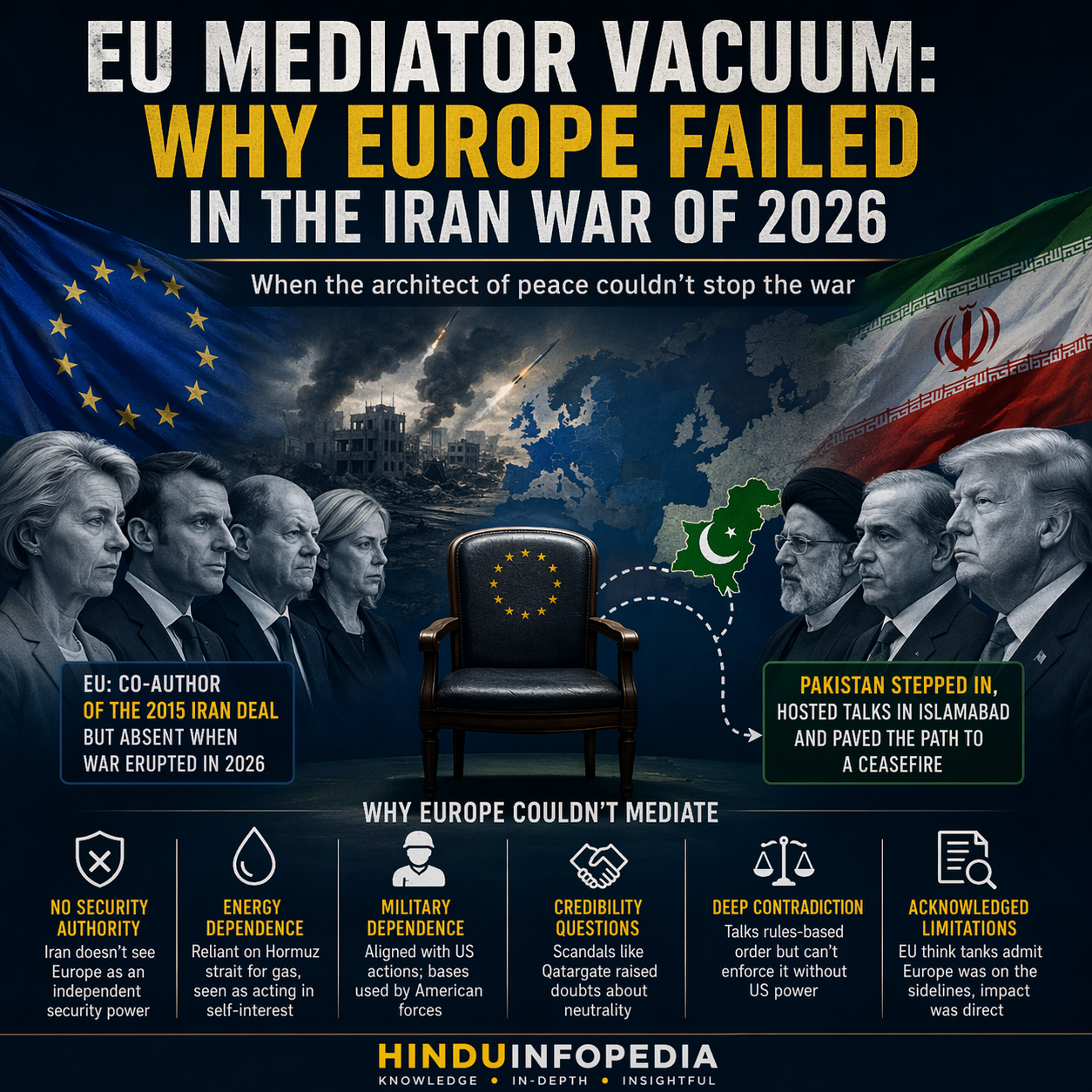
EU Mediator Vacuum: Europe convened 41 countries and brokered nothing. Pakistan hosted the talks. The rules-based order has no independent enforcer. The European Union entered the 2026 Iran war with a specific claim to diplomatic standing that no other non-belligerent power could match. As a co-signatory of the 2015 Joint Comprehensive Plan of Action — alongside the US, UK, France, Germany, Russia, and China — Europe had spent years maintaining the JCPOA framework after Trump’s 2018 withdrawal. It had created the INSTEX payment mechanism to sustain trade with Iran under US sanctions. It had conducted the most sustained multilateral diplomatic engagement with Tehran of any Western actor across the preceding decade. When the strikes began on February 28, the EU High Representative issued a statement calling for maximum restraint, protection of civilians, and full respect for international law.
Europe had the diplomatic record. It had the institutional relationships. It had the stated commitment to multilateral architecture that Pakistan — the actual mediator — with negligible exposure to the international diplomacy of this type. And yet Europe’s own strategic institute, the EU Institute for Security Studies, published a piece titled “Europe Should Fill the Diplomatic Vacuum on Iran” in April 2026 — naming the vacuum itself, acknowledging that Europe was “on the sidelines in the conflict with Iran, yet bears the consequences.” The EU Mediator Vacuum is not the series making an external criticism. It is Europe’s own institutional voice diagnosing its own irrelevance in real time.
Five Reasons the EU Mediator Vacuum Was Structural, Not Accidental
First — Tehran never trusted Europe as a security actor.
The JCPOA relationship gave Europe diplomatic access but not security credibility. Iran negotiated with Europe as a channel to Washington, not as an independent power capable of delivering security guarantees. When Operation Epic Fury began, France called for an urgent UN Security Council meeting and warned against actions outside international law, while the E3 (France, UK and Germany) issued a joint statement that explicitly condemned Iranian retaliatory strikes in the strongest terms but carefully noted they had not participated in the initial US-Israeli action. A subsequent Council on Foreign Relations analysis titled “Europe’s Disjointed Response to the U.S.–Israeli War With Iran” captured the fragmented European position. Tehran read this precisely: Europe lacked the authority to restrain Washington and the independence to offer Iran anything Washington had not already approved. A mediator that cannot deliver on either side of a conflict is not a mediator. It is a spectator with a microphone.
Second — Energy dependency made EU mediation self-interested and therefore distrusted.
Europe imports 12-14% of its LNG from Qatar through Hormuz. European gas prices surged 63% in a week after Ras Laffan was struck. UK Chancellor Rachel Reeves described the conflict as “a war that we did not start and did not want,” and said the blocked Strait “is not getting us involved in the US blockade — we don’t think that is the right approach.” This is precisely the problem: Europe’s primary interest in the Hormuz conflict is reopening the strait for its own gas supply. A mediator whose primary objective is its own energy security is not perceived as neutral by either party. Tehran saw European mediation attempts as self-interested pressure to reopen a chokepoint that was costing Europe — not as genuine diplomatic engagement on Iran’s security concerns.
Third — Military dependency on Washington made EU independence structurally impossible.
The E3 — France, Germany, and the United Kingdom — resolved to back “proportionate military defensive measures” against Iranian drones and missiles, and Britain confirmed US forces could use British bases for defensive strikes. Europe hosting the military infrastructure of the state conducting the war while simultaneously attempting to mediate between that state and its adversary is not a credible diplomatic position. Iran’s calculation was straightforward: Europe cannot mediate between Washington and Tehran while hosting NATO bases through which Washington prosecutes the campaign.
Fourth — Qatargate and Gulf lobbying compromised EU institutional credibility.
The December 2022 Qatargate scandal — in which cash from Qatar was found in the home of a European Parliament Vice President and multiple MEPs were implicated in a documented bribery operation — left a permanent question mark over European institutional independence from Gulf state influence. Blog 26 documented Qatar’s role as a state that had systematically purchased diplomatic influence across Western institutions. Europe’s claim to neutral mediation was compromised by the documented evidence that its institutions had been targeted for financial influence by one of the conflict’s key peripheral actors.
📌 The Mediator That Was Destroyed Before Europe Could Fill Its Role
Qatar’s two-decade diplomatic architecture struck from both sides — why its vacuum could not be filled by a Europe that lacks Qatar’s specific trust relationship with Tehran.
EU Mediator Vacuum: What the Vacuum Reveals
Fifth — and most consequential.
The EU Mediator Vacuum reveals the structural contradiction at the heart of the rules-based order that Europe claims to lead. Europe spoke the language of the rules-based order while pointing it in only one direction, directing its moral framing entirely at Tehran while providing the logistical and political floor for the US-led campaign.
Europe cannot enforce the rules against Washington, and it cannot enforce them against Iran without Washington. The rules-based order Europe claims to lead is therefore not an order at all—it is a preference, enforceable only when Washington chooses to enforce it. Blog 15 documented the UN’s institutional paralysis—the Security Council veto architecture that prevented any legal accountability for the strikes.
The EU Mediator Vacuum is the diplomatic face of the same paralysis. Pakistan filled the vacuum not because of diplomatic prestige—it had none—but because Washington forced it to perform the “dirty cleaning” of the war as enumerated in out blog 31. The US leveraged the specific Muslim-to-Muslim relationship between Islamabad and Tehran, forcing Pakistan to use a civilizational backchannel that Europe, by its very nature, could never access. Pakistan mediated because it was a coerced religious peer; Europe could not mediate because its secular “rules” carried no weight in a conflict defined by raw power and sectarian reality. The EU Mediator Vacuum is what the rules-based order looks like from the outside—a powerful claim with no independent means of enforcement, discarded by Washington the moment an M-M proxy became more functionally useful.
📌 The Colonial Order That Built This Dependency
The century of colonial architecture that made European security permanently dependent on American power — and why that dependency made EU mediation structurally impossible in 2026.
Next: IRGC Mosaic Reckoning — Blog 39 in West Asia’s Endless War examines why Operation Epic Fury killed Iran’s supreme leader, its top generals, and most of its senior command — and the strikes continued anyway. Iran’s Revolutionary Guard does not operate as a centralised hierarchy. It operates as a distributed control architecture: 31 independent commands, each running on local logic, each capable of acting without waiting for central authorisation. You cannot end a distributed system by removing its centre. Washington fought a hierarchical war against a distributed adversary. The Islamabad talks tried to negotiate a ceasefire with a system that had no single authoritative voice left to enforce it. Part of the West Asia’s Endless War Series on hinduinfopedia.com.
Feature Image: Click here to view the image.
Videos
Glossary of Terms
- EU Mediator Vacuum: A condition where Europe possesses diplomatic capacity but fails to act as an effective mediator in a conflict.
- JCPOA (Joint Comprehensive Plan of Action): The 2015 nuclear agreement between Iran and major global powers aimed at limiting Iran’s nuclear program.
- Rules-Based Order: A global system where international rules and institutions are expected to govern state behavior and maintain stability.
- Mediator Vacuum: The absence of a credible and effective intermediary capable of negotiating between conflicting parties.
- INSTEX (Instrument in Support of Trade Exchanges): A European financial mechanism designed to facilitate trade with Iran despite US sanctions.
- E3 Group: The trio of France, Germany, and the United Kingdom coordinating policy on Iran.
- Strait of Hormuz: A critical maritime chokepoint through which a significant portion of the world’s energy supply passes.
- Energy Dependency: Reliance of a region or country on external sources for energy needs.
- Qatargate: A 2022 corruption scandal involving alleged Qatari influence and bribery within European institutions.
- Multilateral Diplomacy: Diplomatic engagement involving multiple countries working collectively on international issues.
- Security Credibility: The perceived ability of a state or institution to guarantee and enforce security commitments.
- Structural Contradiction: An internal inconsistency within a system that limits its effectiveness or coherence.
- NATO Infrastructure: The military and strategic framework of the North Atlantic Treaty Organization.
- Logistical Support: Provision of operational, material, and strategic resources to sustain military or political actions.
- Distributed Control Architecture: A system where authority is decentralized across multiple independent units rather than centralized.
#Iran #Europe #MiddleEast #Geopolitics #EU #JCPOA #Pakistan #Hormuz #War #GlobalPolitics #HinduinfoPedia
West Asia’s Endless War: Why This Series Exists
: https://hinduinfopedia.com/eu-mediator-vacuum-west-asias-endless-war-decoded-38/
[…] भारत / GB […]
[…] Blog 38 established the EU Mediator Vacuum — Europe’s inability to function as an independent mediator because it has no enforcement mechanism that operates outside Washington’s architecture. Blog 39 examines the military dimension of the same structural problem: Washington fought a hierarchical war against a distributed adversary, and the instruments did not match the target. The IRGC Mosaic Reckoning is the explanation for why killing Iran’s supreme leader, its top generals, and most of its senior command did not end the war — and why the ceasefire violations, the continued strikes, and the Islamabad talks’ collapse were architectural consequences, not acts of defiance. […]
[…] Blog 38 established the EU Mediator Vacuum — Europe’s structural inability to function as an independent mediator because its security architecture is dependent on Washington. The energy dimension of that dependency is the EU Energy Umbrella Reckoning’s most current illustration. Europe imports 12-14% of its LNG from Qatar through Hormuz. European gas prices surged 63% in a week after Ras Laffan was struck and Qatar Energy declared force majeure. Europe was not a party to the Iran war and explicitly declined offensive participation, even while supporting broader sanctions architecture. And it absorbed a 63% energy price spike in seven days as the direct consequence of a war it had no voice in launching. […]
[…] EU Mediator Vacuum: West Asia’s Endless War Decoded (38) https://hinduinfopedia.com/eu-mediator-vacuum-west-asias-endless-war-decoded-38/ […]
[…] 1 through 45 of this series have examined consequences: Hormuz closed, NATO fractured, the EU mediated nothing, the Gulf was betrayed, the petrodollar ended, African energy emerged, Russia collected its […]
[…] Read […]