

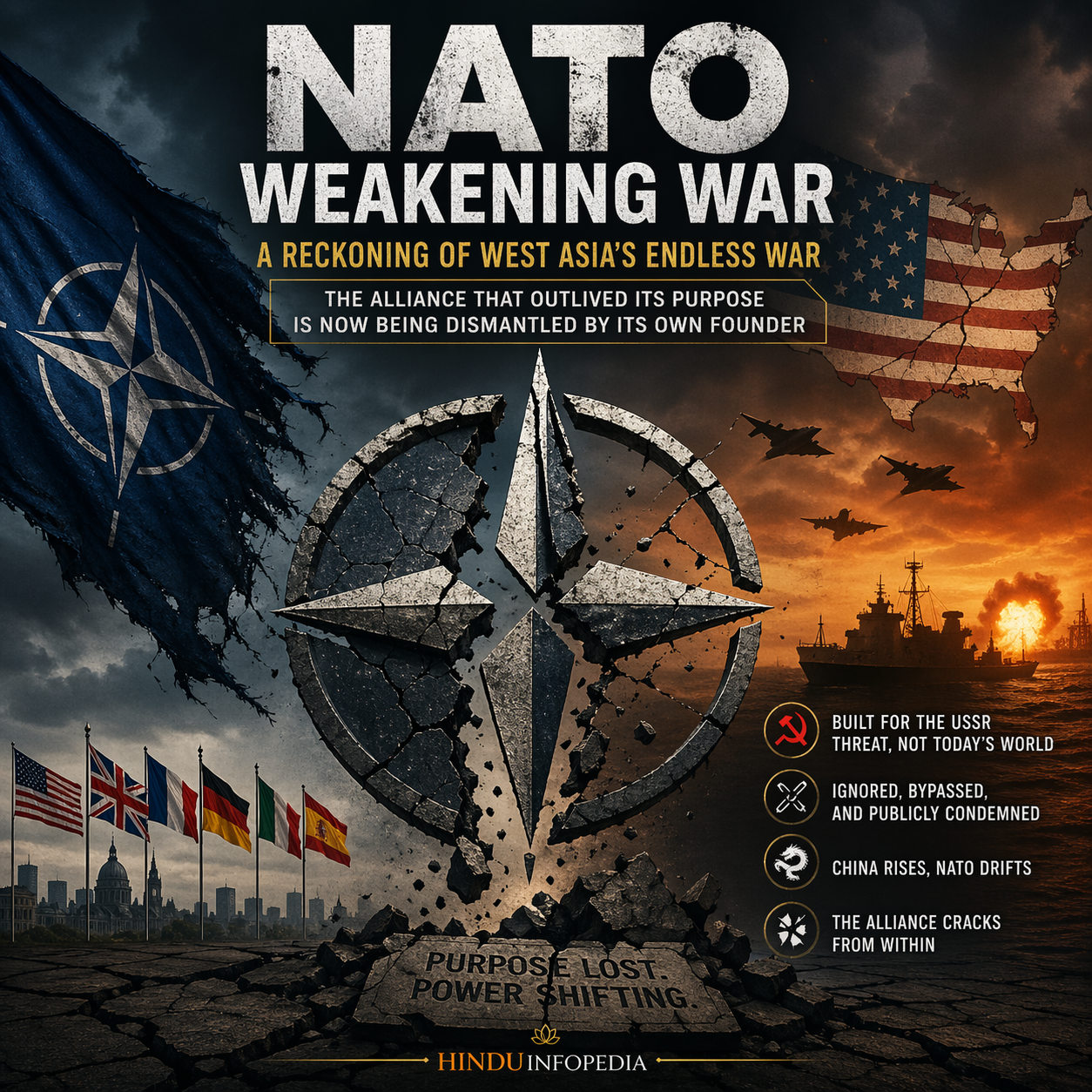
NATO Weakening War: A Reckoning of West Asia’s Endless War (40)
Part 40 of the West Asia’s Endless War Series on hinduinfopedia.com
भारत / GB
The Alliance That Outlived Its Purpose Is Now Being Dismantled by Its Own Founder
Blog 39 established the IRGC Mosaic Reckoning — the distributed architecture that survived decapitation, continued firing after the ceasefire, and shot Indian ships that had Iranian clearance. Blog 40 examines what the Hormuz war has done to the Western military alliance on the other side of that architecture: NATO, which was not consulted before the war began, was not invited to join it, absorbed the economic consequences of a conflict fought without its consent, and was then publicly condemned by its own founder for failing to participate in a war it was never designed to fight.
NATO Weakening War: The Alliance Was Built for a USSR Threat
NATO Weakening War: Built to stop the USSR, an expansionist and authoritative regime with deep and divisive economic policy. The USSR collapsed. NATO remained. Then its own architect launched a war without telling it. The North Atlantic Treaty Organisation was created in 1949 for a precise and limited purpose: to deter Soviet westward expansion in Europe by making an attack on any member state an attack on all. Article 5 of the Washington Treaty — the collective defence clause — was the entire architecture of deterrence that kept Western Europe from Soviet absorption during the Cold War. It worked. The Soviet Union collapsed in 1991. The threat NATO was built to counter ceased to exist. At that moment, NATO faced an existential question that it has never honestly answered: what is the alliance for now?
The NATO Weakening War argument begins here — not in 2026 but in 1991. The answer Washington gave to that question was not strategic. It was institutional. NATO survived because institutions survive. It expanded eastward — absorbing former Warsaw Pact states, pushing its boundaries to Russia’s border — not because this served a coherent new strategic purpose but because expansion justified the institution’s continued existence.
Russia had been given verbal assurances by Western leaders that NATO would not expand eastward — assurances that were subsequently denied or dismissed as the alliance absorbed Poland, Hungary, the Czech Republic, the Baltic states, Romania, and Bulgaria. The colonial order’s enforcement architecture found a new geography without finding a new purpose. The threat NATO required to remain relevant was Russia — which meant that keeping Russia as a threat became institutionally necessary even when accommodation might have been strategically superior.
If NATO has genuine relevance today, it should be directed at China — the power that has actually assumed the expansionist role the USSR played, with blue-water naval ambitions, territorial claims in the South China Sea, Belt and Road infrastructure penetration across three continents, and economic leverage that the USSR never achieved. China is the power that has taken the USSR’s place in the global order. NATO’s entire architecture — land forces, Article 5, European collective defence — is configured for the wrong theatre, against the wrong adversary, in the wrong geography. The NATO Weakening War is not just what happened in 2026. It is the thirty-five-year slow-motion consequence of an alliance that outlived its founding threat and never found a coherent replacement.
NATO Weakening War: What 2026 Revealed
Operation Epic Fury made the NATO Weakening War visible in a single documented sequence. NATO Secretary General Mark Rutte confirmed publicly that Trump chose not to inform allies before launching the strikes, citing the need to maintain operational surprise. The alliance that was founded on collective decision-making and mutual consultation was not consulted. The allies discovered the strikes through global news media rather than official channels , as the unilateral operation was launched without prior consultation while European partners were still actively engaged in de-escalation negotiations. Rutte said he understood the decision. Europe did not.
Spain blocked US planes from using its airspace. Italy blocked US military access to Naval Air Station Sigonella in Sicily for offensive operations, citing 1950s bilateral treaties that require parliamentary authorization for any non-defensive use of bases on Italian soil. France and Germany condemned the strikes. Britain provided defensive support but explicitly declined offensive participation. Trump responded to the alliance’s refusal by posting: “NATO WASN’T THERE WHEN WE NEEDED THEM, AND THEY WON’T BE THERE IF WE NEED THEM AGAIN. Czech President Petr Pavel stated that Trump was “undermining NATO more than Putin” — the most pointed institutional verdict delivered by any NATO head of state during the crisis. He told NATO Secretary General Rutte in a private meeting described by European officials as a “tirade of insults” that the alliance countries had failed a test. White House spokeswoman Anna Kelly said Trump “will remember” which allies were unhelpful—a word of caution, if not a threat.
The NATO Weakening War’s precise irony is this: the member states that declined participation were not abandoning the alliance. They were applying its founding principle. NATO is a collective defence organisation — its Article 5 commits members to treat an attack on one as an attack on all. Operation Epic Fury was not a defensive operation triggered by an attack on a NATO member. It was an offensive strike launched unilaterally against a sovereign state that had not attacked any NATO member.
Italy blocking Sigonella, Spain blocking its airspace, France condemning the strikes — these were NATO members declining to participate in a war that fell outside NATO’s founding mandate. The architect of the alliance launched a war that violated the alliance’s own logic, then condemned the alliance for not following him into the violation.
📌 The Colonial Enforcement Architecture Beneath NATO’s Expansion
How the post-Cold War order converted NATO from a defensive alliance into an enforcement instrument — the century of logic that made the 2026 fracture inevitable.
NATO Weakening War: The Adversary NATO Should Be Watching
While NATO fractured over a war in the Gulf that it was not designed to fight, the adversary it should be configured to contain was quietly accumulating the strategic dividend. China’s oil continued flowing through Hormuz under Iranian authorisation while American-allied shipping was blocked. China called for a ceasefire without joining one. China condemned the strikes without paying any price for the condemnation. And China watched NATO fracture — watched Spain block American airspace, Italy close American bases, Trump denounce the alliance he leads — without spending a single yuan or deploying a single soldier.
The NATO Weakening War’s deepest argument is the one you have identified: the USSR whose expansion NATO was built to contain is gone. The power that has taken its role — Belt and Road penetrating Africa, Latin America, and South Asia; South China Sea islands militarised in direct defiance of international tribunal rulings; Taiwanese sovereignty challenged with a military build-up that no Cold War NATO was ever asked to deter — that power is China. NATO’s entire architecture points the wrong way. This is exactly what the USSR did before 1990: establishing economic and military bases around the continents. Its land forces are configured for the European theatre. Its Article 5 geography covers the North Atlantic. Its institutional memory is Soviet tanks through the Fulda Gap. As the Council on Foreign Relations noted, European governments had barely begun the project of strategic autonomy when the Iran conflict delivered a fresh crisis that their Ukraine-focused military build-up was not designed to address. Meanwhile China’s strategic environment improved measurably across every week the Gulf war continued — energy flowing, alliances fraying, Washington’s credibility as a reliable security partner declining among the very Asian states that NATO’s Pacific partners were trying to hold together.
NATO’s foundational confusion — retain Russia as the primary threat to justify the alliance’s European geography, while the actual expansionist challenge comes from a Pacific power for which NATO has no architecture — is the structural weakness the 2026 war has exposed. An alliance that fractures when its founder launches an offensive war outside its mandate, that is condemned by its founder for applying its own principles, that absorbs the economic consequences of a Gulf conflict while being configured to defend the Rhine — this is not a weakened NATO. It is an alliance that has reached the same terminal point as the UN institutional framework the series documented earlier: a powerful claim with no coherent enforcement mechanism, serving a purpose that history has already superseded.
The architecture of collective Western security was built at enormous cost across eighty years to contain a threat that no longer exists. Every solution the post-Cold War order produced made the underlying problem larger: containing the USSR produced NATO expansion, which produced Russian hostility, which produced the Ukraine war. Solving Iraq produced ISIS. Solving Libya produced the failed state. Solving Iran has produced a fractured NATO, a strengthened China, a Gulf that is evicting its American garrison, and a Global South that has watched the rules-based order consume itself. The USSR that NATO was built to contain is gone. The adversary that will not blink remains. The adversary that NATO should be watching is growing stronger in the silence. The warrior’s every blow is creating a new battlefield. The NATO Weakening War is not an event. It is the structural conclusion of a thirty-five-year question that was never honestly answered — and the question, unanswered, has now answered itself.
📌 The Passive Dividend Russia Has Collected
While NATO fractured and Washington fought Iran, Russia sat out the conflict entirely — absorbing no cost, watching the alliance that contains it weaken from the inside, collecting its strategic dividend without firing a shot.
Next: Rogue Superpower Doctrine — Blog 41 in West Asia’s Endless War examines the argument made not by the Global South but by the Financial Times: that the United States meets its own rogue state criteria more precisely than Iran does. The concept of the rogue state was developed by Washington in the 1990s to justify coercion of non-compliant states. The Rogue Superpower Doctrine applies that checklist simultaneously to Iran and to Washington — and finds that the architect of the label meets its own definition more completely than the state it has labelled. The mirror is being held by the establishment itself. Part of the West Asia’s Endless War Series on hinduinfopedia.com.
Feature Image: Click here to view the image.
Videos
Glossary of Terms
- NATO Weakening War: A coined phrase describing the structural decline of NATO exposed by unilateral military actions and internal contradictions during the 2026 Hormuz conflict.
- IRGC Mosaic Reckoning: A distributed Iranian military doctrine enabling decentralized retaliation even after leadership disruption.
- Operation Epic Fury: The unilateral U.S. military strike that triggered alliance fractures by bypassing NATO consultation mechanisms.
- Article 5 (Washington Treaty): NATO’s collective defence clause stating that an attack on one member is considered an attack on all.
- Collective Defence Architecture: NATO’s foundational principle of coordinated military response among member states.
- Post-Cold War Expansion: NATO’s eastward enlargement after the Soviet Union’s collapse, incorporating former Warsaw Pact nations.
- Colonial Enforcement Architecture: A conceptual framework describing NATO’s evolution from defence alliance to geopolitical enforcement tool.
- Strategic Autonomy (Europe): The effort by European nations to develop independent military and policy capabilities outside U.S. control.
- Hormuz War (2026): The Gulf conflict that disrupted global shipping and exposed Western alliance fractures.
- Rogue Superpower Doctrine: A concept evaluating whether the U.S. meets criteria it historically used to label other states as “rogue.”
- Institutional Survival Logic: The tendency of organizations like NATO to persist and expand regardless of original purpose.
- Pacific vs European Theatre Misalignment: The mismatch between NATO’s Europe-focused structure and emerging threats from Asia, particularly China.
- Strategic Dividend (Passive): Gains achieved by a state (e.g., Russia or China) without direct involvement in conflict.
- Rules-Based Order: The Western-led global governance framework increasingly challenged by geopolitical contradictions.
- Alliance Fracture: Breakdown of unity among member states due to conflicting interests or unilateral actions.
#NATO #WestAsia #Geopolitics #USForeignPolicy #ChinaRise #Russia #GlobalOrder #MilitaryAlliance #ColdWar #StrategicShift #HinduinfoPedia
[…] भारत / GB […]
[…] https://hinduinfopedia.com/nato-weakening-war-a-reckoning-of-west-asias-endless-war-40/ […]
[…] 1 through 45 of this series have examined consequences: Hormuz closed, NATO fractured, the EU mediated nothing, the Gulf was betrayed, the petrodollar ended, African energy emerged, […]
[…] NATO Weakening War (Blog 40) argument is now confirmed from two directions simultaneously: the German Chancellor says Washington […]
[…] नाटो कमजोर पड़ने का युद्ध (ब्लॉग 40) का तर्क अब दो दिशाओं से एक साथ प्रमाणित होता है: जर्मनी के चांसलर कहते हैं कि वाशिंगटन एक विरोधी द्वारा अपमानित हो रहा है, और वाशिंगटन इसका उत्तर अपने सहयोगियों को दंडित करके देता है क्योंकि उन्होंने इसे पहचाना। […]
[…] Read […]