

Gulf Dollar Captivity: A Reckoning of West Asia’s Endless War (53)
Part 53 of the West Asia’s Endless War Series
भारत / GB
Speaking Was Dangerous. Exiting Was Structurally Impossible. Three Reasons the Gulf Could Not Leave the Dollar System — Until All Three Changed Simultaneously.
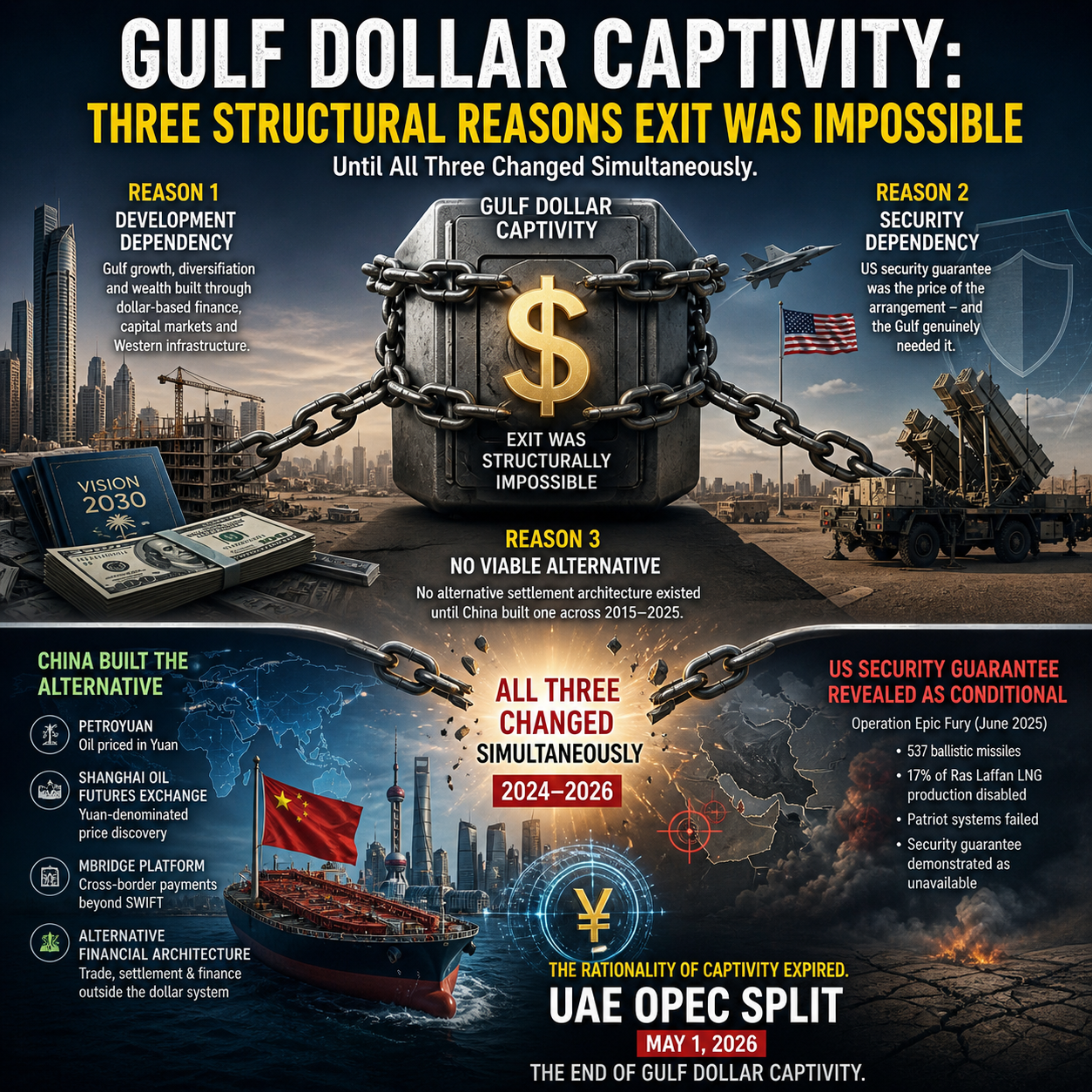
Blog 52 (Gulf Dollar Silence) established why speaking was dangerous — the 1953 enforcement mechanism demonstrated through Iraq in 2003, and the dollar’s network effect making commercial exit self-defeating without an alternative infrastructure. Blog 53 examines the three structural reasons that made exit impossible regardless of what was said: the Gulf’s domestic development was financed through the same system that extracted from it, the American security guarantee was the price of the arrangement and the Gulf genuinely needed it, and no viable alternative settlement architecture existed until China built one across 2015-2025. Gulf Dollar Captivity is the name for those fifty years of structural impossibility — and the UAE OPEC Split of May 1, 2026, is the name for the moment the three structural constraints dissolved simultaneously.
Gulf Dollar Captivity: Three Structural Reasons Exit Was Impossible
Gulf Dollar Captivity: Three structural reasons the petrodollar arrangement was irreversible — until China built the alternative and Washington revealed the security guarantee as conditional. Blog 52 established that speaking was dangerous — the enforcement mechanism was demonstrated, the network effect was real. Gulf Dollar Captivity is a distinct and additional argument: even if the Gulf had found a moment when speaking was safe, the structural architecture of the arrangement made exit commercially and strategically suicidal for reasons that had nothing to do with Washington’s enforcement capacity. The captivity was not only external — threat and network. It was internal — dependency, security, and absence of alternative.
Reason Three — Gulf domestic development required the dollar system it was paying to sustain.
The petrodollar extraction mechanism was simultaneously the Gulf’s primary development financing mechanism. Saudi Arabia’s Vision 2030, the UAE’s economic diversification programme, Qatar’s LNG infrastructure buildout, Kuwait’s sovereign wealth architecture — all required Western capital markets, Western technology companies, Western construction firms, and Western financial services. Blog 31 (Gulf Betrayal Reckoning) documented the dependency architecture the Gulf built across fifty years of petrodollar recycling — the same architecture that Blog 50 (The Dollar’s Gulf Mint) identified as Commercial Captivity in the extraction machine’s fourth component.
Saudi Aramco’s 2019 IPO — which raised $25.6 billion on the Tadawul exchange with international institutional participation — required dollar-denominated share pricing and Western investment bank underwriting, illustrating precisely how Gulf sovereign development had become structurally embedded in the dollar financial system. Exiting the petrodollar arrangement meant simultaneously losing access to the capital markets needed to build the post-oil economy the Gulf was trying to construct. The extraction mechanism and the development financing mechanism were the same system, operated by the same institutions, accessible through the same dollar channels. The Gulf chose to pay the extraction price to maintain the development access — rationally, for as long as the development access remained valuable and no alternative existed. The Sovereign Wealth Fund Institute confirmed that Gulf sovereign wealth funds — ADIA, PIF, QIA, KIA — collectively manage over $3.5 trillion in assets, the majority historically in dollar-denominated instruments, reflecting decades of mandatory petrodollar recycling that shaped the entire asset allocation architecture of Gulf state wealth. IMF analysis of Gulf sovereign wealth fund investment patterns confirmed that 60-70% of Gulf external assets remained in dollar-denominated instruments through 2015 — not as political loyalty to Washington but as the rational consequence of a financial system in which dollar instruments remained the only liquid, deep, and legally enforceable asset class available at the scale Gulf wealth required.
📌 The Silence That Preceded This Captivity
Two reasons speaking was dangerous — the 1953 enforcement mechanism demonstrated through Iraq in 2003, and the dollar network effect. Blog 52 established why the Gulf chose not to speak. Blog 53 establishes why exit was structurally impossible even if speaking had been safe.
Reason Four — The security guarantee was the price of the arrangement — and the Gulf needed it.
The petrodollar deal was not only financial. It came with the American military guarantee — the Praetorian Guard that Blog 34 (Manufactured Stability Reckoning) documented as the arrangement’s primary non-financial value. Gulf monarchies faced a specific threat environment that made the American security architecture genuinely valuable — not as theatre but as operational protection. The 1979 Iranian Revolution demonstrated that a wealthy, Western-aligned Gulf monarchy could be overthrown within months by domestic popular movement. Iraq invaded Kuwait in 1990. Iran’s regional expansion threatened Saudi Arabia’s eastern province, Bahrain’s Shia majority, and Yemen’s Houthi-controlled territory. The American military guarantee — bases, rapid deployment capacity, Patriot missile defence systems, intelligence sharing — provided the containment architecture that no Gulf state could build independently and that no alternative power offered.
The Gulf Dollar Captivity on Reason Four was therefore the most rational of all: the financial extraction was the price of the security, the security was real, and the Gulf needed the security. Paying the extraction price was not submission — it was the rational commercial exchange of a state that needed a service and paid for it. The Gulf Dollar Captivity ended not when the Gulf concluded the extraction was too large but when the security guarantee was revealed as conditional on Washington’s strategic interests rather than Gulf security interests. Operation Epic Fury launched from Gulf bases without consultation, Ras Laffan struck while producing 17% of global LNG, UAE absorbing 537 ballistic missiles — the service the Gulf had been paying for was demonstrated to be unavailable at the moment it was needed. Saudi Arabia’s 2023 request for the US to withdraw Patriot missile batteries — confirmed by Reuters — was the documented moment when Gulf Dollar Captivity on security grounds began to dissolve: the Gulf was returning the service it was no longer confident it would receive when it needed it.
Reason Five — No viable alternative existed until China built one across 2015-2025.
Every extraction mechanism persists until a credible alternative exists. Blog 47 (China Oil Revenge) established that China spent a decade building the architecture the Gulf needed before the Gulf could exit — the petroyuan, the Belt and Road infrastructure, the yuan swap lines, the Shanghai oil futures exchange, and the mBridge multi-CBDC payment platform. The Gulf could not exit into a vacuum. Speaking against the dollar system without an alternative to offer produced the Iraq 2003 consequence. Exiting the dollar system without an alternative to settle trade produced commercial paralysis. Both required the alternative to exist first.
The Shanghai International Energy Exchange launched yuan-denominated crude oil futures in March 2018 — the first non-dollar oil pricing benchmark, providing the price discovery mechanism that any petroyuan settlement system required. By 2023, China and Saudi Arabia had conducted the first yuan-denominated LNG trade — Saudi Aramco signing with CNOOC in a deal Bloomberg confirmed bypassed the dollar clearing mechanism entirely. By 2025, the mBridge platform had completed pilot transactions among UAE, China, Hong Kong, Thailand, and Saudi Arabia. The BIS Innovation Hub confirmed mBridge was designed to replace SWIFT dollar clearing for participating economies — eliminating five of the Gulf Dollar Toll’s six dimensions simultaneously. The alternative that the Gulf could not build alone, China built across a decade. The Gulf Dollar Captivity on Reason Five dissolved when mBridge reached pilot stage, when the yuan oil futures achieved sufficient liquidity, and when Belt and Road infrastructure provided the physical trade corridors that the financial settlement architecture required.
Gulf Dollar Captivity: Why All Three Dissolved Simultaneously
The Gulf Dollar Captivity’s most precise structural observation is that all three internal constraints dissolved within the same 24-month window — 2024-2026 — rather than separately across years. This simultaneous dissolution is not coincidental. It reflects the interdependency of the three constraints: each one reinforced the others, and when one weakened, the others became easier to challenge.
The development financing dependency (Reason Three) weakened as China’s Belt and Road provided an alternative infrastructure financing channel at 3% rather than IMF conditionality rates, and as Gulf sovereign wealth funds accumulated sufficient scale to self-finance major development projects without requiring Western capital market access. The security guarantee (Reason Four) failed operationally in 2026 — not weakened gradually but broken abruptly when Operation Epic Fury demonstrated the guarantee was conditional. The alternative architecture (Reason Five) reached maturity through mBridge, the Shanghai oil futures exchange, and the yuan swap line network precisely as the security failure created the political space to use it.
The UAE OPEC Split of May 1 2026 is the institutional expression of all three constraints dissolving simultaneously. UAE does not need the dollar development financing because ADNOC’s scale and the Abu Dhabi sovereign wealth architecture provide self-financing capacity. UAE does not trust the American security guarantee after absorbing 537 missiles from bases Washington used without consultation. UAE has the dirham-rupee and dirham-yuan settlement frameworks to settle its $202 billion of India-China trade outside the dollar clearing system. Washington’s Global Control War named the design the Gulf had been captive to. Gulf Dollar Captivity is the name for the structural architecture that made fifty years of captivity rational — and the UAE OPEC Split is the name for the moment when the rationality of captivity finally expired.
📌 The Split That Ended the Captivity
UAE exits OPEC May 1 2026 — not because the Gulf suddenly woke up, but because the three structural constraints of Gulf Dollar Captivity dissolved within the same 24-month window. The captivity ended when the captivity’s conditions expired.
Next: India Energy Exposure — Blog 54 in West Asia’s Endless War examines India’s position in the commercial architecture the Iran war has restructured: 90 lakh workers in Gulf states, Chabahar investment in Iran, defence partnership with Israel, energy dependency across four competing supply chains simultaneously, and a Strategic Defence Partnership with UAE signed nineteen days before the war began. India sits inside the Gulf Dollar Toll on every oil import it pays — and is simultaneously building the rupee-dirham bilateral settlement architecture that begins to bypass it. But India’s exposure is not only energy. It is strategic, demographic, and financial simultaneously. Part of the West Asia’s Endless War Series on hinduinfopedia.com.
Feature Image: Click here to view the image.
Videos
Glossary of Terms
- Gulf Dollar Captivity: A concept coined in this series describing the structural condition where Gulf states were economically, financially, and strategically locked into the US dollar system, making exit impractical despite awareness of its costs.
- Petrodollar System: The global arrangement where oil is priced and traded primarily in US dollars, reinforcing demand for the dollar and integrating oil-exporting economies into US-led financial systems.
- Petrodollar Recycling: The process by which oil-exporting countries reinvest surplus dollar revenues into Western financial markets, particularly US treasury bonds and assets.
- Commercial Captivity: A term used in this series to describe how dependence on dollar-based trade, finance, and infrastructure makes exiting the system economically self-damaging.
- Development Financing Dependency: The reliance of Gulf economies on Western capital markets, technology, and financial services to fund domestic growth and diversification projects.
- Security Guarantee (US): The implicit and explicit military protection provided by the United States to Gulf states, including bases, missile defense systems, and strategic deterrence.
- Praetorian Guard Model: A phrase used in the series to describe the US role as a protective military force for Gulf monarchies in exchange for strategic and economic alignment.
- Network Effect (Dollar System): The phenomenon where the widespread global use of the dollar reinforces its dominance, making alternatives less viable due to lack of scale and liquidity.
- Settlement Architecture: The financial and institutional systems that enable international trade transactions, including currency clearing, payment systems, and legal enforcement mechanisms.
- Petroyuan: China’s initiative to price and settle oil trades in Chinese yuan as an alternative to the dollar-based system.
- mBridge Platform: A multi-central bank digital currency (CBDC) project designed to facilitate cross-border payments without relying on traditional dollar-based systems like SWIFT.
- Shanghai Oil Futures Exchange: A Chinese commodities exchange offering yuan-denominated crude oil futures, enabling non-dollar price discovery in global oil markets.
- Sovereign Wealth Funds (SWFs): State-owned investment funds (e.g., ADIA, PIF, QIA, KIA) that manage national surplus revenues, often heavily invested in dollar-denominated assets.
- Alternative Financial Architecture: The emerging ecosystem of non-dollar trade, settlement, and financing systems developed primarily by China between 2015–2025.
- UAE OPEC Split (May 1, 2026): A defining event in this series marking the moment when the UAE formally broke from traditional OPEC alignment, symbolizing the collapse of Gulf Dollar Captivity constraints.
#Petrodollar #OilTrade #USDollar #China #OPEC #Energy #Geopolitics #USD #GlobalEconomy #Trade #Finance #Currency #MiddleEast #HinduinfoPedia
West Asia’s Endless War: Why This Series Exists
[…] भारत / GB […]
[…] https://hinduinfopedia.com/gulf-dollar-captivity-a-reckoning-of-west-asias-endless-war-53/ […]
[…] Blog 53 (Gulf Dollar Captivity) completed the quintet — the five-blog examination of the petrodollar extraction architecture, the transaction-level toll, and the fifty years of strategic silence that made resistance impossible until China built the alternative and Washington revealed its own security guarantee as conditional. Blog 54 is a snap blog documenting a development that occurred on May 1-2 2026: the President of the United States publicly described his Navy as pirates collecting oil as a profitable business. Confession of Superpower Pirate: Washington called Iran’s Hormuz toll extortion. Then seized Venezuelan oil and declared itself sole authorised seller. Then seized Iranian ships and called it a profitable business. Then called itself pirates. This is the confession. […]
[…] ब्लॉग 53 (गल्फ डॉलर कैद) ने पाँच ब्लॉगों के उस समूह को पूरा किया — जिसमें पेट्रोडॉलर निकासी संरचना, लेन-देन स्तर का शुल्क और पचास वर्षों की रणनीतिक चुप्पी का विश्लेषण शामिल था, जब तक चीन ने विकल्प नहीं बनाया तथा वाशिंगटन ने अपनी सुरक्षा गारंटी को शर्तों से जुड़ा बताने का विश्लेषण किया गया। ब्लॉग 54 एक छोटा विश्लेषण ब्लॉग है। यह 1–2 मई 2026 की घटना दर्ज करता है। संयुक्त राज्य के राष्ट्रपति ने सार्वजनिक रूप से अपनी नौसेना को तेल एकत्र करने वाले “समुद्री लुटेरे” कहा। इसे लाभ कमाने का कार्य बताया गया। समुद्री लुटेरे की स्वीकारोक्ति: वाशिंगटन ने ईरान के होरमुज शुल्क को अनैतिक वसूली बताया। फिर वेनेजुएला का तेल जब्त किया। फिर स्वयं को एकमात्र अधिकृत विक्रेता घोषित किया। फिर ईरानी जहाज जब्त किए। फिर इसे लाभकारी कार्य बताया। फिर स्वयं को समुद्री लुटेरा कहा। यह स्वीकारोक्ति है। […]
[…] Read […]