

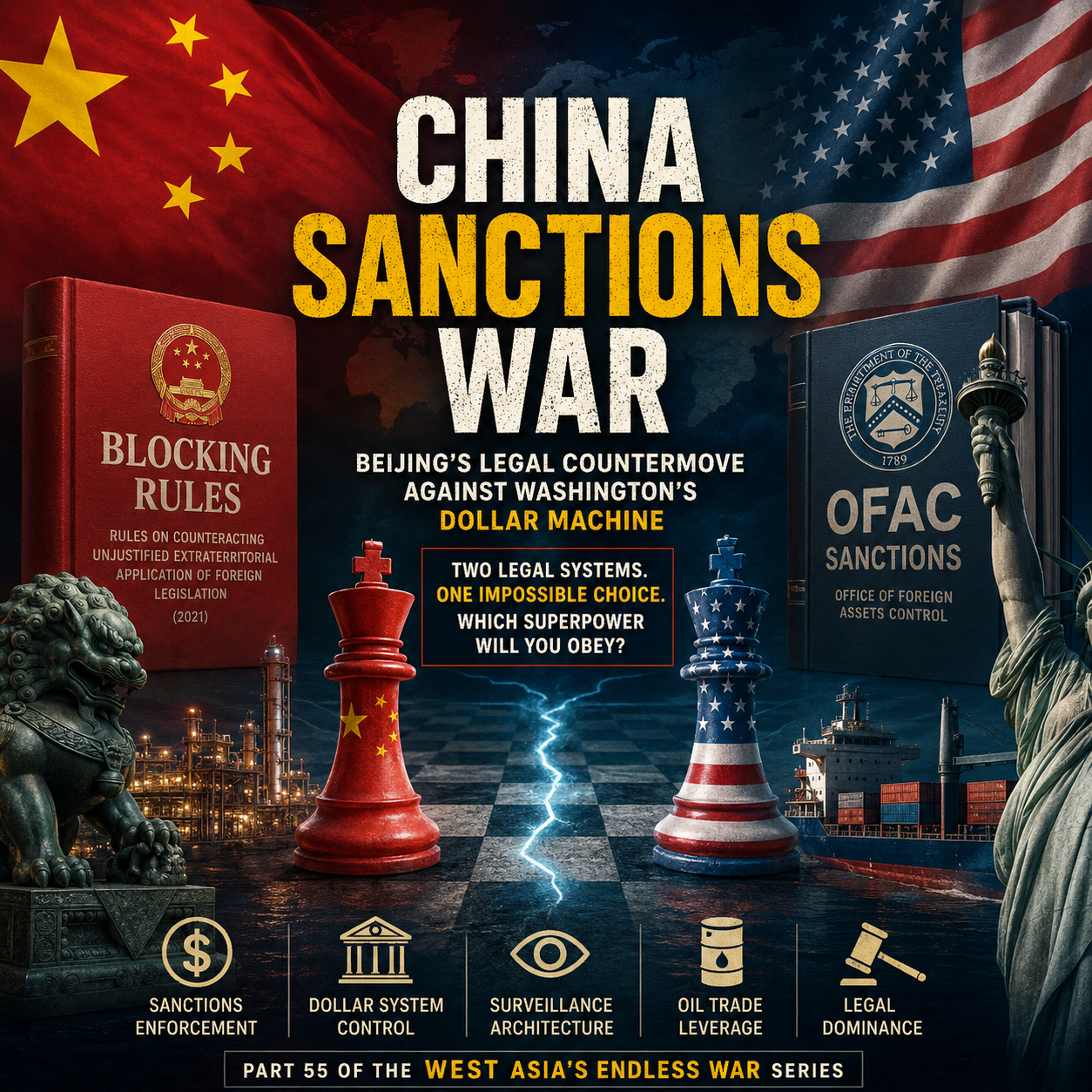
China Sanctions War: A Reckoning of West Asia’s Endless War (55)
Part 55 of the West Asia’s Endless War Series
भारत / GB
Washington Built the Dollar Machine on Sanctions Compliance From Every Actor in the World Simultaneously. China Has Just Made That Compliance Illegal Under Chinese Law. The Machine Has Met Its First Sovereign Challenger.
Blog 54 (Confession of Superpower Pirate) documented the moment Washington named itself — Trump called his Navy pirates collecting oil as a profitable business, declared himself sole authorised seller of Venezuela’s primary resource, and proposed replacing Iran’s Hormuz toll with Washington’s own. Blog 55 documents China’s response: the China Sanctions War is Beijing’s answer to Washington’s Dollar Machine, delivered not through diplomatic protest but through domestic law that makes compliance with Washington’s extraterritorial sanctions illegal within Chinese jurisdiction. Two legal systems now simultaneously make compliance with the other a criminal act. Every multinational operating in both economies must choose which superpower to obey.
China Sanctions War: The Order That Changed Everything
China Sanctions War: Beijing ordered Chinese companies to ignore US sanctions — making compliance with Washington illegal under Chinese law. Every multinational must now choose which superpower to obey. China’s Ministry of Commerce issued a formal order stating that US sanctions on five Chinese refineries — Hengli Petrochemical, Shandong Jincheng Petrochemical, Hebei Xinhai Chemical, Shouguang Luqing Petrochemical, and Shandong Shengxing Chemical — “shall not be recognized, enforced, or complied with” under Chinese law. Beijing invoked its 2021 Blocking Rules — formally the Rules on Counteracting Unjustified Extraterritorial Application of Foreign Legislation — to issue its first formal injunction against foreign sanctions at this scale. CNBC documented that China’s Blocking Rules were specifically designed to counter what Beijing calls the “long-arm jurisdiction” of American law — the principle that Washington can penalise non-American entities for conduct that occurs entirely outside American territory.
The consequences for any entity that complies with Washington instead of Beijing are precise and severe. Any domestic or foreign company that severs ties with the sanctioned Chinese refineries to comply with Washington’s OFAC designations now faces lawsuits in Chinese courts, regulatory penalties, inclusion on a Malicious Entity List, and potential asset freezes and trade restrictions within China. The China Sanctions War’s first casualty is neither a Chinese company nor an American one. It is the legal coherence of operating in both economies at the same time. Blog 50 (The Dollar’s Gulf Mint) documented the Surveillance Architecture as the fifth component of the dollar extraction machine — SWIFT, OFAC, correspondent banking giving Washington visibility and veto power over every global transaction. The China Sanctions War is Beijing’s sovereign challenge to that veto power, written in the language of domestic law rather than the language of diplomacy.
China Sanctions War: The Impossible Position
The China Sanctions War’s most precise consequence is the impossible position it creates for every global bank and multinational corporation operating in both the United States and China. Follow US sanctions and you are breaking Chinese law, facing asset freezes and Malicious Entity List designation in the world’s second largest economy. Ignore US sanctions to comply with Chinese law and you risk being cut off from the dollar-based global financial system. There is no compliance path that satisfies both legal systems simultaneously. The China Sanctions War has manufactured a sovereign legal conflict that every actor in global commerce must navigate — not once as a crisis to be managed but continuously as the permanent operating environment of the new multipolar order.
The five sanctioned Chinese refineries process Iranian oil — Blog 47 (China Oil Revenge) documented that China buys 80-90% of everything Iran ships out, and that the petroyuan architecture has been specifically designed to conduct this trade outside dollar clearing visibility. Washington sanctioned these refineries for precisely this reason — they are the operational nodes of the China Oil Revenge argument, the facilities that make China’s Iranian oil imports possible at scale. Beijing’s blocking order is the specific legal protection of that operational infrastructure. The Gulf Dollar Toll documented how SWIFT surveillance gives Washington visibility over every global transaction. The China Sanctions War is Beijing’s response: we will make the transactions Washington is surveilling legally protected under Chinese law, so that the surveillance itself produces no enforceable consequence.
📌 The Machine the China Sanctions War Is Challenging
Five components — Tax-and-Buy, Council Bills equivalent, Home Charges, Commercial Captivity, Surveillance Architecture. The Dollar’s Gulf Mint mapped the extraction architecture that China’s blocking order directly targets.
China Sanctions War: The Chain Reaction and Who Will Stand
The China Sanctions War raises the two questions that every state currently maintaining tactical non-alignment is now forced to answer explicitly: will others follow, and will they stand when Washington retaliates?
The chain reaction is already operating at three speeds simultaneously.
Formal legal defiance — China’s blocking order — is the first level, available only to states with sufficient economic scale and alternative architecture to absorb Washington’s retaliation. Russia operates at this level by necessity, its entire economy having been formally excluded from dollar clearing since 2022. Bloomberg noted that China’s blocking order creates a parallel to Russia’s post-2022 position — but with a critical difference: Russia was excluded from the dollar system by Washington’s decision, while China is choosing to make Washington’s exclusion legally unenforceable within Chinese jurisdiction. China has now joined at this level by choice — a distinction that matters, because choice implies confidence in the alternative architecture. Blog 53 (Gulf Dollar Captivity) documented that China’s alternative architecture — petroyuan, Belt and Road, mBridge — reached maturity precisely in the 2024-2026 window. The China Sanctions War is the institutional expression of that maturity.
Operational bypass — the second level — is already global. Blog 48 (UAE OPEC Split) documented dirham-rupee and dirham-yuan settlement frameworks eliminating five of six Gulf Dollar Toll dimensions on $202 billion of UAE trade. The BIS mBridge project — with UAE, China, Saudi Arabia, Hong Kong, and Thailand as participants — is designed to replace SWIFT dollar clearing entirely for participating economies. States conducting transactions through mBridge, yuan swap lines, and rupee-dirham settlement are already bypassing the Dollar Machine’s Council Bills equivalent without formal legal declarations.
The China Sanctions War accelerates this operational bypass by demonstrating that formal legal protection is now available for those who want it.
India, Brazil, Turkey, and the Gulf states are not standing with Washington — but neither are they standing formally with Beijing. They are building exits. Rupee-dirham settlement, yuan swap lines, mBridge participation, Russian oil purchases routed outside dollar clearing — these are not diplomatic protests. They are sovereign infrastructure choices, made quietly, that reduce the cost of eventually crossing the line China has now crossed. The China Sanctions War did not create this movement. It named it, legitimised it, and told every state still calibrating its position that the crossing is survivable.
Quiet corporate defection — the third and most consequential level — is the chain reaction that Washington cannot easily measure or punish. Every multinational with significant Chinese market exposure is now calculating: what is the cost of OFAC compliance relative to the cost of Malicious Entity List designation in China? For companies where China represents 20-40% of revenues — and there are hundreds of global firms in this category — the answer increasingly favours Chinese compliance over Washington compliance. This defection happens quietly, through restructured supply chains, through subsidiary structures, through transactions routed through non-dollar clearing channels. It does not make headlines. It makes the sanctions architecture progressively unenforceable.
On the question of who will stand — the series’ analysis of India is the clearest illustration of the spectrum. India maintains tactical non-alignment calibrated to the millimetre — buying Russian oil throughout the Ukraine war, signing the UAE Strategic Defence Partnership, building rupee-dirham settlement — but stopping precisely short of formal OFAC challenge because India’s banking sector remains dollar-clearing dependent and cannot absorb secondary sanctions on its financial system.
The Global South War Narrative that the series documented — six billion people reading the Iran war as resource imperialism — is the political context in which the China Sanctions War is being received. The narrative prepared the ground. China’s blocking order plants the flag. The states that follow will be those where the Chinese market dependency exceeds the dollar system dependency, where the alternative settlement architecture is sufficiently developed to absorb the crossing, and where the domestic political will exists to absorb Washington’s retaliation.
Treasury Secretary Scott Bessent called China an “unreliable partner” for not releasing strategic oil reserves to ease the Hormuz-caused global energy shortage, a statement Reuters confirmed was made on the same day China’s Foreign Ministry called the US blockade “a dangerous and irresponsible move” — the two governments trading legal and diplomatic blows within hours of each other on May 1 2026. — the response of a state that expected compliance and received defiance. The China Sanctions War has produced the first state willing to accept the designation of unreliable partner rather than the designation of compliant client.
The China Sanctions War’s closing argument connects to the series’ thesis precisely. Washington’s Global Control War (Blog 46) established that the war is against economic independence from Washington wherever it exists.
The China Sanctions War may represent the most direct institutional challenge to dollar-system enforcement in the last fifty years — not a diplomatic complaint, not a commercial bypass, but a sovereign domestic law that makes Washington’s extraterritorial enforcement illegal within Chinese jurisdiction. Blog 52 (Gulf Dollar Silence) documented how states maintained strategic silence for fifty years because speaking without the conditions to act produced the Iraq 2003 consequence. China has the conditions to act. China is speaking. The China Sanctions War is the sound of the Gulf Dollar Silence ending — not just for the Gulf, but for the architecture of global dollar compliance that the silence sustained.
📌 The Silence That the China Sanctions War Is Breaking
Why states maintained strategic silence about the dollar extraction architecture for fifty years — the enforcement mechanism, the network effect, and the three structural constraints that made exit impossible until China built the alternative.
Next: India Energy Exposure — Blog 56 in West Asia’s Endless War examines India’s position in the commercial architecture the Iran war has restructured: 90 lakh workers in Gulf states, Chabahar investment in Iran, defence partnership with Israel, energy dependency across four competing supply chains simultaneously, and a Strategic Defence Partnership with UAE signed nineteen days before the war began. India sits inside the Gulf Dollar Toll on every oil import it pays — building the rupee-dirham settlement architecture that begins to bypass it, calibrated to the millimetre to stop precisely short of the formal OFAC challenge that the China Sanctions War represents. Part of the West Asia’s Endless War Series on hinduinfopedia.com.
Feature Image: Click here to view the image.
Videos
Glossary of Terms
- China Sanctions War: A term coined in this series describing China’s legal and institutional challenge to US extraterritorial sanctions through domestic law and alternative financial architecture.
- Blocking Rules: China’s 2021 legal framework formally called the “Rules on Counteracting Unjustified Extraterritorial Application of Foreign Legislation,” designed to prohibit compliance with certain foreign sanctions inside Chinese jurisdiction.
- OFAC: The Office of Foreign Assets Control, a US Treasury agency responsible for enforcing American sanctions programs globally.
- Extraterritorial Sanctions: Sanctions imposed by one country on foreign entities or activities occurring outside its own territory, usually through financial or legal pressure.
- Dollar Machine: A phrase coined in the series referring to the global dollar-based enforcement and extraction architecture built around sanctions, SWIFT access, correspondent banking, and reserve currency dominance.
- SWIFT: The Society for Worldwide Interbank Financial Telecommunication, the global messaging network used by banks for international financial transactions.
- Malicious Entity List: A Chinese regulatory mechanism that can penalise foreign companies or entities deemed harmful to Chinese commercial or national interests.
- Petroyuan: Oil trade conducted in Chinese yuan rather than US dollars, viewed as part of broader de-dollarisation efforts.
- mBridge: A cross-border central bank digital currency project involving China, UAE, Thailand, Hong Kong, and others aimed at reducing dependence on dollar clearing systems.
- Dollar Clearing: The international banking process through which dollar-denominated transactions are settled, largely under US financial oversight.
- Surveillance Architecture: A phrase used in the series for the financial monitoring system created through SWIFT, OFAC, correspondent banking, and dollar settlement visibility.
- Operational Bypass: The use of alternative settlement systems, currencies, and trade routes to reduce exposure to US sanctions enforcement.
- Secondary Sanctions: Penalties imposed by the US on third-party countries, companies, or banks conducting business with sanctioned entities.
- Tactical Non-Alignment: A strategic posture where states avoid fully aligning with either Washington or Beijing while quietly building alternative economic and diplomatic options.
- Gulf Dollar Toll: A concept coined in the series describing the financial and strategic costs imposed through dollar-denominated Gulf energy trade and associated enforcement mechanisms.
#China #USChina #Sanctions #Iran #Oil #Dollar #SWIFT #Yuan #Geopolitics #BRICS #TradeWar #DeDollarization #OFAC #WestAsia #HinduinfoPedia
West Asia’s Endless War: Why This Series Exists
[…] भारत / GB […]
[…] https://hinduinfopedia.com/china-sanctions-war-a-reckoning-of-west-asias-endless-war-55/ […]
[…] Blog 55 (China Sanctions War) documented Beijing’s blocking order making compliance with Washington’s sanctions illegal under Chinese law — the Dollar Machine’s surveillance architecture meeting its first sovereign challenger. Blog 56 examines the stalemate that the Fujairah strikes of May 4 2026 have made undeniable: the Hormuz Logical Trap is a situation in which every available move produces a worse outcome than the current one — and the current one is already unsustainable. Washington swallowed this war on February 28 by launching Operation Epic Fury. It cannot achieve its objectives. It cannot withdraw without humiliation. And it cannot continue without fighting the entire world simultaneously. […]
[…] precisely to stop short of the formal OFAC challenge that the China Sanctions War represents. Blog 55 (China Sanctions War) established India’s precise limit: India buys Russian oil, builds rupee-dirham settlement, […]
[…] Read […]
[…] defence budgets that reached $800 billion annually, and the surveillance architecture that China Sanctions War (Blog 55) documented as the Dollar Machine’s fifth […]
[…] settlement systems, and its own enforcement mechanisms. The order does not collapse. It fragments. Blog 55 (China Sanctions War) documented the blocking order that was the first sovereign challenge to dollar dominance. The […]