

Islamic NATO Reckoning: A Reckoning of West Asia’s Endless War (74)
Part 74 of the West Asia’s Endless War Series
भारत / GB
The SMDA Promises What NATO Took Seventy Years to Build. It Is Led by a State Whose Army Maintains Operational Relationships With the Organisations It Is Supposed to Suppress. Its Nuclear Umbrella Is Held by a State With 30-40 Million Shia Citizens Who Are the Designated Enemy of Its Primary Member.
Blog 73 (Palestine: The Peace Process Invoice) completed the four-blog Palestine arc — establishing that the peace process has been one-directional, that every Israeli territorial concession was converted by the Raktbeej ecosystem (Starfish organic mechanism) into preparation for the next elimination attempt, and that genuine resolution requires the Dagdhabeej sterilisation of the three germination essentials rather than another offer of territory. Blog 74 examines the alliance architecture that the Hormuz war’s most consequential structural shift has produced on the Sunni side: the Strategic Mutual Defence Agreement signed between Saudi Arabia and Pakistan on September 17 2025, with Turkey’s observer status, promising Article 5-equivalent collective defence for a Sunni-majority bloc. The Islamic NATO Reckoning is the examination of what the SMDA promises, what it actually delivers, and what its internal contradictions reveal about whether an alliance formed against Washington’s revealed conditionality can survive the irresolvabilities of its own founding members.
Islamic NATO Reckoning: What the SMDA Promises
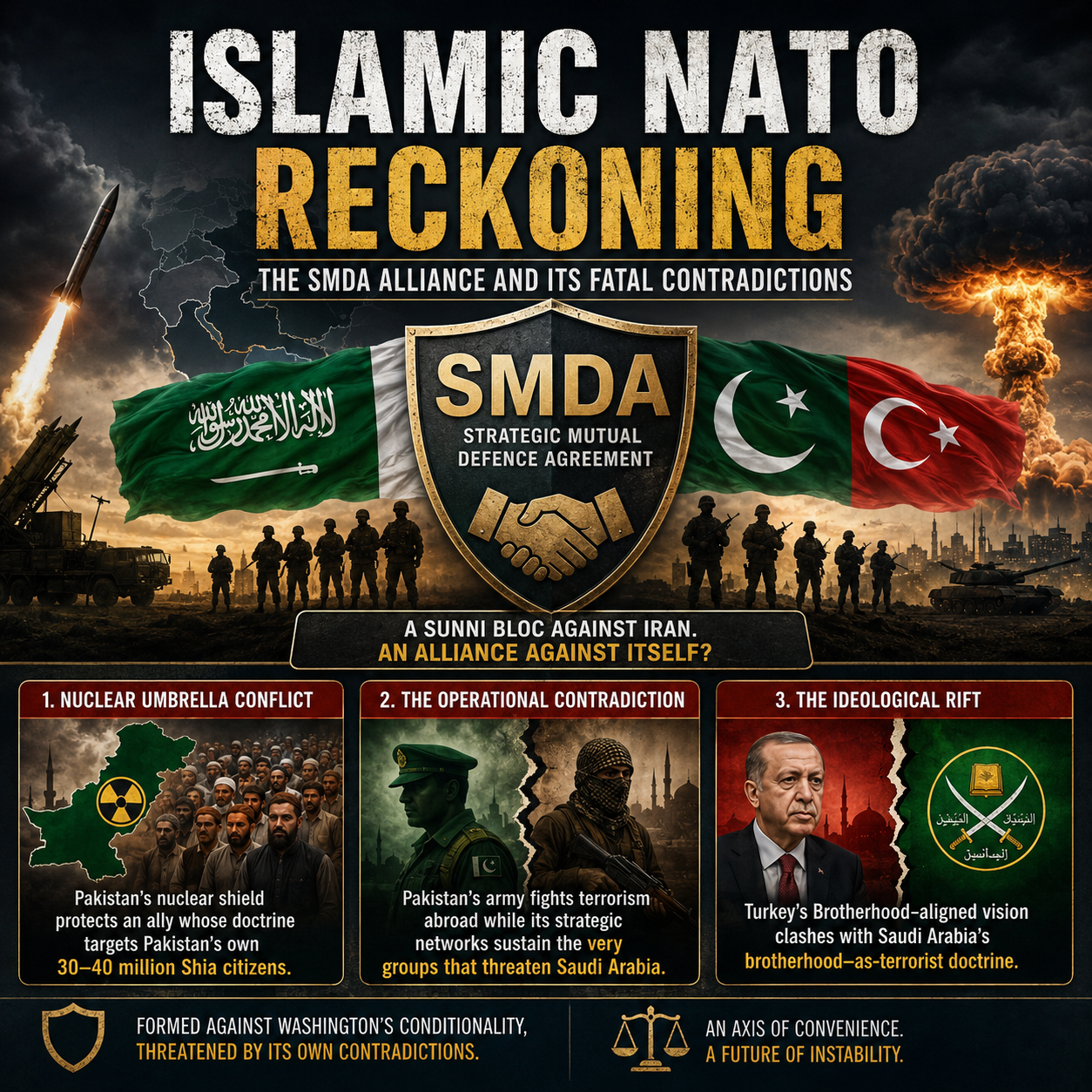
Islamic NATO Reckoning: The Saudi-Pakistan-Turkey SMDA examined as Islamic collective defence. Operational void. Shia-Sunni contradiction. Nuclear umbrella creating existential conflict with Pakistan’s own 30 million Shia. The alliance carries the contradiction that will dissolve it. The Islamic NATO Reckoning begins with the SMDA’s founding logic established in Blog 34 (Manufactured Stability Reckoning) — Saudi Arabia’s insurance policy against the American security guarantee’s revealed conditionality. Operation Epic Fury was launched from bases on Saudi Arabia’s doorstep without consultation. Ras Laffan was struck while producing 17% of global LNG. UAE absorbed 537 ballistic missiles. The Praetorian Guard that Blog 31 (Gulf Betrayal Reckoning) documented was revealed as a conditional commercial arrangement rather than an unconditional security commitment. Saudi Arabia’s response was rational: seek an alternative. Reuters confirmed Saudi Arabia had already requested US withdrawal of Patriot missile batteries in 2023 — returning the service it was no longer confident it would receive when needed.
The SMDA promises what its architects call an Islamic Article 5 — an attack on one member is an attack on all, requiring collective military response. Pakistan’s Defence Minister confirmed at the SMDA signing that the agreement includes mutual defence obligations and that Pakistan’s strategic capabilities — explicitly including its nuclear deterrent — are available for the alliance’s collective security. Saudi Arabia receives the nuclear umbrella it has sought since Iran’s nuclear programme became a documented threat. Pakistan receives the Gulf financial relationship it requires for economic survival — Gulf remittances constitute approximately 7-8% of Pakistan’s GDP and Gulf state deposits underpin Pakistan’s foreign exchange reserves. Turkey receives the Sunni bloc leadership role it has sought since Erdoğan’s AKP government began positioning Turkey as the successor to Ottoman regional influence.
On paper the SMDA addresses Saudi Arabia’s three primary security concerns simultaneously: Iranian ballistic missile threat (Pakistan’s nuclear deterrent as counter), internal Islamist challenge (Pakistan’s army as supplementary security force), and the loss of American military infrastructure (Pakistan’s military expertise as replacement). The Islamic NATO Reckoning begins with the observation that each of these three solutions carries within it the precise contradiction that makes it self-defeating.
📌 The Gulf Betrayal That Made This Alliance Necessary
Operation Epic Fury launched without consultation, Ras Laffan struck, UAE absorbing 537 missiles — the four-pillar Gulf-Washington dependency exposed as conditional in a single operational sequence.
Islamic NATO Reckoning: Three Contradictions That Dissolve the Promise
Contradiction One — The nuclear umbrella points at Pakistan’s own population.
Pakistan’s nuclear deterrent is offered as protection against Iran’s potential nuclear capability. The Islamic NATO Reckoning’s first contradiction: Pakistan has between 30 and 40 million Shia Muslim citizens — the second largest Shia population in the world after Iran itself. Pew Research documents Pakistan’s Shia population at approximately 10-15% of the total — between 22 and 36 million people in a country of 220 million. The SMDA’s nuclear umbrella is extended in the context of a Sunni-Shia strategic confrontation in which Iran is the primary designated adversary. Pakistan’s nuclear weapons would be deployed, in the SMDA framework, against a state whose theological and political community is represented by tens of millions of Pakistani citizens. The Pakistani army has historically managed this contradiction through a combination of Sunni sectarian dominance within the military establishment and periodic suppression of Shia political organisation. The SMDA formalises and institutionalises the contradiction at the level of strategic doctrine — making it a treaty commitment rather than an operational reality that could be managed through ambiguity.
Blog 20 (Shia Sunni War Roots) established 1,400 years of theological and political competition. The SMDA’s nuclear umbrella clause is the most institutionally explicit expression of the Sunni side of that competition since the Ottoman Caliphate’s collapse in 1924. Pakistan’s Shia population — historically among the most politically organised and economically integrated religious minorities in Pakistani society — will register the SMDA’s nuclear commitment as an existential threat dressed in alliance language. The domestic political consequences of Pakistan’s most explicit Sunni-vs-Shia strategic commitment are not yet visible. They will become visible at the first operational activation of the SMDA’s collective defence clause.
Contradiction Two — The security guarantor maintains the threat it is guaranteeing against.
Blog 63 (Dar Al Harb Ambivalence Pakistan) established Pakistan’s bifurcated state architecture — two parallel policies operating simultaneously as official strategy. Pakistan’s ISI has maintained documented operational relationships with Lashkar-e-Taiba, Jaish-e-Mohammed, and the Haqqani Network — organisations whose theology is the Wahhabi-Deobandi maximalist synthesis that simultaneously threatens the Saudi monarchy’s domestic legitimacy. The SMDA brings Pakistan’s army into Saudi Arabia as a supplementary security force against the internal Islamist challenge that the 1979 Grand Mosque seizure first made visible. Blog 62 (Dar Al Harb Ambivalence) documented that Saudi Arabia uses American military forces to contain the domestic Wahhabi threat while funding the same Wahhabi infrastructure abroad. The SMDA replaces the American forces with Pakistani forces — whose ISI maintains institutional relationships with the Brotherhood-adjacent organisations that represent precisely the ideological threat the Pakistani forces are supposed to suppress. The US State Department’s own Country Reports on Terrorism document Pakistan-based organisations responsible for attacks across multiple consecutive years — the same Pakistan whose army is now the SMDA’s primary military instrument.
Contradiction Three — Turkey is the Brotherhood’s primary state patron.
Saudi Arabia designated the Muslim Brotherhood a terrorist organisation in 2014. Turkey under Erdoğan has been the Brotherhood’s primary state patron — hosting Brotherhood leadership expelled from Egypt, providing diplomatic cover and media infrastructure for Brotherhood-aligned movements across the Arab world. The SMDA’s Turkish observer status — and the bilateral security commitments that accompany it — incorporates the Brotherhood’s primary state patron into an alliance that Saudi Arabia formally treats as a terrorist organisation’s sponsor. Turkey’s strategic interest in the SMDA is the Ottoman successor role it represents — Sunni bloc leadership through military presence in the Gulf. Turkey’s institutional interest in the Brotherhood is the ideological legitimation the Brotherhood provides for Erdoğan’s political Islam project domestically. The two interests are not compatible within the SMDA framework. Saudi Arabia cannot simultaneously designate the Brotherhood a terrorist organisation and maintain a collective defence relationship with the Brotherhood’s primary state patron without the designation being recognised as performative rather than substantive.
The Islamic NATO Reckoning’s closing argument is the series’ Axis of Convenience argument (Blog 68) applied to its most internally contradictory member. The SMDA was formed against Washington’s revealed conditionality — a rational response to the Gulf Betrayal Reckoning’s documented failure. But the alliance it has produced carries three structural contradictions simultaneously: a nuclear umbrella pointed at the domestic population of the state holding it, a security guarantor institutionally connected to the threats it is supposed to suppress, and an observer state that is the primary institutional patron of the organisation the alliance’s primary member has designated as a terrorist group. Washington’s Global Control War produced the condition that made the SMDA necessary. The SMDA’s internal architecture will produce the condition that makes it ineffective. The Islamic NATO Reckoning is not that the alliance will not form. It is that the alliance cannot hold when its internal contradictions reach operational activation.
📌 The Dar Al Harb Ambivalence Pakistan Carries Into This Alliance
Pakistan’s bifurcated state architecture — two parallel policies operating simultaneously as official strategy — and why the security guarantor of the Islamic NATO maintains operational relationships with the organisations the alliance is supposed to suppress.
Next: Decapitation Template History — Blog 75 in West Asia’s Endless War examines the historical record of targeted leadership elimination — from 1953 to Soleimani to Khamenei — and whether the decapitation doctrine produces compliance or the IRGC Mosaic outcome every time it is applied against a state with a distributed military architecture and a constitutional mandate to continue regardless of who is removed. Part of the West Asia’s Endless War Series on hinduinfopedia.com.
Feature Image: Click here to view the image.
Videos
Glossary of Terms
- SMDA (Strategic Mutual Defence Agreement): A Saudi Arabia–Pakistan defence pact signed in September 2025 promising collective military response similar to NATO’s Article 5 framework.
- Islamic NATO Reckoning: The blog’s core analytical phrase examining whether the Sunni defence bloc can survive its own internal contradictions.
- Article 5-equivalent collective defence: A defence principle where an attack on one alliance member is treated as an attack on all members.
- Operational activation: The stage where alliance promises are tested in an actual military or geopolitical crisis rather than remaining theoretical commitments.
- Washington’s revealed conditionality: A recurring series phrase describing how US security guarantees were shown to depend on strategic convenience rather than unconditional protection.
- Praetorian Guard: A metaphor used in the series for Gulf dependence on American military protection and security infrastructure.
- Ras Laffan strike: A referenced attack on Qatar’s major LNG infrastructure during the Hormuz conflict, symbolising Gulf vulnerability.
- Nuclear umbrella: Strategic protection offered by a nuclear-armed state to allied countries against external military threats.
- Shia-Sunni strategic confrontation: The geopolitical and theological rivalry between Shia-led Iran and Sunni-led regional powers.
- Dar Al Harb Ambivalence: A unique series concept describing Pakistan’s dual-track strategic behaviour where official state policy and covert militant relationships operate simultaneously.
- Bifurcated state architecture: A state structure in which formal institutions and parallel unofficial strategic networks function together.
- Wahhabi-Deobandi synthesis: A hardline ideological convergence between Saudi Wahhabism and South Asian Deobandi movements influencing several Islamist organisations.
- Brotherhood-adjacent organisations: Islamist groups ideologically linked to or influenced by the Muslim Brotherhood’s political Islam framework.
- Axis of Convenience: A recurring series concept describing alliances formed from temporary strategic necessity rather than deep ideological unity.
- Decapitation doctrine: A military strategy focused on eliminating top political or military leadership to weaken or collapse an adversary’s command structure.
#IslamicNATO #SMDA #SaudiArabia #Pakistan #Turkey #Iran #NATO #MiddleEast #Geopolitics #WestAsia #Sunni #Shia #Defense #Alliance #HinduinfoPedia
West Asia’s Endless War: Why This Series Exists
Refer to Various Arks Referred to in the Blog
https://hinduinfopedia.com/proof-of-endless-war-master-reference-table/
[…] भारत / GB […]
[…] Blog 74 (Islamic NATO Reckoning) examined the alliance architecture the Hormuz war has produced on the Sunni side — its three internal contradictions and its structural inability to survive operational activation. Blog 75 examines the strategic doctrine that produced the war itself: the decapitation template — the belief that removing a leadership will produce the compliance that military pressure alone cannot. The Decapitation Template History is the documented record of this template’s application across seven decades, three targets, and zero instances of the compliance it was designed to produce. The explanation for the pattern is not in the three applications. It is in the fundamental misidentification of what was being targeted. […]
[…] https://hinduinfopedia.com/islamic-nato-reckoning-a-reckoning-of-west-asias-endless-war-74/ […]