

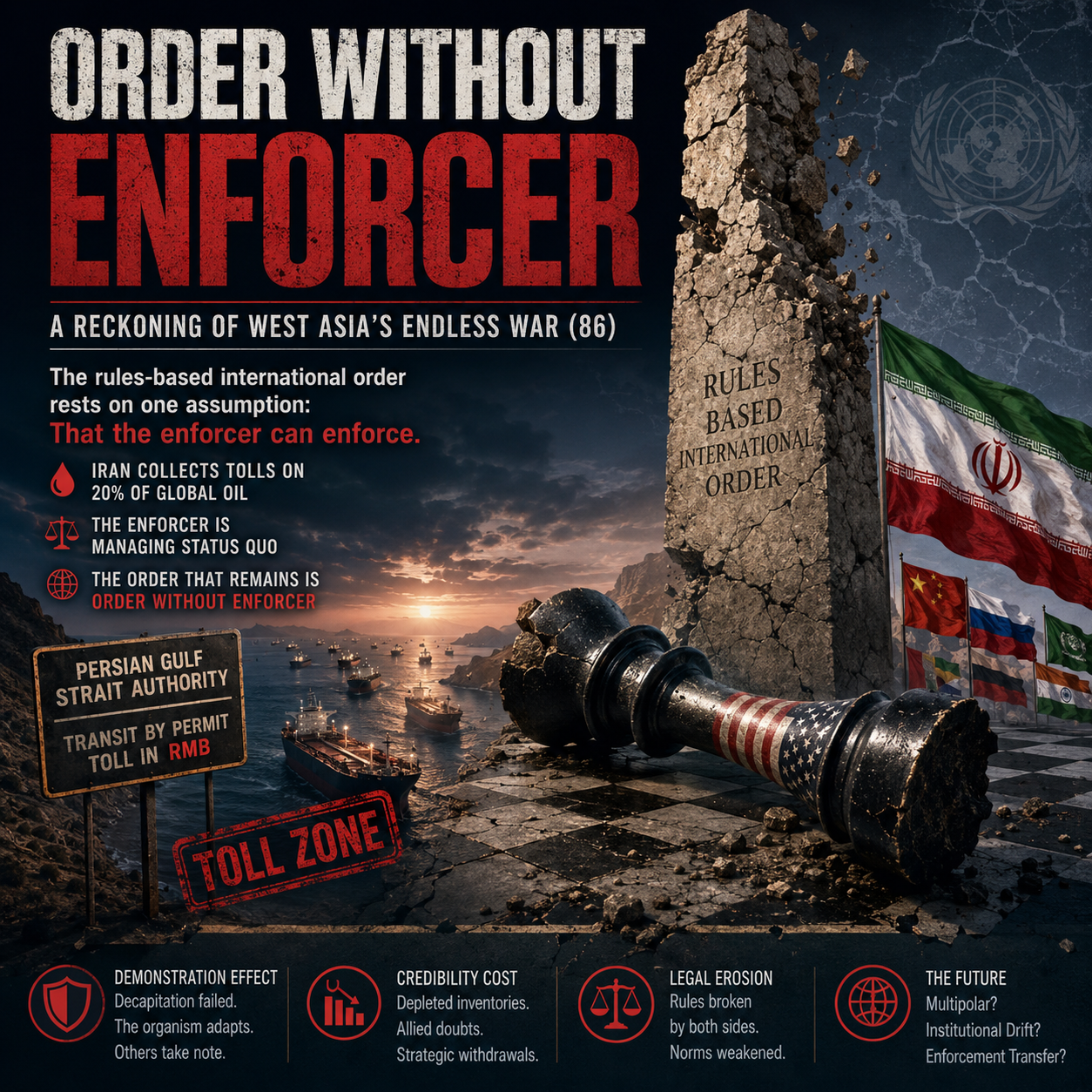
Order Without Enforcer: A Reckoning of West Asia’s Endless War (86)
Part 86 of the West Asia’s Endless War Series
भारत / GB
The Rules-Based International Order Rests on One Assumption: That the Enforcer Can Enforce. The Iran War Has Tested That Assumption Against the Most Capable Organism Washington Has Faced Since 1945. Iran Declared to Collect Tolls on 20% of Global Oil. The Enforcer Is Managing Status Quo. The Order That Remains Is Order Without Enforcer — and the World Has Not Yet Agreed on What That Means.
Blog 85 (The War Ledger) established that the endgame will be decided by whose constraints arrive first — Washington’s fixed institutional and electoral clocks against Iran’s slower-dated economic and demographic pressures. Blog 86 is the series’ closing argument: what the world looks like when the enforcer of the rules-based international order has demonstrated the limits of its enforcement capability — and what order, if any, fills the space that demonstration has created.
Order Without Enforcer: What the Rules-Based Order Actually Was
Order Without Enforcer: The rules-based international order rests on one assumption — that the enforcer can enforce. The Iran war has tested that assumption. Iran has decided to collect tolls on 20% of global oil. The enforcer is managing status quo. What order exists when the enforcer cannot enforce? The rules-based international order is not a set of rules agreed upon by sovereign equals. It is a set of rules whose enforcement has been provided, since 1945, by a single state with the military and financial capability to make violations costly. The Order Without Enforcer question requires understanding what the order actually was. The rules themselves — the UN Charter’s prohibition on aggressive war, the freedom of navigation on international waters, the non-proliferation architecture — are genuine expressions of collective interest. Their enforcement has been American.
JURIST documented the legal analysis precisely: the US-Iran conflict flouts UN Charter jus ad bellum and Geneva jus in bello norms — eroding the post-1945 order from both sides simultaneously. Washington launched the war without Congressional authorisation — violating its own constitutional order. Iran closed the Strait of Hormuz and struck civilian infrastructure — violating international humanitarian law. Over 100 international law experts documented that the 2026 National Defense Strategy omits references to civilian protection and international law entirely — and that the War Department under Hegseth systematically removed the legal oversight mechanisms designed to ensure compliance with international humanitarian law. The enforcer of the rules-based order removed its own compliance mechanisms while enforcing the order. The order’s foundation — that the enforcer’s power is legitimate because the enforcer operates within the rules — was removed from the inside.
CFR’s James Lindsay documented that Iran has imposed tolls on some shipping in Chinese renminbi, allowed passage for select countries, and achieved unprecedented control over escalation — giving Tehran new, significant leverage in any negotiation. The order Washington enforced included freedom of navigation as a foundational principle. That principle has been replaced, in the Strait of Hormuz, by Iran’s Persian Gulf Strait Authority — a toll collection institution operating in the world’s most critical chokepoint with Washington’s tacit acceptance. The order without enforcer’s first visible expression: the freedom of navigation principle, enforced for 80 years, replaced by a toll authority that Washington calls extortion and cannot remove — and at the same time, expresses desire to share the revenue from the toll.
📌 The Trap That Produced This Outcome
Five walls, no exit — the Hormuz Logical Trap that converted the enforcer’s most ambitious military operation into the demonstration of its enforcement limits.
Order Without Enforcer: What the Demonstration Has Cost
The Iran war’s demonstration of enforcement limits has produced three documented costs to the order itself — each visible in the current record.
Cost One — The credibility demonstration.
The German Marshall Fund documented that the enormous depletion of scarce munition inventories from the Iran war contributed to Washington’s withdrawal of military assets from Europe — with German Chancellor Friedrich Merz telling students that the United States “had no strategy” and was being “humiliated” by Iran. This drew Trump’s immediate response — threatening to withdraw US troops from Germany — and following through. The enforcer whose credibility underwrites the rules-based order in Europe depleted its munition inventories in the Gulf and responded to a European ally’s observation of that depletion by withdrawing the forces whose presence makes the order credible. The credibility demonstration is not only in the Gulf. It is in every theatre where Washington’s extended deterrence has been the order’s enforcement mechanism.
Cost Two — The legal order’s self-dismantlement.
The rules-based order’s legitimacy rests not only on the enforcer’s power but on the enforcer’s claim to operate within the rules. The war’s legal analysis documented by Wikipedia’s synthesis of expert opinion: Iran has sued the US in the Hague Tribunal over the 2026 war, invoking the Algiers Accords of 1981 in which the United States pledged it “is and from now on will be the policy of the United States not to intervene, directly or indirectly, politically or militarily, in Iran’s internal affairs.” The enforcer of international law is being sued under international law it signed. The 2026 National Defense Strategy’s removal of civilian protection and international law references from its text is not an operational change. It is the enforcer publicly removing the legal framework that justified its enforcement claim. An order whose enforcer has removed its own legal compliance mechanisms is an order whose legitimacy claim has been removed from the inside.
Cost Three — The demonstration effect.
Every state that has been managing American pressure — North Korea, Venezuela, Cuba, smaller states across Africa and Asia — has watched the Iran war’s outcome with the same analytical attention Iran spent 47 years developing. Blog 75 (Decapitation Template History) established that Iran’s IRGC Mosaic was built specifically by studying Washington’s decapitation successes in Iraq, Afghanistan, and the Balkans. Every state that observed the Iran war now has an updated study guide: the distributed architecture, the Hormuz leverage, the proxy network, the constitutional succession mechanism — all tested under maximum American pressure and demonstrated survivable. The order without enforcer’s third cost: the template for resisting it has been publicly demonstrated at operational scale.
Order Without Enforcer: What Comes Next
The Order Without Enforcer question does not have a clean answer — and the series does not pretend it does. Three possibilities are visible in the current configuration, each with documented evidence for its trajectory.
Possibility One — Managed multipolarity:
The four-power world Professor Pape identified — US, China, Russia, Iran — develops implicit rules through the same mechanism that governed great power competition before 1945: spheres of influence, negotiated limits, and the mutual recognition that certain lines produce costs no actor wants to pay. Iran’s toll authority becomes normalised as Iran’s sphere. The dollar’s reserve status is managed alongside the petroyuan. The rules-based order is replaced not by chaos but by negotiated coexistence without a single enforcer. India — the swing actor in this configuration — becomes the most courted non-aligned state in the system’s history.
Possibility Two — Institutional drift:
The UN becomes more irrelevant, the ICC proceeds against Washington without consequence, the WTO rules are applied selectively, and the global commercial architecture fragments into competing blocs — dollar bloc, petroyuan bloc, non-aligned bloc — each with its own rules, its own settlement systems, and its own enforcement mechanisms. The order does not collapse. It fragments. Blog 55 (China Sanctions War) documented the blocking order that was the first sovereign challenge to dollar dominance. The mBridge, the petroyuan, the alternative SWIFT architecture — each a component of the fragmented order already under construction.
Possibility Three — Enforcement transfer:
No single state acquires Washington’s 1945-2026 enforcement capability, but regional enforcement becomes distributed — Gulf states enforcing Gulf norms through the Strategic Mutual Defence Agreement (SMDA), China enforcing Indo-Pacific norms through economic leverage, the EU enforcing European norms through regulatory architecture. The global order becomes a collection of regional orders, each enforced by the dominant actor in its region, with the global commons — the oceans, the chokepoints, the financial infrastructure — governed by negotiated arrangements among the regional enforcers rather than by a single global power. Hormuz is the first test case: Iran enforcing its regional norm, Washington accepting the regional enforcement while calling it extortion, the global shipping industry paying the toll and passing the cost to consumers globally.
The Order Without Enforcer is the series’ closing observation rather than its closing conclusion. The series has documented 86 blogs of evidence for how the current configuration was produced — the commercial architecture, the organism’s design, the decapitation template’s failure, the Raktbeej mechanism, the Palestine arc, the Dollar Machine, the Hormuz Logical Trap. What replaces the order whose enforcer has demonstrated its limits is not yet documentable because it has not yet been decided. Blog 83 (Who Decides Endgame) established that nobody currently positioned can deliver the endgame. The same is true of the order: nobody currently positioned can enforce it, and nobody has yet constructed the replacement. The world the series has documented is a world in transition — from a unipolar order with a single enforcer to a configuration that has not yet been named, whose rules have not yet been agreed, and whose enforcement mechanism has not yet been built. The Raktbeej and Starfish Thesis on hinduinfopedia.com identified the organism that no modern framework can contain. The Order Without Enforcer is what the world looks like when the framework has been tested against the organism — and the organism is still standing, collecting tolls, and waiting for the enforcer’s ledger to close.
📌 The Series That Documented the Transition
86 blogs. The commercial architecture. The organism’s design. The Dollar Machine. The Raktbeej mechanism. The Palestine arc. The Hormuz Logical Trap. The complete analytical record of how the order without enforcer was produced.
The West Asia’s Endless War — Hormuz Reckoning Series continues at hinduinfopedia.com as the situation develops. The series has documented 86 analytical arguments about the structure of the conflict, the actors within it, and the global order it is reshaping. The event-driven blog — Blog 87 — will be assigned when the development that warrants it occurs. The series does not predict. It documents, analyses, and names. The naming continues as long as the war does.
Feature Image: Click here to view the image.
Videos
Glossary of Terms
- Order Without Enforcer: The central concept of this blog. A condition in which international rules continue to exist, but the dominant power responsible for enforcing them can no longer do so effectively.
- Rules-Based International Order: The post-1945 global framework built around institutions, treaties, international law, freedom of navigation, and collective security arrangements.
- Strait of Hormuz: One of the world’s most strategically important maritime chokepoints through which a significant share of global oil exports passes.
- Persian Gulf Strait Authority (PGSA): A term used in the blog to describe Iran’s toll-collection and regulatory mechanism operating in the Strait of Hormuz.
- IRGC Mosaic: A distributed organizational structure developed by Iran’s Islamic Revolutionary Guard Corps (IRGC) to maintain operational continuity under extreme military pressure.
- Decapitation Template: A military strategy aimed at disabling an adversary by eliminating or neutralizing its leadership structure.
- Proxy Network: A system of allied organizations, militias, or partner groups that advance a state’s strategic objectives without direct state involvement.
- Managed Multipolarity: A potential future international system in which several major powers maintain stability through negotiated limits, spheres of influence, and mutual restraint.
- Institutional Drift: The gradual decline in the effectiveness, authority, or relevance of international institutions while they continue to exist formally.
- Enforcement Transfer: A process in which global enforcement responsibilities shift from a single dominant power to multiple regional powers.
- Petroyuan: The use of the Chinese yuan in international oil transactions as an alternative to dollar-denominated energy trade.
- mBridge: A cross-border central bank digital currency platform designed to facilitate international payments outside traditional financial networks.
- Dollar Machine: A recurring concept in this series describing the mechanisms through which the US dollar-based financial system generates global influence and leverage.
- Hormuz Logical Trap: A unique concept developed in this series describing the strategic, economic, and geographic constraints that limit external powers’ options in the Strait of Hormuz.
- Raktbeej Mechanism: A series-specific concept inspired by the mythological figure Raktbeej, describing an organizational structure capable of regenerating and adapting despite sustained pressure or losses.
#Iran #USA #War #Oil #Hormuz #China #Geopolitics #MiddleEast #Politics #World #HinduinfoPedia
West Asia’s Endless War: Why This Series Exists
Refer to Various Arks Referred to in the Blog
https://hinduinfopedia.com/proof-of-endless-war-master-reference-table/
[…] भारत / GB […]
[…] Blog 86 (Order Without Enforcer) closed the series’ analytical arc by documenting what the world looks like when the enforcer of the rules-based order has demonstrated the limits of its enforcement capability. Blog 87 is the event-driven slot the series reserved for the moment the analytical arguments became operational events. That moment is now — June 5–8, 2026. The events of this week do not change the series’ arguments. They are the series’ arguments, expressed in the most precise human terms available: a ceasefire that isn’t, a tanker on fire, a president calling his closest ally crazy, and an Iranian foreign minister who has added a condition the ceasefire cannot meet. […]
[…] https://hinduinfopedia.com/order-without-enforcer-a-reckoning-of-west-asias-endless-war-86/ […]