

Agricultural Feudalism Reckoning: A Reckoning of West Asia’s Endless War (45)
Part 45 of the West Asia’s Endless War Series
भारत / GB
Empires Once Controlled Breadbaskets Through Soldiers. This One Uses Patents, Hybrid Seeds, and Credit Agreements. The Farmer Owns the Dirt. The Corporation Owns the Result.
Blog 44 established the Ukraine Agricultural Reckoning — how Europe’s food market sovereignty is being restructured through war into US corporate-controlled production, and why this follows the same 1953 commercial capture architecture that destroyed Iran’s oil sovereignty and Europe’s energy independence. Blog 45 examines how the capture works at farm level: the triple-lock system of legal, biological, and financial control that converts the Ukrainian farmer from a sovereign food producer into a manager of corporate assets on their own land, and the three-node toll system through which 70% of agricultural value leaves Ukraine before it can be counted as Ukrainian income.
The Link Between West Asia’s Endless War And Agricultural Feudalism Reckoning
The Structural Link: While the geography has shifted from the oil fields of the Persian Gulf to the black soil of the Steppe, the blueprint remains identical. Ukraine is the modern laboratory for the same commercial capture architecture perfected in West Asia. Just as the 1953 Iranian intervention was never about democracy but about the ownership of the flow of oil, the Ukrainian conflict has been leveraged to ensure that the ownership of the flow of food remains a Western corporate prerogative.
Agricultural Feudalism Reckoning: The Triple Lock
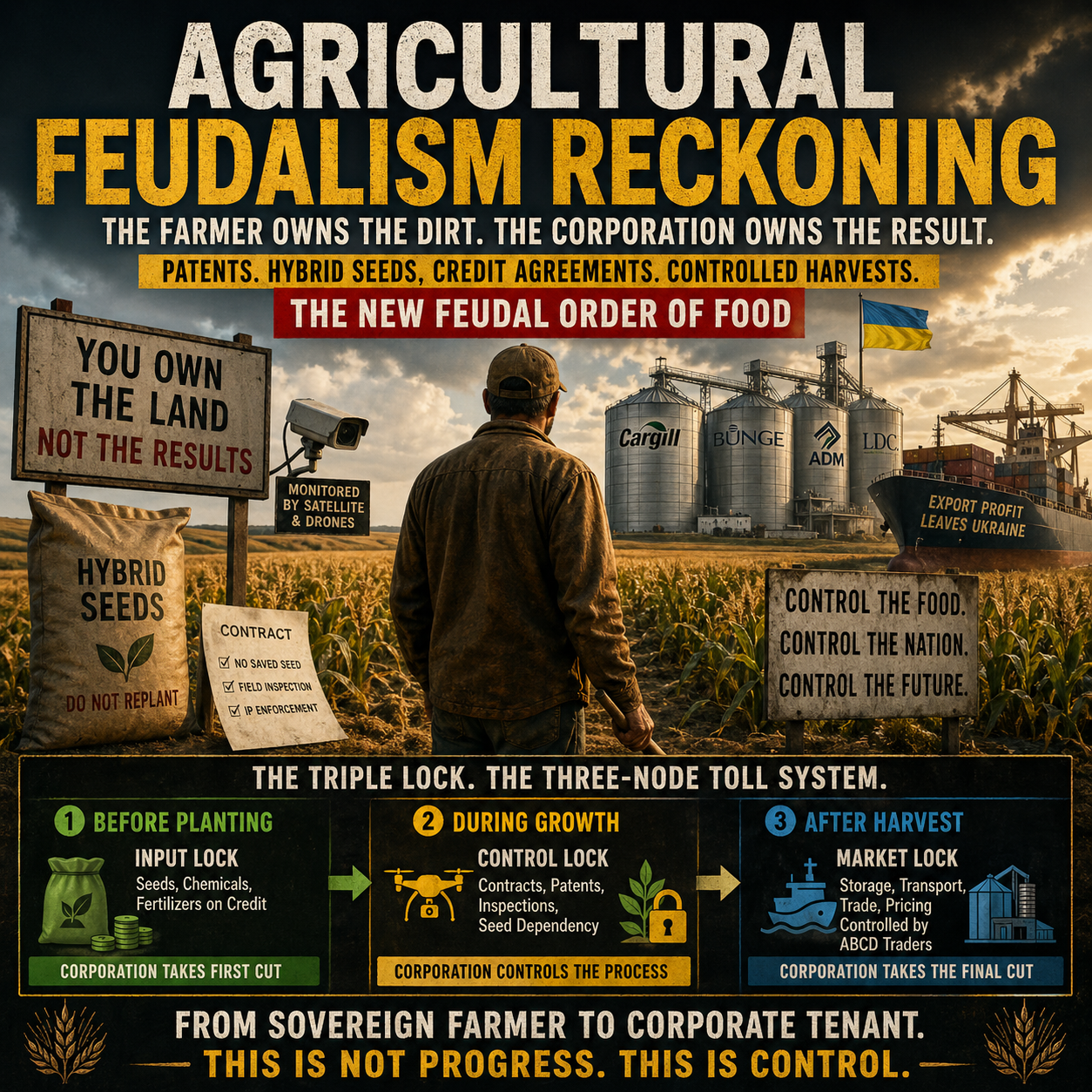
Agricultural Feudalism Reckoning: The farmer owns the dirt. The corporation owns the result. Patents replaced soldiers. The harvest goes the same direction. The agricultural capture documented in Blog 44 does not operate through visible force. It operates through three interlocking control mechanisms — legal, biological, and financial — each of which individually creates dependency, and all three of which together make the dependency irreversible without a sovereign decision to break from the system entirely.
The legal lock — intellectual property and inspection rights.
When a Ukrainian farmer plants Bayer-Monsanto or Corteva seeds, they sign a contract that includes a no-saved-seed clause: the farmer may not retain seeds from the harvest for planting the following season. This is not a custom or an informal practice. It is an enforceable legal agreement backed by the intellectual property architecture of the World Trade Organisation’s TRIPS agreement — the same rules-based international order that the series has documented throughout as the framework Washington both enforces and selectively violates. GRAIN documented that corporations including Bayer retain the legal right to inspect a farmer’s fields — increasingly through satellite monitoring and drone surveillance — to verify that no unauthorised seeds are being grown. The farmer’s land is legally theirs. The farmer’s crop is legally the corporation’s intellectual property until sold. The Agricultural Feudalism Reckoning begins here: sovereignty over the land without sovereignty over what grows on it is not agricultural independence. It is a more sophisticated form of the same arrangement that colonial administrators called a land tenure system.
The biological lock — the hybrid subscription model.
Modern commercial seeds used in Ukrainian agriculture are overwhelmingly F1 hybrids — first-generation crosses that express the desired characteristics of yield and uniformity in their initial planting but lose that vigour if the farmer saves seeds and replants them the following season. This is not a defect. It is a design. The biological architecture of the F1 hybrid converts seed purchasing from a one-time capital investment — as it was for every agricultural civilisation in human history — into an annual subscription. The farmer cannot exit the subscription by saving seeds because the biology of the saved seeds makes exit economically unviable. The Chokehold Industrial Chain argument established how control of a critical supply chain node creates structural leverage over everything downstream. The F1 hybrid seed is that node in the agricultural supply chain — and it was designed to be.
The financial lock — input financing and the harvest percentage.
The Ukraine war has left the majority of Ukrainian farmers cash-poor. Local banking infrastructure was damaged or disrupted. International credit is available — but primarily through input financing arrangements offered by the same corporations that supply the seeds and chemicals. The Kyiv School of Economics documented how Bayer, Corteva, and Cargill offer input financing in which seeds and agrochemicals are supplied upfront against a percentage of the final harvest. The farmer receives the inputs without the cash to pay for them. The corporation receives a percentage of the crop before the farmer has sold a kilogram. The farmer’s land is collateral. The farmer’s labour is the production mechanism. The corporation’s intellectual property and logistics infrastructure capture the margin. This is the Agricultural Feudalism Reckoning’s most precise modern form: the farmer owns the land and provides the labour; the owner of the tools and the transport takes the majority of what the land produces.
📌 How the War Created the Conditions for the Lock
The geopolitical architecture of Ukraine’s agricultural capture — EU policy failure, the 1953 commercial template, and the reconstruction financing conditions that made the triple lock possible at scale.
Agricultural Feudalism Reckoning: The Three-Node Toll System
The Agricultural Feudalism Reckoning’s commercial anatomy is documented with precision across the value chain. The Ukrainian farmer does not lose 70% of their crop’s value in a single visible transaction as presented in blog 44. The extraction happens in three stages, each controlled by a different corporate node, each taking a toll before the farmer receives what remains.
Before planting — up to 30% of final value.
The farmer purchases seeds from Bayer-Monsanto, Corteva, Syngenta, or BASF — the four corporations that Oxfam documented as controlling over 60% of the world’s commercial seed market and approximately 75% of the global agrochemical market. These seeds are designed to work optimally with specific, corporately-owned fertilisers and pesticides — input dependency that is engineered into the seed’s chemistry. The farmer who buys the seed buys the agrochemical programme that the seed requires. The corporation captures value before the first seed enters the ground. Bayer operates the largest seed-processing plant in Ukraine at Pochuiky — and during the war injected over €60 million into expanding the facility, positioning itself as the primary supplier for the post-war agricultural recovery before that recovery had begun.
During growth — up to 10% of final value.
Input financing interest accumulates through the growing season. Where the farmer has accessed seeds and chemicals through corporate credit arrangements, the interest payments begin immediately. Where the farmer has accessed international reconstruction aid, the aid frequently came in the form of vouchers redeemable only for certified — meaning patented, meaning corporately-controlled — seeds, locking the farmer into the input supply chain through the aid architecture itself. ReliefWeb documented that international aid seed voucher programmes in Ukraine disproportionately benefited Western corporate seed suppliers rather than rebuilding local Ukrainian seed production capacity.
After harvest — up to 30% or more of final value.
The grain reaches harvest. The farmer must store it, transport it, and sell it. Local Ukrainian grain storage infrastructure — silos, small ports, cooperative logistics networks — was heavily damaged during the war and has been only partially rebuilt. The corporations with the infrastructure to move grain — Cargill, ADM, Bunge, and Louis Dreyfus, collectively known in the industry as the ABCD traders — control significant storage terminals, export logistics, and influence over pricing mechanisms for Ukrainian agricultural exports. The Oakland Institute has documented how Cargill and Bunge (among others) have acquired major grain terminal and storage capacity at Ukrainian Black Sea ports — the critical export infrastructure through which Ukrainian agricultural production reaches global markets. The corporation that controls the terminal sets the terms on which the farmer can export. In a crisis, as the war demonstrated, the person with the keys to the gate makes more money than the person who grew the food.
The Hormuz toll booth the series documented — Iran capturing a percentage of every barrel that passes through its territorial waters — is the same architecture. Cargill’s grain terminal is a toll booth. The difference is that one is called extortion and the other is called logistics. The difference is that one is called extortion and the other is called logistics. The background is traceable to Americans—whether government or corporate—engaged in the control and extraction of resources from around the world.
The net result across all three nodes: Kyiv School of Economics data confirmed that while Ukrainian agricultural export volumes recovered and nominal profits rose, the real value retained by Ukrainian farmers fell — compressed by seed costs, input financing, and grain trading margins that left approximately 30% of the total value generated in Ukraine. Over 80% of Ukrainian corn and maize is now planted with Western-patented hybrid seeds. Nearly 100% of large-scale industrial farms are bound by IP contracts. The Agricultural Feudalism Reckoning’s verdict on this arithmetic is precise: this is not agricultural recovery. It is agricultural tenancy at continental scale.
📌 The Same Architecture Applied to Energy
Washington destroyed cheap Russian pipeline gas, then offered American LNG at a 50-90% premium. The EU Energy Umbrella Reckoning — the energy version of the same toll system.
The Agricultural Feudalism Reckoning’s closing argument is historical and structural simultaneously. Every agricultural empire in history has understood that controlling the food supply is more durable than controlling the military. The Mughal revenue system, the British zamindari, the colonial plantation economy — all operated on the same principle: the cultivator owns the labour, the state or corporation owns the productive infrastructure, and the surplus flows upward through the ownership of critical nodes rather than through the ownership of the land itself. What has changed in the Ukrainian case is the instrument of control.
The zamindari needed administrators and tax collectors. The Agricultural Feudalism Reckoning needs a patent, an F1 seed, and a grain terminal. The New Colonial Enforcement does not require occupation. It requires that the farmer have no viable alternative to the corporation’s terms — and the war ensured that the alternatives that previously existed were destroyed before the reconstruction financing arrived to replace them on corporate terms. The farmer owns the dirt. The corporation owns the result. The Agricultural Feudalism Reckoning is the name for this cross-continental arrangement.
Whether it is a British petroleum executive in Abadan in 1950 or a Cargill logistics director in Mykolaiv in 2026, the objective is the same: the extraction of sovereign wealth through the control of a “Chokehold Industrial Chain.” The theater changes—from the desert to the farm—but the script of the Endless War remains written in the same corporate ink. What is new is that it is now enforced not by soldiers but by the intellectual property framework of the rules-based international order that Washington both champions and selectively violates — and that Europe, having surrendered its independent foreign policy, cannot challenge.
Next: China Oil Revenge — Blog 46 in West Asia’s Endless War examines China’s position in the conflict: not passive like Russia but active in a calculated direction. China’s oil continued flowing through Hormuz under Iranian authorisation while American-allied shipping was blocked. But the deeper structural argument is this — the EU’s loss of energy sovereignty (Blog 43), agricultural sovereignty (Blog 44), and market independence (Blog 45) is the commercial context that makes China’s alternative order more credible to more governments every week. Part of the West Asia’s Endless War Series on hinduinfopedia.com.
Feature Image: Click here to view the image.
Videos
[…] भारत / GB […]
[…] ended, African energy emerged, Russia collected its dividend, European energy was captured, Ukrainian agriculture was feudalised. Blog 46 asks the question the series has been building toward: what single design produced all of […]
[…] https://hinduinfopedia.com/agricultural-feudalism-reckoning-a-reckoning-of-west-asias-endless-war-45… […]