

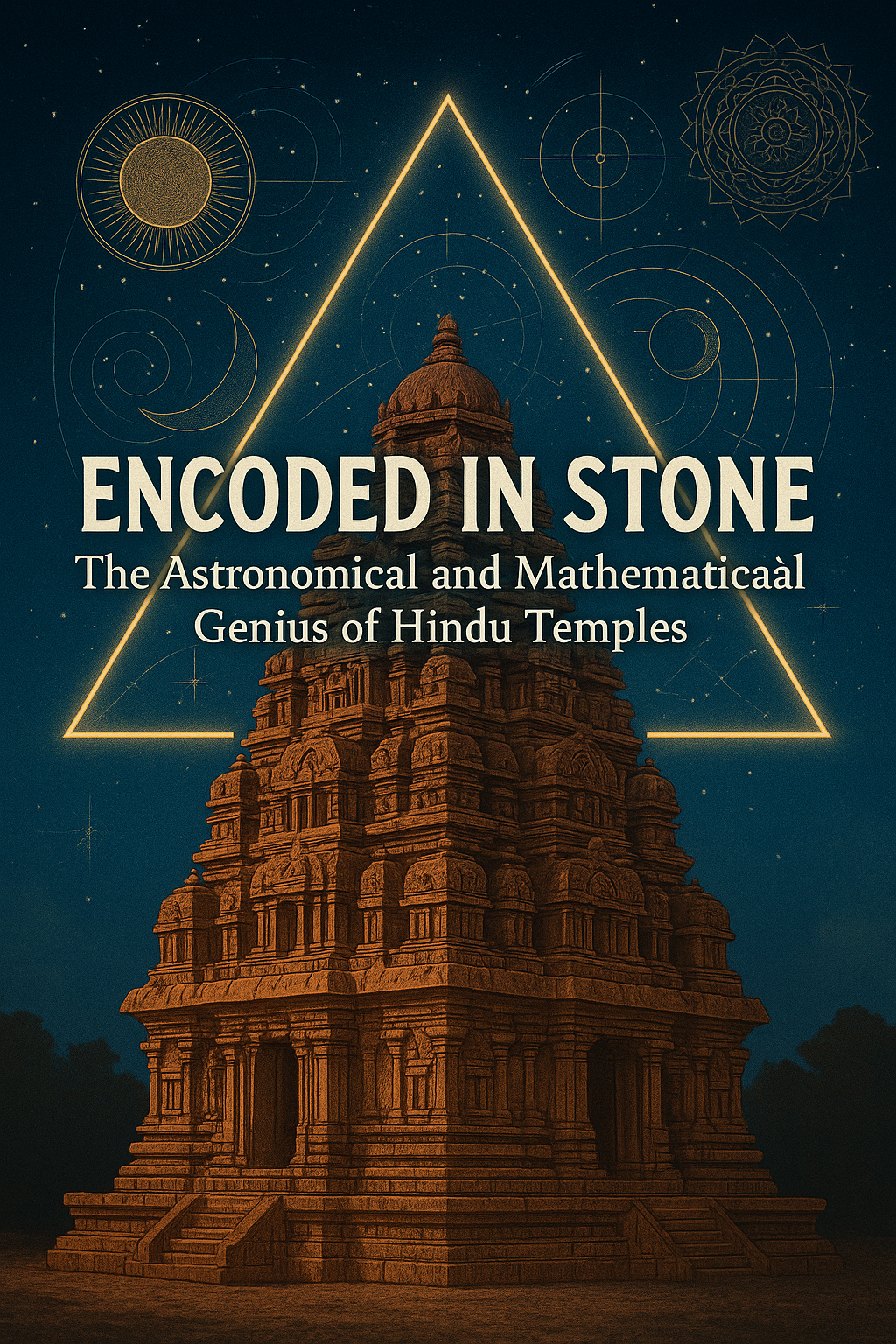
Encoded in Stone: The Astronomical and Mathematical Genius of Hindu Temples
Sacred Geometry, Sidereal Science, and Celestial Coding — Not a Myth
Encoded in Stone: When Temples Were Timekeepers
Encoded with cosmic logic and sacred geometry, Hindu temples across the Indian subcontinent stand not merely as spiritual sanctuaries, but as monumental testaments to advanced knowledge systems in astronomy, mathematics, and timekeeping. Their alignment with solstices, lunar phases, and cardinal directions was no accident — it was a result of precise Shastric design.
Yet much of this encoded intelligence has been forgotten, dismissed as myth, or left yet to be decoded. This blog uncovers how Hindu temples functioned as living observatories, why this knowledge was lost, and how modern science is finally beginning to rediscover what was once encoded in stone.
Historical Context: How Hindu Knowledge Was Encoded in Stone
This scientific vision didn’t emerge in isolation—it was rooted in scriptural texts and tradition, carried through generations through guru shishya parampara and flourished during specific historical periods.
The knowledge that underpins temple construction draws from Vedic and post-Vedic periods, particularly texts like:
- Vedanga Jyotisha (1200–600 BCE) – the earliest known Hindu astronomical treatise.
- Sulba Sutras (800–300 BCE) – geometric rules for altar design, including square root approximations and principles akin to the Pythagorean theorem.
- Agama and Shilpa Shastra traditions (1st–8th century CE) – codified temple measurements, proportions, and astrological alignments.
The Golden Age of temple construction (7th–13th century CE) under dynasties like the Cholas, Pallavas, and Hoysalas saw this knowledge fully manifested in granite and bronze. These traditions declined after the 13th century, primarily due to Islamic invasions, temple destruction, and ruler-imposed constraints that deliberately curtailed Hindu kings from funding or building temples — leading to a systematic erosion of temple sciences.
The erosion of temple sciences didn’t end with invasions. Under British colonial rule, the cultural foundations of Hindu knowledge systems were systematically dismantled. Vedic astronomy, mathematics, and cosmology were reclassified as mythology, stripped of scientific legitimacy, and removed from formal education. Temples — once seen as encoded instruments of cosmic order — were recast as ornamental oddities or relics of superstition. Colonial ethnographers and missionary schools imposed Eurocentric chronologies, mocked shastric wisdom, and severed the guru–shishya transmission line that had sustained Hindu knowledge for centuries. The result was a rupture so deep that its tremors are still felt today — in public perception, academic discourse, and cultural confidence. Only now, with renewed scholarship and decolonial research, is the scientific genius behind these sacred structures being rediscovered and respected.
Encoded in Stone: Sacred Geometry and Celestial Logic
This legacy took physical form through astonishing architectural decisions that aligned temples with the cosmos which is reflected in the following paras.
Temples were designed as mandalas on earth, using grids that aligned the devotee with the cosmos. A few examples:
Chidambaram Nataraja Temple
- The five halls represent Pancha Mahabhuta (five elements).
- The central sanctum aligns with the sky element (Akasha) and is kept empty — symbolizing pure consciousness and astronomical void.
Brihadeeswarar Temple
- Its vimana (tower) casts no shadow at noon, due to perfect alignment with latitude and sun angle.
- Contains murals referencing planetary deities and lunar phases, indicating active astronomical tracking.
Konark Sun Temple
- Its 24 wheels represent the hours of the day.
- Each wheel is a functional sundial, with spokes calibrated to cast shadows indicating time.
Techniques and Tools of the Ancients
As reflected in this section, these temples weren’t accidents of artistry—they were constructed using precise tools, units, and methods drawn from advanced knowledge systems.
This knowledge wasn’t mystical guesswork — it was systematic and measurable:
- Units of measurement: Angula (finger width), Hasta (forearm), and Danda were used consistently across temple construction.
- Geometric tools: Plumb lines, cords, measuring rods, and gnomons (shadow sticks) helped define true north, equinox points, and temple orientation.
- Mathematics: The Sulba Sutras describe construction of squares, circles, and rectangles with equal area — geometry vital for temple foundations and altars.
These tools formed the basis for aligning temples with solar paths, lunar cycles, and zodiacal transitions — long before the invention of telescopes.
Cosmic Dance and Interpretative Possibilities
The Nataraja image offers more than devotional symbolism—it hints at deeper conceptions of motion, rhythm, and energy cycles of the universe.
A commonly discussed curiosity is the speed of light analogy associated with Shiva’s Nataraja dance. Some modern thinkers observe that the circular rhythm of the dance pose and associated numerology bear symbolic similarity to values near the speed of light (~299,792 km/s). However:
This is an interpretive insight, not a direct scientific derivation. No ancient Hindu text explicitly states this constant numerically.
That said, the deeper meaning remains: ancient Hindus perceived vibration, frequency, and cyclical motion — all foundational to modern physics — as divine principles, encoded in art, dance, and ritual.
Sidereal Calendars and Ritual Synchronization Encoded in Stone
Temple timekeeping wasn’t just symbolic—it was functional, designed to synchronize rituals with the universe’s natural rhythms.
Many temples were ritually synchronized with astronomical events:
- Festivals occur on days when sunlight enters sanctums through strategic openings (e.g., Srirangam during equinox).
- Temple bells and rituals were performed at calculated times to match planetary and lunar positions, guided by Panchang (Vedic calendar).
Even tithis (lunar days), rashis (zodiac signs), and muhurtas (auspicious timings) were embedded in temple routines, showing how astronomy was inseparable from dharma.
Modern Rediscoveries of Knowledge Encoded in Stone
What was once dismissed as religious myth is now attracting serious scientific interest and institutional research.
While long ignored by mainstream academia, modern studies are re-evaluating temple science:
- IIT Kharagpur researchers analyzed the Konark Sun Temple as an ancient timekeeping device and published findings on its sundial precision.
- IIT Bombay and ASI studies on temple acoustics and thermal flow in South Indian temples show that mandapas were optimized for sound resonance without amplification.
- Archaeoastronomy conferences globally now feature papers on Hindu temple alignments, comparing them with structures like Stonehenge, the Great Pyramid, and Mayan observatories.
Compared to these, Hindu temples uniquely integrate ritual, cosmology, acoustics, timekeeping, and metaphysical design — all in one.
Comparative Insight: How Hindu Temples Stand Apart
Here is a brief snapshot of comparative insight of Hindu temples
Konark Sun Temple (Hindu, India)
- Function: Solar observatory
- Key Features: 24 sundial wheels representing hours; planetary deities sculpted into the structure
Stonehenge (Celtic, UK)
- Function: Solstice marker
- Key Features: Aligned with summer and winter solstice sunrise/sunset positions
El Caracol, Chichen Itza (Mayan, Mexico)
- Function: Venus tracking observatory
- Key Features: Strategic windows aligned to Venus cycles and equinox sunsets
Great Pyramid of Giza (Egyptian, Egypt)
- Function: Funerary monument with astronomical elements
- Key Features: Aligned with Orion’s Belt and exhibits precise latitude placement
Hindu temples differ by integrating continuous public use, ritual utility, symbolic cosmology, and encoded mathematics — not just observation or burial.
Encoded in Stone: How Hindu Temples Outclass Global Monuments
Across civilizations, monumental structures have served as more than just symbols of power or faith — they often aligned with celestial events, encoded philosophical ideas, or displayed numeric symbolism. But Hindu temples go far beyond these isolated functions. They offer a multi-domain synthesis of science, spirituality, art, and ritual utility — an integration not seen in any other ancient monument.
Comparative Narrative: Scientific Precision Encoded in Hindu Temples vs. Global Monuments
To appreciate the uniqueness of Hindu temples, we must compare them with other ancient structures that also sought celestial alignment.
Hindu temples like Chidambaram, Konark, and Brihadeeswarar stand apart when compared with global wonders such as Stonehenge (UK), El Caracol (Mayan), and the Great Pyramid (Egypt). Here’s how they excel on multiple fronts:
- Solar Alignment:
Hindu temples are aligned with equinoxes and solstices and often direct sunlight into inner sanctums (e.g., Srirangam during equinox).
– By comparison, Stonehenge marks solstices, El Caracol tracks equinox sunsets, and the Great Pyramid aligns roughly with Orion and solar paths. - Lunar Tracking:
Temples encode tithi, nakshatra, and paksha in rituals (e.g., lunar phase murals in Brihadeeswarar).
– By contrast, Stonehenge and the Pyramid show no lunar calibration, and El Caracol has limited Venus/lunar tracking. - Mathematical Proportions:
Hindu temples use Vastu Purusha Mandala, Sulba Sutra ratios, and Shilpa Shastra formulas for structural geometry.
– Stonehenge lacks defined ratios; El Caracol is limited; Pyramid proportions (Pi and Golden Ratio) remain speculative. - Sundial and Timekeeping:
The Konark Sun Temple features 24 chariot wheels, each functioning as a precise sundial.
– No such functional clocks exist in the other monuments. - Ritual Synchronization:
Hindu temples time daily and seasonal rituals with astronomical events (e.g., Madurai Meenakshi during celestial festivals).
– Other monuments serve observational purposes without ritual synchronization. - Multi-Disciplinary Integration:
Temples combine astronomy, acoustics, ritual, cosmology, and architecture.
– Stonehenge is purely observational, El Caracol mostly astronomical, and the Pyramid is funerary. - Public Utility:
Hindu temples are still active for worship, festivals, and cosmic timekeeping.
– The others are archaeological relics with no contemporary use. - Sound & Resonance Engineering:
Temples like Madurai Meenakshi have resonance chambers optimized for mantra chanting (validated by ASI studies).
– Absent in the other monuments. - Encoded Cosmology:
Temples mirror chakra systems, Pancha Mahabhuta, and cosmic cycles.
– Others reflect symbolic or funerary cosmologies but lack metaphysical encoding. - Sustainability:
Hindu temples have stood for over 1,000 years and remain structurally and functionally intact.
– While durable, other monuments are no longer in ritual or cultural use.
Why Knowledge Encoded in Stone Makes Hindu Temples Scientifically Superior
The reasons temples stand apart aren’t incidental—they stem from multidimensional design principles rarely seen elsewhere.
Multi-Layered Design Purpose
Most ancient structures served a single domain — such as burial, solar tracking, or ritual. In contrast, Hindu temples track time using sundials and lunar phases, sync with celestial events, reflect yogic and elemental systems, and serve as spiritual, educational, and social gathering hubs. They are living, integrated systems — not static artifacts.
Shastric Precision Over Visual Grandeur
Temples were not designed merely to impress the eye but to align with natural, spiritual, and mathematical laws, based on Shilpa Shastra, Sulba Sutras, and Agama texts. This internal coherence created buildings that are aesthetic, cosmic, and functional.
Functional Sustainability
Where most global wonders are now archaeological sites, Hindu temples are in daily use, embedded in community rhythm, and continuously transmitting cultural memory. They are structures that live, not just endure.
Unique Elements Encoded in Stone: Only Found in Hindu Temples
These exclusive features reflect the synthesis of science, spirituality, and societal design embedded within temple architecture
Special Features Found Only in Hindu Temples
Hindu temples, like those at Chidambaram, Konark, and Brihadeeswarar, have unique elements that combine science, spirituality, and daily life in ways no other ancient structures do:
- Tithi-Based Ritual Planning:
Architecture and rituals are aligned with lunar tithis, enabling priests to conduct ceremonies in sync with the moon’s cycle. - Vastu-Aligned Energy Fields:
Floor plans follow Vastu Shastra, creating balanced energy fields through orientation, sacred geometry, and mandala design. - Prana Pratishtha (Energetic Activation):
Consecration rituals transform the temple into a living energy field, a concept now loosely paralleled in modern resonance field studies. - Integration with Ayurvedic and Cosmological Cycles:
Temple festivals align with seasonal, solar, and lunar transitions, and food practices reflect Ayurvedic and satvik principles. - 108 Symbolic Mathematics:
Temples encode sacred numbers such as:
108 Symbolic Mathematics: Temples encode sacred numbers like 108 (used in prayer beads and step counts) and 21,600 (Chidambaram’s gold tiles matching daily breaths), reflecting cosmic and biological cycles per Vedic numerology, with modern resonance studies (e.g., IIT Madras research) exploring these patterns.
While Stonehenge marks a moment in the sun’s cycle, and the Pyramids align with stars, Hindu temples encode time, space, sound, life, rasa, and liberation into living architecture — proof that this is not a myth. They are not just aligned with nature, but integrated with it, using science as a pathway to dharma and moksha.
What Being Encoded in Stone Truly Means
In their silence, these stones speak volumes—if only we decode what was intentionally preserved across millennia.
Hindu temples are not static monuments — they are cosmic blueprints, living laboratories of a civilization that saw divinity not in abstraction, but in precision. Their builders were not mere sculptors — they were astronomer-mathematicians, embedding vast knowledge systems into every angle and axis.
What modern science decodes with satellites and computers, they achieved through shastra, mantra, and chisel. Their genius is not lost — only hidden — waiting to be rediscovered, studied, and restored.
📣 Call to Action: Decode, Share, Reclaim
The rediscovery of Hindu temple science is not just an academic exercise — it’s a civilizational imperative.
Visit a temple not as a tourist, but as a seeker of truth encoded in stone. Observe the shadows, the alignments, the numbers carved into steps and wheels. Reconnect with a legacy where architecture was astronomy, ritual was rhythm, and stone was scripture.
Document what you uncover. Share your insights with others. Support research that validates what tradition never forgot.
Because these are not abandoned ruins — they are living equations of dharma, time, and cosmic harmony. Every pillar, every mandala, every chant still holds meaning — and it’s time we listen.
Discover the entire “not-a-myth” series to learn fascinating facts about Hinduism, its traditions and culture and Hindu texts.
Feature Image: Click here to view the image.
Videos:
Glossary of Terms
- Agama Shastra: Ancient Hindu scriptures detailing temple construction, rituals, and iconography, forming the spiritual and architectural blueprint for temple design.
- Angula: A traditional unit of measurement in ancient India, roughly equal to the width of a finger (about 0.75 inches), used in temple architecture.
- Hasta: Another traditional unit of length, approximately the length of a forearm (~18 inches), commonly used in shilpa (craft) and vastu design.
- Danda: A linear measure used in ancient Indian construction, equal to 96 angulas (roughly 6 feet), often used in temple layout planning.
- Sulba Sutras: Vedic-era texts (800–300 BCE) containing mathematical principles and geometric instructions for constructing sacrificial altars and temple layouts.
- Vastu Purusha Mandala: A sacred geometric grid used in Hindu temple architecture to align the temple structure with cosmic energies and cardinal directions.
- Vedanga Jyotisha: One of the earliest known texts on Indian astronomy (circa 1200–600 BCE), guiding calendrical and ritual timings in Vedic practices.
- Tithi: A lunar day in the Hindu calendar, used to determine auspicious timings for rituals and temple festivals.
- Nakshatra: One of the 27 (sometimes 28) lunar mansions or constellations in Hindu astronomy, critical in determining ritual and astrological timing.
- Paksha: A fortnight in the lunar calendar, divided into Shukla Paksha (waxing moon) and Krishna Paksha (waning moon), used to time rituals.
- Rashi: A zodiac sign in Vedic astrology; there are 12 rashis corresponding to 12 sectors of the ecliptic.
- Muhurat: An auspicious time chosen for performing religious rituals or ceremonies, often calculated using Panchang (Hindu almanac).
- Panchang: The traditional Hindu calendar that includes five elements—tithi, vaar (weekday), nakshatra, yoga, and karana—used for selecting ritual timings.
- Shilpa Shastra: A collection of Sanskrit texts that codify principles of art, sculpture, and architecture, particularly for temple building.
- Mandala: A geometric design representing the universe in Hindu and Buddhist symbolism, often used as a floor plan in temple architecture.
- Prana Pratishtha: A Vedic ritual in which divine energy is ceremonially infused into a temple idol or structure, turning it into a spiritually active entity.
- Pancha Mahabhuta: The five fundamental elements—Earth (Prithvi), Water (Apas), Fire (Agni), Air (Vayu), and Space (Akasha)—that form the basis of all creation in Hindu cosmology.
- Akasha: The element of ether or space, considered the subtlest of the five elements in Hindu cosmology; symbolized in temples by open sanctums or voids.
- Nataraja: A depiction of Lord Shiva as the cosmic dancer, symbolizing the rhythmic cycles of creation and destruction in the universe.
- Equinox: An astronomical event occurring twice a year when day and night are approximately equal, used in temple alignment to direct sunlight into sanctums.
- Sidereal Calendar: A calendar system based on the position of fixed stars rather than the sun, used in Hindu astronomy to track time with greater celestial accuracy.
- Archaeoastronomy: A modern interdisciplinary field studying how ancient cultures understood and incorporated astronomy into their architecture, especially relevant in analyzing temple alignments.
- Yogic Chakras: Energy centers in the subtle body according to yogic philosophy, often mirrored in temple architecture and mandala layouts.
- Satvik: A quality or dietary principle in Ayurveda characterized by purity, balance, and harmony, often promoted through temple food offerings.
- 108 (Sacred Number): A highly significant number in Hindu cosmology and mathematics, representing wholeness and used in prayer beads (japa mala), steps, and measurements.
- 21,600 (Breaths in a Day): A Vedic numerological concept referring to the total number of breaths taken by an average human in one day, encoded into temple symbolism (e.g., tiles, patterns).
- Resonance Chambers: Architectural features in temples (e.g., Madurai Meenakshi) designed to enhance acoustic properties, allowing mantras to reverberate harmonically.
- Gnomon: A vertical stick or rod used in ancient astronomy to cast shadows and measure time and solar angles, used in temple sundial design.
- Orion Alignment: Refers to the alignment of structures (e.g., Great Pyramid of Giza) with the stars in Orion’s Belt—a practice echoed in temple star alignments.
- Mantra: A sacred sound or syllable believed to have spiritual power, often chanted in temples; architectural acoustics were designed to amplify their effect.
#EncodedInStone #TempleScience #VedicMath #SacredGeometry #HinduinfoPedia
References
Temple Science & Archaeological Studies
1. IIT Bhubaneswar: Iron Beams of Konark Sun Temple
Research by IIT Bhubaneswar, under IKS funding, shows that the 13th-century iron beams used in the Konark Sun Temple exhibit corrosion resistance nearly 100× better than modern steel — insights published via Times of India and confirmed by New Indian Express .
2. IIT Kharagpur: Geological Study of Temple Collapse
A study published in the Journal of Earth Science System by IIT Kharagpur suggests neotectonic activity, not mere construction flaws, may have been responsible for the collapse of Konark’s main tower .
Acoustic Engineering in South Indian Temples
3. ASI-Supported Study: Madurai Meenakshi Temple Acoustics
Both audiology experts (1983) and modern ASI research found that the Thousand Pillar Hall maintains no echo even at ~80 dB crowd noise — showing extraordinary acoustic design .
Astronomical Encoding & Geometry
4. Vedic Mathematics & Konark Sundial
As detailed by Hinduinfopedia and supported in research journals, the 24 wheels of Konark act as functional sundials, reflecting Vedic mathematical precision .
5. Subhash Kak, “The Axis and the Perimeter of the Temple” (2009)
Provides textual and architectural evidence for astronomical orientation and proportions underlying temple layouts, authored by noted archaeoastronomer Subhash Kak.
Previous Blogs on of the Series
- https://hinduinfopedia.com/cosmic-seed-of-universe/
- https://hinduinfopedia.com/bhagwan-varaha-and-his-tusks/
- https://hinduinfopedia.com/surya-siddhanta-astronomical-truth-of-rahus-bite/
- https://hinduinfopedia.com/vedic-astronomy-and-basic-concepts/
- https://hinduinfopedia.com/solar-eclipse-insights-from-hindu-texts/
- https://hinduinfopedia.com/astronomy-in-surya-siddhanta/
- https://hinduinfopedia.com/science-of-vedic-astronomy/
- https://hinduinfopedia.com/hindu-wisdom-in-yagna-fire-real-not-myth/
- https://hinduinfopedia.com/hindu-wisdom-in-ritual-and-food/
- https://hinduinfopedia.com/hindu-wisdom-in-surgery-sushruta-blades-are-rea/
- https://hinduinfopedia.com/surgeon-sushrutas-pioneering-procedures/
- https://hinduinfopedia.com/surgeon-sushrutas-scalpel-unveiled/
- https://hinduinfopedia.com/metal-mastery-hindu-zinc-science-not-myth/
- https://hinduinfopedia.com/hygiene-in-hindu-texts/
- https://hinduinfopedia.com/vegetarian-diet-of-hindu-wisdom/
- https://hinduinfopedia.com/vegan-food-and-hindu-wisdom/
- https://hinduinfopedia.com/varna-system-hindu-merit-not-myth/
- https://hinduinfopedia.com/gurukul-truths-of-hindu-wisdom/
- https://hinduinfopedia.com/science-hub-rituals-vedic-truths-unveiled/
- https://hinduinfopedia.com/genetic-testing-in-ancient-gotra-system/
- https://hinduinfopedia.com/peace-in-sanatana/
- https://hinduinfopedia.com/aryabhata-and-mathematical-astronomy-not-myth/
- https://hinduinfopedia.com/bhaskara-i-refining-vedic-mathematics-not-myth/
- https://hinduinfopedia.com/bhaskara-ii-algebra-to-gravity-not-myth/
- https://hinduinfopedia.com/shankaracharyas-vedic-mathematics-practical-applications/
- https://hinduinfopedia.com/raman-effect-unveiling-vedic-sciences-light/
- https://hinduinfopedia.com/hindu-calendar-scientific-timekeeping-not-a-myth/
- https://hinduinfopedia.com/hindu-calendar-traditions-timekeeping-in-ramayana-mahabharata/
- https://hinduinfopedia.com/vimana-shastra-ancient-hindu-aeronautics-unveiled/
- https://hinduinfopedia.com/108-meaning-ancient-hindu-science-not-a-myth/
- https://hinduinfopedia.com/genetic-vedic-lineage-wisdom-your-spiritual-dna-not-myth/
- https://hinduinfopedia.com/hindu-texts-and-the-shastras-a-scientific-legacy-not-a-myth/
Link for Next Related Blog
[…] Read the full story at: https://hinduinfopedia.com/encoded-in-stone-the-astronomical-and-mathematical-genius-of-hindu-temple… […]
[…] — whether in Hindu Wisdom in Yajna Fire where fire becomes a channel of cosmic order, or in Encoded in Stone where temples themselves were designed as resonant fields of […]
[…] Read more… […]
[…] The Mughal Empire receives dedicated chapters across multiple grades. Chola maritime power, Vijayanagara’s brilliance, Rashtrakuta and Chalukya contributions spanning centuries — compressed into passing mentions or […]
На сайті [url=https://qpoaswap.space/]qpoaswap.space[/url] ви знайдете цікаву інформацію, публікації та інтуїтивний інтерфейс. Тут зібрано все, що стане в нагоді активним користувачам: від публікацій до рекомендацій. Перейдіть та оцініть в його якості на власні очі!
[…] https://hinduinfopedia.com/encoded-in-stone-the-astronomical-and-mathematical-genius-of-hindu-temple… […]