

Palestine: The Elimination Doctrine’s Invoice: A Reckoning of West Asia’s Endless War (72)
Part 72 of the West Asia’s Endless War Series on hinduinfopedia.com
भारत / GB
The Elimination Doctrine Did Not Recover Territory. It Generated the Territory It Claimed to Recover. Each Application of the Doctrine Presented an Invoice That Israel Settled in the Only Currency Available — Territorial Consolidation. The Doctrine Is the Occupation’s Author. Not Israel.
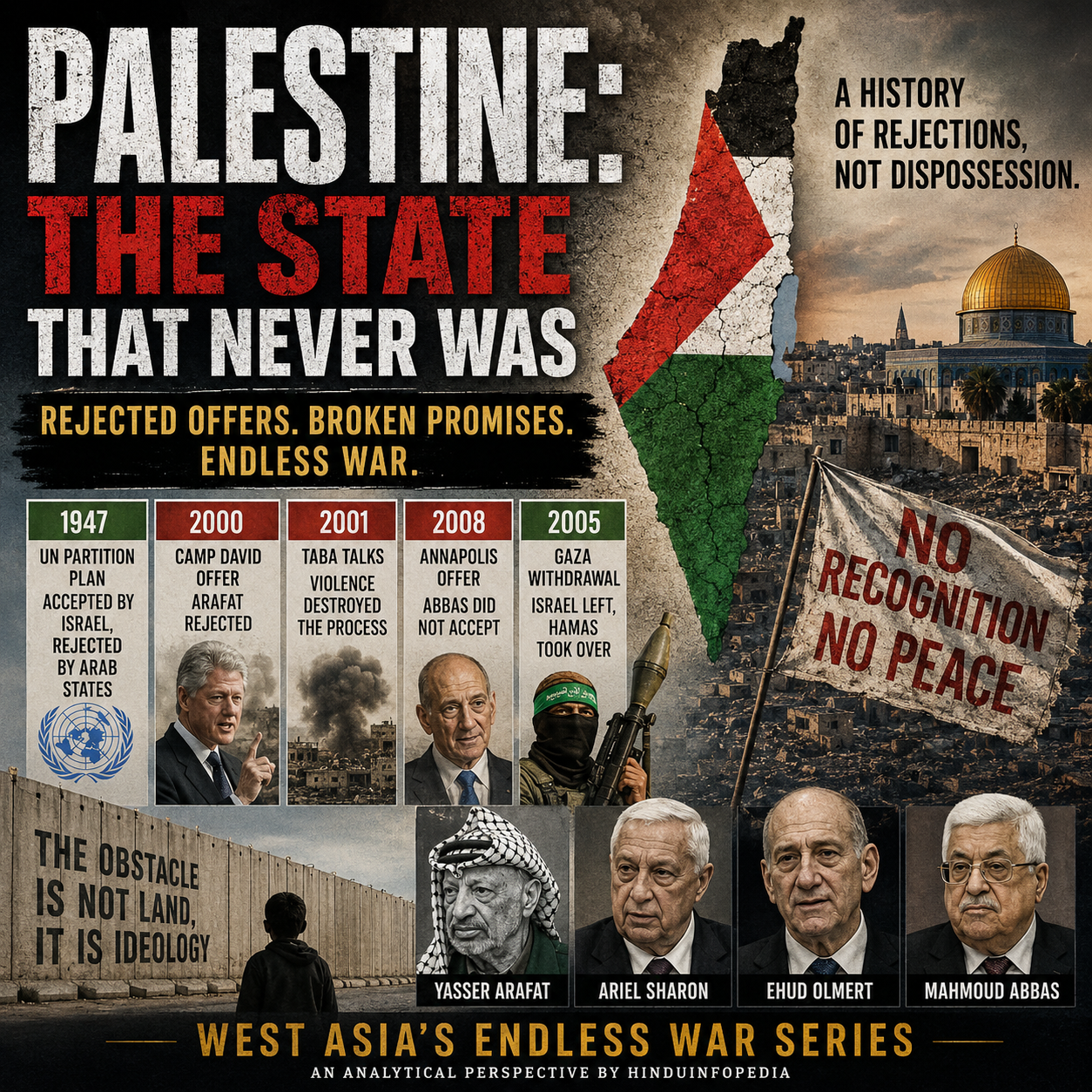
Blog 71 (Palestine: The State That Was Never Born) established that a Palestinian state was formally offered three times through negotiation and rejected each time — the obstacle not Israeli refusal but Palestinian leadership’s unwillingness to accept the one condition any two-state solution requires: acknowledgment of Israel’s permanent existence. Blog 72 examines the military dimension of the same pattern: what each Arab attempt to eliminate Israel through force has produced territorially, and how the cumulative invoice of the elimination doctrine has created the occupation that the doctrine itself claims to oppose.
Elimination Doctrine’s Invoice: The Cumulative Account
Palestine: The Elimination Doctrine’s Invoice: Each Arab military attempt to eliminate Israel produced a larger Israel. The invoice accumulates with each application. The doctrine did not recover territory from Israel. It generated the territory it claimed to recover. The occupation’s author is the elimination doctrine itself, not Israel. The accounting begins in 1947 — before the first shot was fired. UN General Assembly Resolution 181 proposed the creation of a Jewish state on approximately 56% of the British Mandate territory — predominantly the Negev desert, arid and agriculturally marginal — and an Arab state on 43%, including the more fertile West Bank highlands and Gaza. The Jewish state accepted. The Arab states rejected — and announced military force would be used to prevent implementation.
1948 — The First Entry
The rejection and the force it produced are the Elimination Doctrine’s Invoice’s first entry: Arab states rejected a Jewish state on 56% of the territory. The war they launched to prevent it produced a Jewish state with armistice lines that in several areas exceeded the Resolution 181 allocation. The elimination attempt did not prevent the Jewish state. It produced a larger and more militarily consolidated Jewish state than the diplomatic proposal alone would have created. The invoice’s first line: attempt to eliminate, receive a more extensive state in exchange.
The pattern repeated precisely across every subsequent military application:
1967 — The invoice’s largest single entry
Egypt massed 100,000 troops on Israel’s border, expelled UN peacekeeping forces, closed the Straits of Tiran, and entered a military alliance with Jordan and Syria. Nasser declared the objective was Israel’s destruction. Israel struck first on June 5. Six days later it occupied the Sinai Peninsula, the West Bank, Gaza, and the Golan Heights — territory approximately three times the size of pre-war Israel. The Arab states launched a war to eliminate a state on 56% of the original territory. They received an Israeli state on three times that territory in exchange. The Elimination Doctrine’s Invoice second entry is its largest: one elimination attempt, territory tripled.
1973 — The invoice’s ambiguous entry
Egypt and Syria launched a coordinated surprise attack on Yom Kippur — the Jewish holy day — catching Israel militarily unprepared. Initial Arab military gains were reversed within days as Israeli forces crossed the Suez Canal and encircled Egypt’s Third Army. The war’s outcome was militarily inconclusive — Israel sustained significant losses — but strategically confirmatory: a surprise attack on two fronts failed to eliminate or significantly reduce Israel’s territorial position. Some territorial gains by Israel and The Sinai’s eventual return to Egypt through Camp David came not from military pressure but from Egyptian President Sadat’s strategic decision to recognise Israel — the precise instrument that the elimination doctrine consistently refuses to deploy. The invoice’s third entry: surprise attack on two fronts, territory unchanged, Sinai recovered only through the recognition the elimination doctrine opposes.
2000-2005 — The invoice’s internal entry
The Second Intifada — launched after Arafat’s rejection of Camp David 2000 as Blog 71 documented — produced the Israeli security barrier, the expansion of settlement infrastructure in the West Bank, and the hardening of Israeli political opinion against further territorial concession. The elimination doctrine’s internal expression — suicide bombings, rocket attacks, civilian targeting — did not recover territory. It produced the physical infrastructure of the occupation’s most visible expression: the barrier that the International Court of Justice ruled illegal and that Israel built because the alternative was absorbing mass civilian casualties indefinitely. The Second Intifada killed over 1,000 Israeli civilians and produced a security architecture more extensive than anything that preceded it. The invoice’s fourth entry: mass civilian targeting, receive permanent security infrastructure in exchange.
📌 The State That Was Never Born Through These Wars
Three formal offers of a Palestinian state rejected — each requiring the one acknowledgment the elimination doctrine refuses. The negotiated dimension of the same pattern the Elimination Doctrine’s Invoice documents through military force.
Elimination Doctrine’s Invoice: The 2023 Entry and the Raktbeej Mechanism
The Elimination Doctrine’s Invoice’s most recent entry is October 7 2023 — and it is simultaneously the doctrine’s most operationally sophisticated application and its most self-defeating territorial consequence. Hamas’s October 7 attack killed approximately 1,200 Israelis and took 251 hostages — the largest single-day killing of Jewish people since the Holocaust. It was planned over years, executed with operational precision, and launched from Gaza — the territory Israel had completely evacuated in 2005, as Blog 71 documented, giving the Palestinian Authority complete control over infrastructure that was subsequently converted into military capability rather than state-building capacity.
The October 7 attack was enabled by Iranian weapons technology, tunnel infrastructure built over fifteen years, and rocket manufacturing capability supplied through the same proxy architecture that Blog 64 (Iran’s Revolutionary Doctrine) documented. The attack was designed within the Raktbeej mechanism that Blog 69 (Palestine Cause or Instrument) established: the theological architecture that converts martyrdom into the highest aspiration produced fighters for whom the attack’s consequences to Gaza’s civilian population were subordinate to the attack’s theological imperative. The Raktbeej mechanism’s specific property — the method of attack is the mechanism of replication — is precisely visible in the October 7 calculus: the attack was designed to produce an Israeli military response that would generate the next generation of fighters from Gaza’s civilian casualties.
The Invisible Invoice
The territorial consequence was the Elimination Doctrine’s Invoice’s fifth and most extensive entry since 1967. Israel’s military operation in Gaza — launched in response to October 7 — produced the most extensive Israeli military presence in Gaza since the 1967 occupation, the displacement of Gaza’s entire population, and the destruction of Hamas’s governmental and military infrastructure. The UN documented Gaza’s civilian casualties and infrastructure destruction at a scale that produced Israel’s international isolation — ICC proceedings, UN General Assembly resolutions, and the suspension of weapons supply by several Western states. The Elimination Doctrine’s Invoice’s fifth entry: the attack designed to generate international sympathy and fighters simultaneously produced the most comprehensive military defeat in Hamas’s history and the most extensive international legal pressure on Israel since 1967. Both consequences were the elimination doctrine’s product, not Israel’s choice.
The Elimination Doctrine’s Invoice closing argument connects the military pattern to the series’ Raktbeej framework. The Raktbeej and Starfish Thesis on hinduinfopedia identifies the mechanism precisely: each blood drop that reaches the prepared ground produces a new demon — and the prepared ground is the Raktbeej ecosystem’s three essentials (UNRWA hereditary status, Martyr Fund, martyrdom curriculum). The Elimination Doctrine’s Invoice demonstrates the same mechanism from the Israeli side: each elimination attempt produces a more defensively extensive Israel, each more extensive Israel becomes the evidence that justifies the next elimination attempt, each justification recruits from the ecosystem’s three essentials, each recruitment produces the next attack.
The cycle is self-sustaining — not because Israel perpetuates it but because the ecosystem that generates the doctrine is designed to perpetuate it regardless of the territorial outcome. Blog 70 (Palestine: The Territorial Record) documented what the doctrine has produced. Blog 72 names who authored it: not the occupier but the occupation’s doctrine — the elimination imperative that has consistently generated the occupation it claims to oppose, one invoice at a time.
📌 The Ecosystem That Sustains the Doctrine
The three Raktbeej germination essentials — UNRWA hereditary status as earth, Martyr Fund as fertiliser, martyrdom curriculum as water — that produce the elimination doctrine’s next generation regardless of the previous generation’s territorial outcome.
Next: Palestine: The Peace Process Invoice — Blog 73 in West Asia’s Endless War examines the negotiated dimension of the same pattern: every Israeli territorial concession — Oslo 1993, Gaza 2005, the Camp David and Taba frameworks — was used to prepare the next elimination attempt rather than to build the Palestinian state the concession was designed to enable. The Peace Process Invoice is the Elimination Doctrine’s Invoice’s civilian complement: the same doctrine, the same outcome, through a different operational channel. Part of the West Asia’s Endless War Series on hinduinfopedia.com.
Feature Image: Click here to view the image.
Videos
Glossary of Terms
- Elimination Doctrine: The recurring strategic doctrine discussed in the series in which Israel’s opponents seek Israel’s removal through military, political, or ideological struggle rather than negotiated coexistence.
- Elimination Doctrine’s Invoice: A central phrase coined in this blog describing the cumulative territorial, military, and security consequences produced by repeated attempts to eliminate Israel.
- Resolution 181: The 1947 United Nations General Assembly partition plan proposing separate Jewish and Arab states in the British Mandate of Palestine.
- British Mandate Territory: The territory administered by Britain between 1920 and 1948 after the fall of the Ottoman Empire, covering present-day Israel, Gaza, and the West Bank.
- Armistice Lines: The ceasefire boundaries established after the 1948 Arab–Israeli War, commonly referred to as the 1949 Green Line.
- Six-Day War: The June 1967 Arab–Israeli war in which Israel captured the Sinai Peninsula, Gaza Strip, West Bank, and Golan Heights after fighting Egypt, Jordan, and Syria.
- Straits of Tiran: A strategically vital maritime passage whose closure by Egypt in 1967 became one of the triggers for the Six-Day War.
- Yom Kippur War: The 1973 war launched by Egypt and Syria against Israel on the Jewish holy day of Yom Kippur to regain territory lost in 1967.
- Camp David Accords: The 1978 U.S.-brokered peace framework between Egypt and Israel that led to Egyptian recognition of Israel and the return of Sinai.
- Second Intifada: The violent Palestinian uprising from 2000–2005 marked by suicide bombings, armed attacks, and Israeli counter-security operations.
- Israeli Security Barrier: The barrier constructed by Israel during the Second Intifada to prevent militant infiltration from the West Bank into Israeli population centers.
- Raktbeej Mechanism: A unique conceptual term used in this series, derived from Hindu mythology, describing a self-replicating ideological ecosystem where every violent confrontation generates future recruits and renewed conflict.
- Starfish Thesis: A series concept describing decentralized ideological and militant structures that survive leadership losses by regenerating through distributed networks.
- Martyr Fund: Financial support systems provided to families of militants or attackers, discussed in the series as part of the conflict’s sustaining ecosystem.
- UNRWA: The United Nations Relief and Works Agency for Palestine Refugees in the Near East, established in 1949 to support Palestinian refugees and referenced in the series regarding hereditary refugee status debates.
#Israel #Palestine #Gaza #Hamas #MiddleEast #WestAsia #Iran #War #History #Geopolitics #Occupation #Conflict #UN #HinduinfoPedia
West Asia’s Endless War: Why This Series Exists
Refer to Various Arks Referred to in the Blog
https://hinduinfopedia.com/proof-of-endless-war-master-reference-table/
[…] भारत / GB […]
[…] Blog 72 (Palestine: The Elimination Doctrine’s Invoice) documented the military dimension — each Arab attempt to eliminate Israel through force produced a more territorially extensive Israel. Blog 73 examines the civilian dimension of the same pattern: each Israeli territorial concession through the peace process was converted by the Raktbeej (or starfish biological system) ecosystem into preparation for the next elimination attempt rather than into the Palestinian state the concession was designed to enable. The Palestine’s Peace Process Invoice is the Elimination Doctrine’s Invoice’s complement — the same doctrine, the same outcome, through the negotiating table rather than the battlefield. […]
[…] पढ़ें: उन्मूलन सिद्धांत का इनवॉइस → […]
[…] https://hinduinfopedia.com/palestine-the-elimination-doctrines-invoice-a-reckoning-of-west-asias-end… […]