

IRGC Mosaic Reckoning: A Reckoning of West Asia’s Endless War (39)
Part 39 of the West Asia’s Endless War Series
भारत / GB
Operation Epic Fury Killed Iran’s Command Centre. The War Continued. The Architecture Explains Why.
Blog 38 established the EU Mediator Vacuum — Europe’s inability to function as an independent mediator because it has no enforcement mechanism that operates outside Washington’s architecture. Blog 39 examines the military dimension of the same structural problem: Washington fought a hierarchical war against a distributed adversary, and the instruments did not match the target. The IRGC Mosaic Reckoning is the explanation for why killing Iran’s supreme leader, its top generals, and most of its senior command did not end the war — and why the ceasefire violations, the continued strikes, and the Islamabad talks’ collapse were architectural consequences, not acts of defiance.
IRGC Mosaic Reckoning: The Architecture Washington Did Not Understand
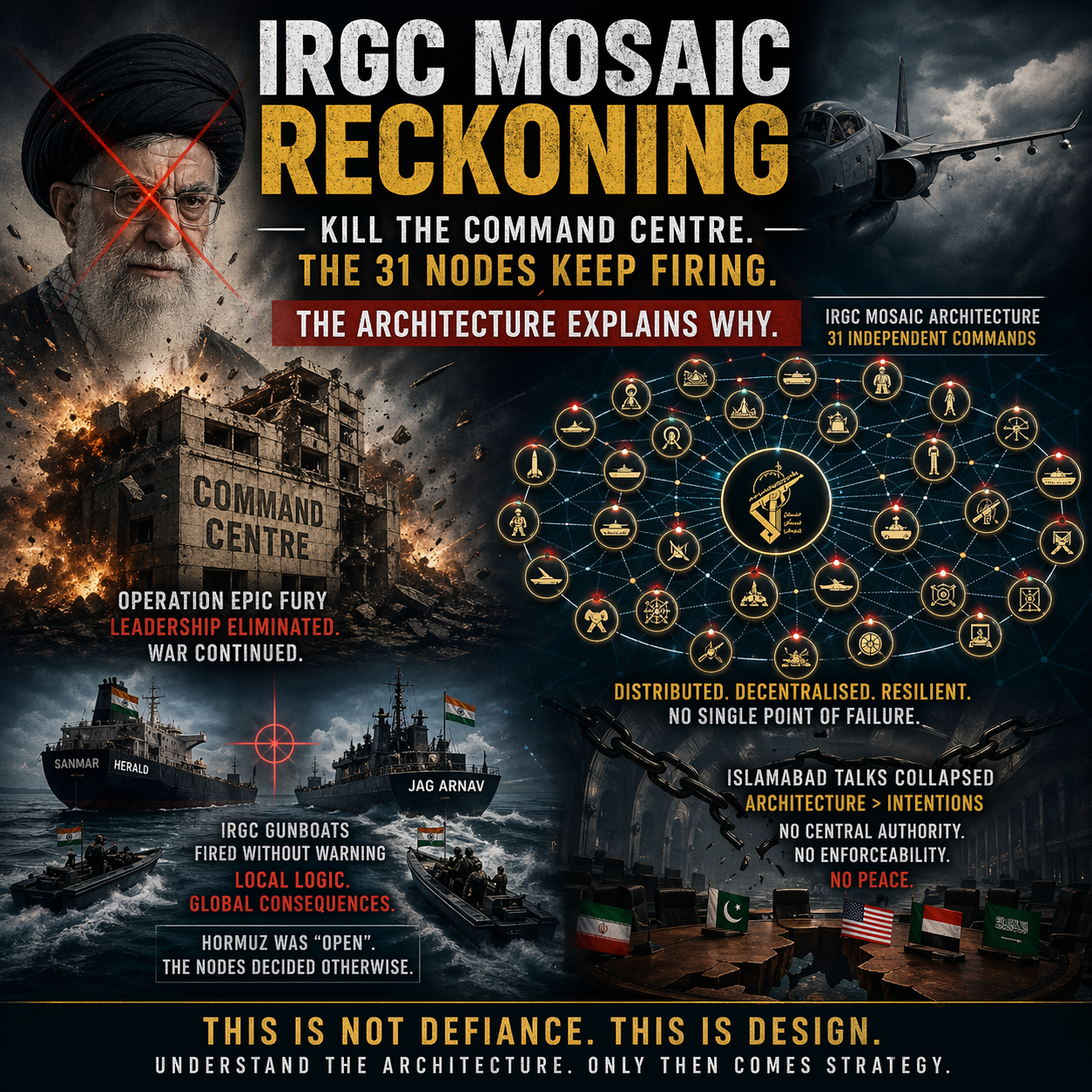
IRGC Mosaic Reckoning: Washington killed the command centre. The 31 nodes kept firing. You cannot end a distributed system by removing its centre. In industrial process management, a distributed control architecture solves a specific problem: how do you keep a complex, critical process running when individual components fail? The answer is to distribute the control logic across multiple independent processors. If one fails, the others continue. No single point of failure can bring down the whole system. Each processor operates on its own local variables and makes decisions without waiting for central authorisation.
The IRGC’s mosaic defence architecture — 31 separate commands explicitly documented in Iranian military doctrine — was built on precisely this logic. The Wilson Center’s analysis of IRGC structure confirmed the organisation’s deliberate decentralisation across ground, naval, aerospace, and Quds Force components, each with independent command authority and standing operational orders. Iran watched the United States destroy Iraq’s military in 1991 and 2003 through decapitation: kill the command structure, the military collapses. RAND documented how Iraq’s centralised command architecture made it uniquely vulnerable to decapitation strikes — the removal of Saddam Hussein’s command network in 2003 produced institutional paralysis within days. Iran drew the lesson and built the opposite. The IRGC Mosaic Reckoning begins here: the architecture was not an accident or an improvisation. It was the deliberate answer to the question of how to survive what America did to Iraq.
IRGC Mosaic Reckoning: What Happened When the Centre Was Removed
On Day 1 of Operation Epic Fury, Khamenei was killed alongside senior IRGC commanders in coordinated decapitation strikes on his residential compound. The senior military leadership was systematically targeted in the hours and days that followed. By any conventional military logic, this should have produced command paralysis — the same paralysis that ended Iraqi resistance in 2003 within weeks of the regime’s leadership being removed.
It did not. Missile and drone barrages continued. Gulf states continued to absorb strikes days and weeks into the campaign. The Soufan Center noted that after the ceasefire announcement, Iranian missiles and drones continued to strike Gulf Arab states — Qatar intercepting seven ballistic missiles, the UAE intercepting 17 ballistic missiles and 35 drones in the period immediately following the declared ceasefire. Analysts at the Critical Threats Project had documented the mosaic doctrine specifically — noting that IRGC commands hold pre-authorised standing orders designed to continue executing in the absence of central command. The ceasefire violations were attributed to the IRGC’s decentralised command structure — individual nodes either disagreeing with the ceasefire or operating on pre-authorised standing orders that had not been countermanded because there was no central authority left intact to countermand them.
This is not defiance of a central order. This is a distributed system operating exactly as designed. Each of the 31 IRGC commands holds standing orders, standing threat assessments, and standing rules of engagement. When the central processor is removed, the nodes do not stop. They continue on their pre-authorised local logic. The strikes after the ceasefire were not rogue elements acting against Tehran’s wishes. They were components of a distributed architecture continuing to execute their standing instructions — because the architecture was specifically designed to continue executing in exactly these conditions.
📌 Why Iran Was Always Going to Outlast the Campaign
The civilisational patience, the chess game operating on a timescale no electoral democracy can sustain — and why the distributed architecture is the military expression of the same strategic logic.
IRGC Mosaic Reckoning: The Indian Ships and Local Logic
The IRGC Mosaic Reckoning’s most precise illustration is not a historical case. It happened on April 18, 2026 — two days before this blog was published. Iran had declared Hormuz open. Two Indian-flagged vessels — the Sanmar Herald, a very large crude carrier loaded with nearly two million barrels of Iraqi crude bound for India, and the Jag Arnav, a bulk carrier travelling from Saudi Arabia’s Al Jubail — obtained prior clearance under that declaration and entered the strait. IRGC gunboats opened fire on both vessels without radio warning. Both ships were forced to reverse course and exit the strait. No crew were injured. India summoned the Iranian Ambassador, conveyed deep concern through Foreign Secretary Vikram Misri, and warned that such actions would have consequences.
But the radio transmission captured from the Sanmar Herald is what makes this incident the IRGC Mosaic Reckoning in its most concentrated form. A crew member was heard on maritime radio channels: “Sepah Navy. Sepah Navy. This is motor tanker Sanmar Herald. You gave me clearance to go. My name is second on your list. You are firing now. Let me turn back.” The ship had clearance. The name was on the list. A local IRGC naval node fired anyway. The central command’s decision did not reach the operational node, was not accepted by it, or was overridden by it — and the crew of the Sanmar Herald paid for the gap between the two.
This is the distributed architecture contradicting its own central decision in a thirty-second audio clip. Tehran declared open. An IRGC maritime node in the strait fired on a ship that Tehran had placed second on its approved transit list. The local node was not responding to Indian hostility — India had repatriated Iranian warship crews, maintained engagement despite Khamenei’s repeated Kashmir criticism, and conducted the ship-by-ship diplomacy that kept Indian vessels moving through the crisis.
The local node was operating on its own threat matrix: India had joined UK-led Hormuz talks, the toll system was being contested, India had not accepted Iranian transit fees. The central decision said approved. The local node said fire. The IRGC Mosaic Reckoning’s lesson for every non-aligned state is now captured in that radio call: a clearance from Tehran does not bind the node you encounter in the strait.
The Global South War Narrative of neutrality and prior authorisation was written for centralised adversaries. Against distributed systems, your name on the list means nothing if the node holding the gun was not updated, did not agree, or decided its local logic came first.
IRGC Mosaic Reckoning: The Islamabad Problem
The IRGC Mosaic Reckoning’s final argument is structural and connects directly to the Islamabad talks failure examined in Blog 36. Vance arrived in Islamabad to negotiate a ceasefire with Iran’s Foreign Minister and Parliament Speaker. The negotiation produced near-agreement on most points. It collapsed on nuclear and Hormuz toll. A US official confirmed that Iranian negotiators refused several red lines including ending uranium enrichment, dismantling enrichment facilities, and fully opening Hormuz without tolls. Multiple analysts noted that even had political agreement been reached, the fractured IRGC command structure made military compliance across all nodes structurally uncertain. And this is the result of destruction of the central command of IRGC through systematic elimination of top leadership as also the communication system that enabled effective communication of information.
But the deeper structural problem at Islamabad was not the negotiating positions. It was the question of enforceability. Even if Araghchi and Ghalibaf had signed a complete agreement — nuclear, Hormuz, proxies, sanctions — which of the 31 IRGC commands would have received the order to stand down, and which would have continued on their local standing orders?
A ceasefire signed with Iran’s political leadership requires the distributed military architecture to comply. After Khamenei’s death, after the senior IRGC command was degraded, there was no central processor with unquestioned authority over all 31 nodes. The Islamabad talks were trying to negotiate a hierarchical solution with a distributed system. The instruments did not match the target. The IRGC Mosaic Reckoning is the military face of the series’ central argument: this war has no clean ending because the adversary was not built to have one.
📌 The Decapitation Strategy This Architecture Was Built to Defeat
The historical pattern of decapitation as a US military doctrine — and why Iran studied it, named it, and built the mosaic architecture as its specific counter.
Next: NATO Weakening War — Blog 40 in West Asia’s Endless War examines the Atlantic alliance’s structural exposure in the Hormuz conflict: Operation Epic Fury launched without NATO consultation, declined by member states, European economies absorbing consequences of a war fought without their consent. The architecture of Western collective security is being dismantled by its own architect — and the Dagdhabeej thread deepens here. Part of the West Asia’s Endless War Series on hinduinfopedia.com.
Feature Image: Click here to view the image.
Videos
[…] भारत / GB […]
[…] Blog 39 established the IRGC Mosaic Reckoning — the distributed architecture that survived decapitation, continued firing after the ceasefire, and shot Indian ships that had Iranian clearance. Blog 40 examines what the Hormuz war has done to the Western military alliance on the other side of that architecture: NATO, which was not consulted before the war began, was not invited to join it, absorbed the economic consequences of a conflict fought without its consent, and was then publicly condemned by its own founder for failing to participate in a war it was never designed to fight. […]
[…] IRGC Mosaic Reckoning: A Reckoning of West Asia’s Endless War (39) https://hinduinfopedia.com/irgc-mosaic-reckoning-a-reckoning-of-west-asias-endless-war-39/ […]
[…] निंदा थी। केवल आभार व्यक्त किया गया। आईआरजीसी मोज़ेक विश्लेषण दर्शाता है कि स्थानीय इकाई ने […]
[…] was killed in the opening strikes. Blog 39 (IRGC Mosaic Reckoning) established that the distributed architecture was designed precisely to survive decapitation. The […]
[…] October 7) — it has done so. The constraint operates on the vocabulary, not on the ambition. Blog 39 (IRGC Mosaic Reckoning) established that Iran’s military architecture is distributed, resilient, and designed to […]
[…] पर लागू हुई, उद्देश्य पर नहीं। ब्लॉग 39 (IRGC Mosaic Reckoning) ने स्पष्ट किया था कि ईरान की सैन्य […]
[…] Read […]
[…] Blog 39 (IRGC Mosaic Reckoning) established that Iran’s 31 independent IRGC commands were specifically designed to survive decapitation — distributed architecture in which each command can operate autonomously without central direction. The removal of Khamenei in Operation Epic Fury did not remove the capability. The Fujairah strikes of May 4 2026 — 12 ballistic missiles, 3 cruise missiles, 4 drones engaged by UAE air defences — were the Mosaic architecture’s operational proof after decapitation. Blog 56 (Hormuz Logical Trap) established that this produces the trap’s second wall: Iran is hungry but cannot surrender, because surrender requires a central authority capable of delivering it — and the distributed Mosaic architecture means there is no single actor whose compliance produces system-wide compliance. Washington removed the head. The Mosaic continued. Negotiations require a counterparty capable of enforcing agreements. The Mosaic’s distributed autonomy makes Iran a difficult negotiating partner not from diplomatic bad faith but from structural architecture: local IRGC commanders can continue operations regardless of what any central authority agrees. […]
[…] of Hamas’s governmental infrastructure, and the displacement of Gaza’s population. The IRGC Mosaic architecture (Blog 39) that made the attack possible was built through the same Raktbeej mechanism the attack triggered […]
[…] any individual ant — irrelevant. The operational capacity is in the system, not the individual. The IRGC Mosaic (Blog 39) — 31 independent commands, each operating on doctrine and standing orders — is Iran’s ant […]
[…] IRGC Mosaic’s response to the simultaneous elimination of its senior command tier confirmed Blog 39’s distributed architecture argument in its most precise operational test. Within 24 hours of the strikes, the Hormuz Strait was closed […]
[…] external pressure through proxy warfare, calibrated retaliation, and the distributed architecture Blog 39 (IRGC Mosaic Reckoning) documented. Each Iranian action was measured, proportional, and designed to avoid triggering […]
[…] and the Balkans. Every state that observed the Iran war now has an updated study guide: the distributed architecture, the Hormuz leverage, the proxy network, the constitutional succession mechanism — all tested […]