

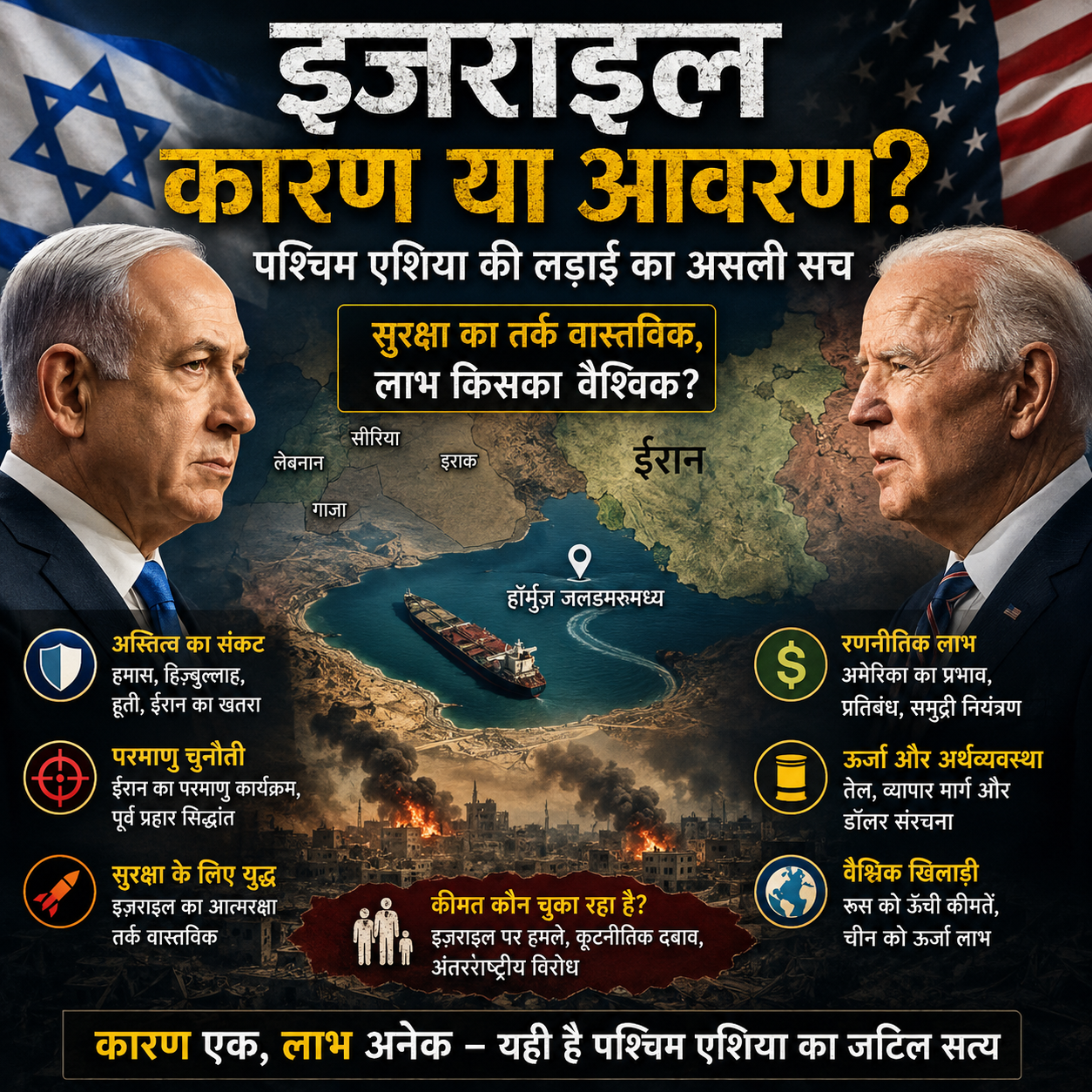
Israel Cause or Cover: A Reckoning of West Asia’s Endless War (59)
Part 59 of the West Asia’s Endless War Series
भारत / GB
The Series Has Examined Every Actor for What It Gains and What It Pretends Not to Know. Blog 59 Applies the Same Framework to Israel — the Actor That Is Simultaneously the Conflict’s Most Visible Participant and Its Most Contested Explanation.
Blog 58 (India Strategic Neutrality) documented the civilisational complexity of a state holding nine contradictions simultaneously — and closed with the question the ideology arc of this series is now required to answer: whether India’s neutrality is doctrine or rationalisation. Blog 59 applies the same question to Israel — the actor that every Global South narrative names as the conflict’s cause and every Washington narrative names as the conflict’s justification. Israel Cause or Cover examines both claims simultaneously and finds that the binary is wrong. Israel is both cause and cover — and the distinction between what Israel is for Israel and what Israel is for Washington is the argument this blog makes.
Israel Cause or Cover: The Question the Series Has Deferred
Israel Cause or Cover: Is Israel a genuine cause of the West Asia conflict or Washington’s cover for its Global Control War? The answer is not binary. Israel is both — and the distinction between the two is the argument. This blog applies a dual analytical lens — security logic and political economy — to separate what Israel’s existence as a state requires from what Washington’s strategic and commercial interests extract from the conflict Israel’s existence makes possible. The series has examined fifty-eight dimensions of the West Asia conflict without directly addressing this question — not from evasion but from sequencing. The factual, commercial, and strategic architecture had to be established before the ideological question could be asked cleanly. Blog 46 (Washington’s Global Control War) named Washington’s war as being against economic independence from Washington wherever it exists. Blog 54 (Confession of Superpower Pirate) documented Washington naming itself. Now the question must be asked: where does Israel fit in this architecture — as a genuine independent actor pursuing its own survival logic, or as Washington’s operational instrument for a war that serves American commercial interests?
Israel as genuine cause — the survival logic argument.
The Israel survival logic argument was established in Blog 10 (Israel Survival Logic). Israel is a state of nine million people surrounded by populations of several hundred million, several of whom have declared its elimination as a political objective. Iran’s nuclear programme — whatever its current status after IAEA inspectors withdrew for safety reasons in June 2025 — represents an existential threat to a state that cannot absorb a single nuclear strike. Iran’s proxy architecture — Hezbollah on Israel’s northern border, Hamas in Gaza, the Houthis controlling maritime access in the Red Sea, militias in Iraq — represents a strategic encirclement that no Israeli government can accept indefinitely. The October 7 2023 Hamas attack demonstrated that the encirclement was not theoretical — it could produce mass civilian casualties on Israeli soil in a single operation. Iran’s Supreme Leader had repeatedly stated that Israel “must be wiped off the map.” These are the operational conditions in which Israeli decision-making occurs — conditions that make the survival logic argument substantively grounded rather than merely asserted.
From Israel’s own survival logic, the Iran war was not optional. A nuclear-armed Iran with functional delivery systems — which Iran was approaching in 2025-2026 — changes the deterrence calculus permanently. Israel had conducted previous operations against nuclear infrastructure in Iraq (1981) and Syria (2007) for the same reason: a nuclear adversary that has declared Israel’s elimination as a state objective is an existential threat that pre-emption doctrine permits addressing. Blog 5 (Nuclear Pretext) documented the nuclear argument’s weaknesses — Iran was mid-negotiation with IAEA inspectors when strikes began. But the underlying Israeli calculation — that a nuclear Iran is an existential threat requiring pre-emption — is genuine, not manufactured. Israel as cause is real.
📌 The Survival Logic That Makes Israel’s Position Rational
Nine million people, existential encirclement, a nuclear threat from a state whose Supreme Leader declared Israel must be eliminated. The Israel Survival Logic — the foundational argument that makes Blog 59’s binary question necessary.
Israel Cause or Cover: Washington’s Instrument Argument
Israel as cover — the Global Control War argument.
The Global Control War argument established in Blog 46 is that Washington’s real war is against economic independence from Washington — and that Iran is the instrument through which that war is prosecuted. The question Israel Cause or Cover raises is: if Iran is Washington’s instrument, is Israel Washington’s pretext? The evidence assembled across the series is most consistent with a partial version of this argument — not that Israel’s role is purely instrumental but that Washington’s interests diverge from Israel’s at precisely the point where Washington’s strategic and commercial gains begin to accumulate.
Operation Epic Fury was launched from American and Israeli assets simultaneously. The political and media framing emphasised Israel’s security — Iran’s nuclear threat, the October 7 legacy, the proxy encirclement. Blog 8 (Western Narrative War) documented how that framing was constructed and deployed. The pattern of Washington’s own statements — documented in Blog 54 (Confession of Superpower Pirate) — points in a different direction: “Thanks” when told Iran fired on Indian ships. “So what” when told Hormuz was choking European energy. “We’re like pirates” collecting $6 billion in Iranian oil. Statements of this kind are more consistent with commercial strategic interest than with the conduct of a war prosecuted for an ally’s existential security. The cover interpretation follows from this pattern — not as the only possible reading but as the reading most consistent with the documented record.
Blog 41 (Rogue Superpower Doctrine) documented Stephen Walt’s verdict: Washington meets its own rogue state criteria more completely than Iran does. The criteria include: strikes without UN Security Council authorisation, targeted assassination of a foreign head of state, defiance of multilateral inspection processes, economic coercion of civilian populations, unilateral withdrawal from multilateral frameworks. The UN Charter’s foundational principles — sovereign equality, prohibition on the use of force, peaceful settlement of disputes — are the standards against which these criteria are assessed. Israel’s survival logic may justify some of these acts from Israel’s perspective. Washington’s strategic and commercial interests justify them from Washington’s perspective. The two justifications are different — and the difference matters for understanding what the war was actually for.
The Israel Cause or Cover Distinction the Series Requires.
Israel Cause or Cover does not require choosing one or the other. It requires holding both simultaneously and identifying where they diverge. Israel’s interests and Washington’s interests aligned in the decision to act against Iran’s nuclear programme. They diverged immediately after: Israel’s interest was in destroying Iran’s nuclear infrastructure and its proxy architecture permanently. Washington’s interest was in establishing control over Hormuz, collecting Iranian oil, and consolidating the commercial architecture of dollar dominance in Gulf energy markets. Israel’s survival logic does not require $6 billion in seized Iranian oil. Israel’s survival logic does not require calling the Navy pirates. Israel’s survival logic does not require saying “so what” when European allies face an energy crisis. Those statements are better explained by Washington’s interests than by Israel’s — which is the point at which the cover argument becomes analytically necessary rather than merely rhetorical.
The divergence is most precisely visible in the war’s commercial outcomes. Russia collected $9 billion monthly in oil windfall from a price spike the war created. China collected its oil revenue advantage through a decade of pre-positioning that the war’s disruption made commercially decisive. Washington collected seized Iranian oil and proposed collecting Hormuz tolls as a winner’s right. Israel collected — what, precisely? Israel absorbed Hezbollah’s rocket barrages. Israel absorbed Iranian ballistic missile attacks. Israel absorbed international isolation from the Global South, from the ICC, from multiple UN resolutions. Israel fought the war that its survival logic required. Washington extracted the strategic and commercial gains that its Global Control War made possible. The alignment of interests at the decision point and the divergence of interests at the point of collection is the Israel Cause or Cover argument’s most precise formulation.
The Israel Cause or Cover’s closing argument connects the ideology arc to the series’ foundational thesis. Blog 1 opened with Hormuz as the world’s most important chokepoint and asked who controls it and why. Blog 59 answers the question at its ideological root: Israel is the genuine cause of a conflict that is publicly framed in terms of Israeli security while its strategic and commercial gains accrue principally to Washington. The cause and the cover are simultaneously true — operating in the same conflict at different levels of explanation. The distinction between them is not an academic exercise. It is the difference between understanding why the war was launched and understanding what the war was for. Israel’s survival logic explains the first. Washington’s Global Control War explains the second. The two explanations do not contradict each other. They name different dimensions of the same event — which is analytically the most difficult kind of dual explanation, because it permits every party to claim accuracy about the dimension they chose to examine while remaining silent about the one they did not.
📌 The War That Served Washington’s Commercial Interests
Iran is the instrument. The war is against economic independence from Washington. Israel’s survival logic provided the justification. Washington’s commercial interest provided the purpose. Blog 46 named the design.
Next: Dar Al Harb Doctrine — Blog 60 in West Asia’s Endless War examines the theological framework that Iran, its proxies, and political Islam more broadly deploy to legitimise permanent conflict with non-Islamic state systems — and asks whether this doctrine is the war’s ideological engine or its post-hoc justification. The ideology arc continues. Part of the West Asia’s Endless War Series on hinduinfopedia.com.
Feature Image: Click here to view the image.
Videos
[…] भारत / GB […]
[…] Blog 59 (Israel Cause or Cover) established that the binary between genuine cause and cover is wrong — Israel is both, and the distinction between them is the argument. Blog 60 opens the ideology arc by establishing the precise classical content of the Dar Al Harb Doctrine — the theological framework several parties to the Hormuz conflict invoke, weaponise, or are accused of holding. The series approach to this doctrine is sequential: this blog states the framework precisely; three subsequent blogs examine what three separate actors have done to it. The reason for sequencing is analytical discipline — every analysis of the Dar Al Harb Doctrine that conflates the classical framework with its modern weaponised form produces conclusions that serve the conflator’s political interests rather than the truth. The series refuses the conflation. This blog is the refusal’s starting point. […]
[…] https://hinduinfopedia.com/israel-cause-or-cover-a-reckoning-of-west-asias-endless-war-59/ […]
[…] within it the structural contradiction that will produce the next conflict. Blog 69 applies the same dual analytical lens Blog 59 applied to Israel: is Palestine a genuine cause driving West Asia’s endless war, or the instrument through […]
[…] लिया जाए तो विश्लेषण अधूरा रह जाएगा। ब्लॉग 59 (इज़राइल: उद्देश्य या आवरण) ने इज़राइल के लिए यही द्विस्तरीय […]