

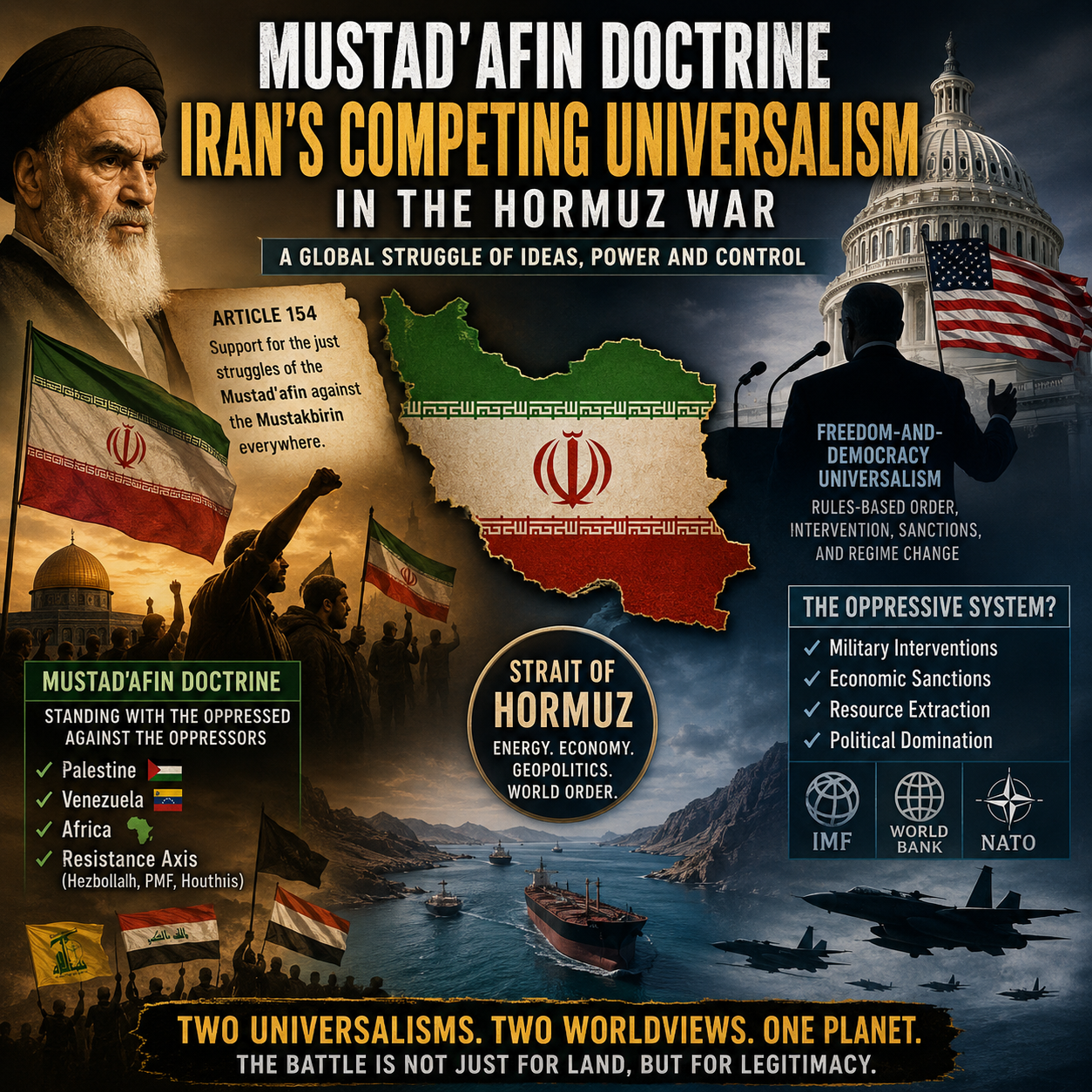
Mustad’afin Doctrine: A Reckoning of West Asia’s Endless War (66)
Part 66 of the West Asia’s Endless War Series
भारत / GB
The World Has Two Competing Universalisms. Washington Calls Its Version Freedom and Democracy. Iran Calls Its Version the Mustad’afin Doctrine. The Hormuz War Is What Happens When Two Universalisms Fight Over the Same Chokepoint.
Blog 65 (Iran’s War Logic) reconnected the ideology arc to the operational war — establishing that the Mustad’afin mandate, the Velayat-e Faqih governance model, and the IRGC Mosaic architecture together explain why forty-seven years of maximum pressure have produced a more capable Iranian adversary rather than a more compliant one. Blog 66 examines the Mustad’afin Doctrine on its own terms — not as Iran’s specific foreign policy instrument but as a complete alternative framework for understanding the global political order, one that predates the Islamic Republic, carries Quranic authority, applies across religious lines, and competes directly with the freedom-and-democracy universalism through which Washington legitimises its own global presence. The series has named the Mustad’afin Doctrine as Iran’s constitutional foundation. This blog asks what the doctrine actually says about the world — and why its answer is more threatening to Washington’s global architecture than the Dar al-Harb framework that Western analysis consistently misapplies to Iran.
Mustad’afin Doctrine: The Quranic Foundation and Khomeini’s Operationalisation
Mustad’afin Doctrine: Iran’s constitutional mandate — support the oppressed against the oppressors everywhere, regardless of religion. A third framework, more universal than Dar al-Harb, competing directly with Washington’s freedom-and-democracy universalism. The Mustad’afin — the oppressed, the downtrodden, the dispossessed — appear across the Quran as a specific category of humanity whose condition demands divine and human response. The Oxford Dictionary of Islam documents that Mustad’afin appears in multiple Quranic verses as the category of people whom God specifically intends to favour — the fourth chapter (An-Nisa) states that God wishes to make the Mustad’afin leaders and inheritors of the earth. This is not a peripheral Quranic concept. It is a structural category that divides humanity by condition — the oppressed and the oppressor — and assigns divine alignment to the first against the second.
The structural parallel with Washington’s own universalism is precise and deliberately unacknowledged. Washington divides the world into functioning democracies and rogue states that require intervention — a binary that assigns moral authority to Washington as the democracy’s guardian and designates non-compliant states as legitimate targets of coercion. The Mustad’afin Doctrine divides the world into the oppressed and the oppressors — a binary that assigns constitutional obligation to Iran as the oppressed’s defender and designates non-compliant states as Mustakbirin. Both frameworks are universalisms operated by the state making the designation. Both produce the same operational consequence: the designating state acquires the moral authority to intervene wherever its framework identifies the appropriate category. The difference is not structural. It is in whose interests the designation serves — and in which populations pay the cost of the interventions both frameworks authorise.
Khomeini’s contribution was not inventing the Mustad’afin concept — it exists in the Quran and in fourteen centuries of Islamic scholarly tradition. His contribution was constitutionalising it. The 1979 Iranian constitution converted a theological category into a state obligation. Article 154 does not say Iran may support liberation struggles. It says Iran supports them — present tense, active voice, constitutional obligation. The constitutional text is precise: “it supports the just struggles of the Mustad’afin against the Mustakbirin in every corner of the globe.” Every corner of the globe. Not the Islamic world specifically. Not Muslim-majority territories. Every corner. The universalism of the Mustad’afin Doctrine is written into its constitutional formulation.
The Mustakbirin — the arrogant ones, the oppressors — are equally a Quranic category. Britannica’s Islamic studies reference documents that the Mustakbirin in classical Islamic thought are those who arrogantly refuse to submit to God’s will and exploit others — the Pharaoh of the Exodus narrative is the Quran’s primary Mustakbirin archetype. Khomeini applied this category to Washington and to the Gulf monarchies with deliberate precision. Washington is the modern Pharaoh — the global Mustakbirin whose military, financial, and cultural power maintains the oppression of the Mustad’afin globally.
This is not a statement that requires the Mustad’afin theological framework to validate. The series has documented the same conclusion across sixty-six blogs through secular historical and economic evidence: 230 military interventions following the same extraction pattern, zero real return for the states running Washington’s monetary machinery, oil seized from sovereign states and their governments declared illegitimate, Hormuz tolls called extortion when Iran charges them and a winner’s right when Washington proposes them. The Mustad’afin Doctrine names Washington as the global Mustakbirin through Quranic categories. The series names Washington as the global Mustakbirin through documented evidence. The two methodologies arrive at the same designation. Iran is not wrong about what Washington does. It is using a different language to name the same operational reality the series has recorded.
The Gulf monarchies that host Washington’s military are the Pharaoh’s local administrators — Muslim in identity, Mustakbirin in function. This is why the Mustad’afin Doctrine produces the behaviours Blog 65 documented: Iran fires on Gulf monarchies because the doctrine does not protect them as fellow Muslims. It designates them as Mustakbirin for hosting the global Mustakbirin’s instruments.
📌 The War Logic the Doctrine Produces
Three doctrines explain why forty-seven years of maximum pressure have produced a more capable Iranian adversary. The Mustad’afin mandate is the first — it converts every act of external pressure into a constitutionally legitimising event.
Mustad’afin Doctrine: The Third Universalism
After we have described the two universalisms, Washington’s “freedom and democracy” and Iran’s Mustad’afin Doctrine” we discuss the third one, Mustad’afin Doctrine in itself.
The Mustad’afin Doctrine’s most significant analytical dimension — the one that makes it more threatening to Washington’s global architecture than Dar al-Harb — is its universalism. The Dar al-Harb framework divides the world by religious category. It applies to non-Muslim territories specifically and has no claim on populations that are already Muslim. The Mustad’afin Doctrine divides the world by political-economic category. It applies to every population labelled as “oppressed” everywhere regardless of their religion, ethnicity, or geography. This makes it a genuinely global framework — the theological equivalent of the Third World non-alignment movement, but with constitutional force behind it rather than diplomatic aspiration.
The universalism operates in practice across five documented applications that collectively demonstrate its scope:
Palestinian liberation.
The most visible application — Iran’s constitutional mandate to support the Palestinian cause is not merely anti-Israel sentiment or pan-Islamic solidarity. It is the Mustad’afin Doctrine’s most operationally sustained expression. Palestinians are designated Mustad’afin — dispossessed, occupied, denied statehood — and the obligation to support their struggle is constitutional. This is why Iran’s support for Hamas survived the Shia-Sunni theological distance, the Palestinian Authority’s Fatah faction’s preference for negotiation, and repeated Israeli-American pressure to sever the relationship. The support is not strategic preference. It is constitutional obligation.
Latin American anti-imperialism.
Iran’s relationships with Venezuela, Cuba, Bolivia, and Nicaragua are the Mustad’afin Doctrine applied beyond the Islamic world entirely. The BBC documented Iran’s Latin American engagement as a deliberate strategy to build coalitions among states that share Washington as a primary strategic adversary. Reuters documented Iran’s deepening military cooperation with Venezuela — joint weapons manufacturing, naval exercises, economic agreements that explicitly framed as South-South solidarity against American imperialism. The populations of Venezuela and Cuba are not Muslim. They are Mustad’afin in Iran’s constitutional framework — oppressed by the same global Mustakbirin whose sanctions strangle Iran simultaneously. The shared adversary is Washington. The Mustad’afin Doctrine provides the theological framework through which Iran can articulate solidarity with non-Muslim populations without theological contradiction.
African liberation movements.
Iran’s relationship with African anti-colonial movements and post-colonial governments has been sustained through the same Mustad’afin framework — African populations designated as oppressed by centuries of Western extraction, currently maintained in economic dependency through the same IMF-World Bank conditionality architecture that the Global Capitalist Capture Disorder series will examine in full. Iran’s African engagement is not primarily military or commercial. It is ideological — the Mustad’afin Doctrine provides African leaders with a non-Western legitimising framework that does not require adoption of either Washington’s freedom-and-democracy universalism or Beijing’s development-without-conditionality pragmatism. Al Jazeera documented Iran’s outreach to African Union members at the 2023 non-alignment summit as explicitly framed through the oppressed-versus-oppressors narrative — Tehran positioning itself as a Global South ally rather than a regional power seeking sphere-of-influence expansion.
The Global South narrative.
Blog 9 (Global South War Narrative) documented six billion people reading the Hormuz war as resource imperialism. The Mustad’afin Doctrine is the theological infrastructure through which Iran can claim alignment with that narrative without requiring the six billion to convert to Shia Islam or accept Velayat-e Faqih governance. The Mustad’afin framework says: we are all Mustad’afin. The adversary is the same. The struggle has different expressions in different territories. Iran’s expression is the Hormuz war. Yours is IMF conditionality. Venezuela’s is oil sanctions. Palestine’s is occupation. The doctrine provides the unifying framework across all expressions simultaneously.
The Shia diaspora globally.
The Mustad’afin Doctrine’s most operationally precise application within the Islamic world is the Shia diaspora — communities in Lebanon, Iraq, Bahrain, Saudi Arabia’s Eastern Province, Pakistan, and India whose minority status within Sunni-majority states or whose political marginalisation within nominally secular states qualifies them as Mustad’afin within Iran’s constitutional framework. This is the theological foundation of the proxy architecture Blog 64 documented — Hezbollah in Lebanon, the PMF in Iraq, the Houthis in Yemen are not simply strategic assets. They are Mustad’afin communities whose just struggle Iran is constitutionally obligated to support.
Mustad’afin Doctrine: The Competing Universalism Argument
The Mustad’afin Doctrine’s most precise challenge to Washington’s global architecture is not military. It is ideological — and ideology is the real battlefield that a later Blog (Philosophy Real Battlefield) will examine directly. Washington’s freedom-and-democracy universalism claims that liberal democracy, free markets, and individual rights are universal values whose application benefits all humanity regardless of cultural or historical context. This universalism legitimises Washington’s military presence — American forces are not occupiers but protectors of universal values. It legitimises Washington’s sanctions architecture — economic coercion is not imperial pressure but enforcement of the rules-based international order. It legitimises Washington’s political interventions — regime change is not sovereignty violation but democracy promotion.
The Mustad’afin Doctrine challenges every element of this legitimising framework simultaneously. Blog 16 (Colonial Order Endless War) established the post-1945 international order as colonial architecture updated. If the world’s populations are divided not by their adoption of liberal democracy but by their position in the oppressor-oppressed hierarchy — and if Washington is the global Mustakbirin whose military, financial, and cultural architecture maintains that hierarchy — then Washington’s universalism is not a neutral framework for global benefit. It is the ideological instrument of the world’s primary oppressor. Washington’s Global Control War (Blog 46) named Washington’s war as being against economic independence from Washington wherever it exists. The Mustad’afin Doctrine names the same phenomenon from the other direction: there are oppressors who extract and oppressed who are extracted from, and the constitutional obligation of the Islamic Republic is to support the second against the first.
The Mustad’afin Doctrine’s closing argument for this series is the one that makes the Hormuz war’s ideological dimension comprehensible. The Western Narrative War (Blog 8) documented how the Hormuz conflict was framed as a civilisational war between the democratic West and the theocratic East. The Mustad’afin Doctrine reveals why that framing is analytically wrong: Iran is not fighting a civilisational war between Islam and the West. Iran is fighting a universalist war between two competing frameworks for organising global political reality — Washington’s freedom-and-democracy universalism and Iran’s Mustad’afin universalism. The Hormuz chokepoint is where these two universalisms have their most operationally concentrated confrontation. Blog 1 asked who controls Hormuz and why. The Mustad’afin Doctrine answers the second half of that question: because whoever controls Hormuz controls the primary commercial artery of the global economy — and in the Mustad’afin framework, that control must not be held by the Mustakbirin whose extraction architecture the doctrine is constitutionally committed to challenging. The Hormuz war is not a religious conflict. It is a conflict between two universalisms about who has the right to extract from the global economy and who has the obligation to resist that extraction.
Structural Comparison: Two Competing Universalisms
The conflict in West Asia and the strategic chokepoint of the Strait of Hormuz is framed not as a clash of civilizations (Islam vs. the West), but as a direct confrontation between two competing universalisms that authorize global intervention:
| Attribute | Washington’s Universalism | Iran’s Mustad’afin Doctrine |
| Core Binary | Functioning Democracies vs. Rogue States | Mustad’afin (Oppressed) vs. Mustakbirin (Oppressors) |
| Moral Mandate | Guardian of Freedom, Democracy, and Free Markets | Defender of the Downtrodden and Dispossessed |
| Geographic Scope | Global (Rules-Based International Order) | Global (“Every corner of the globe” — Article 154) |
| Action Authorized | Sanctions, Regime Change, Democracy Promotion | Resistance, Material Support, Proxy Architecture |
| Target of Coercion | Non-compliant autocracies/terrorist states | The global hegemon and its regional administrators |
📌 The Global South Narrative the Doctrine Speaks To
Six billion people reading the war as resource imperialism — the non-Western narrative that the Mustad’afin Doctrine provides theological infrastructure for, without requiring religious conversion or political alignment with Tehran.
Next: Axis of Convenience — Blog 67 in West Asia’s Endless War examines the three alliance architectures the Hormuz conflict has formalised: the Iran-Russia-China convergence, the UAE-India-Israel triangle, and the Saudi-Pakistan-Turkey SMDA framework. None of these are principled alliances formed around a shared vision. Each was formed against a shared adversary — and each carries within it the structural contradiction that will produce the next conflict even as the current one remains unresolved. Part of the West Asia’s Endless War Series on hinduinfopedia.com.
Feature Image: Click here to view the image.
Videos
Glossary of Terms
- Mustad’afin Doctrine: Iran’s constitutional and ideological framework that defines the state’s obligation to support the oppressed (Mustad’afin) against oppressors (Mustakbirin) globally, regardless of religion or geography.
- Mustad’afin: A Quranic term meaning the oppressed, downtrodden, or dispossessed people whom Islamic tradition identifies as deserving divine and political support.
- Mustakbirin: A Quranic category referring to arrogant oppressors or dominant powers who exploit and subjugate weaker populations.
- Velayat-e Faqih: Iran’s governing doctrine of “Guardianship of the Islamic Jurist,” under which supreme political authority rests with an Islamic jurist.
- IRGC Mosaic Architecture: Iran’s decentralised defence and resistance structure developed by the Islamic Revolutionary Guard Corps to sustain warfare and internal resilience under prolonged pressure.
- Dar al-Harb: A classical Islamic geopolitical concept referring to territories considered outside Islamic governance, often contrasted with Dar al-Islam.
- Article 154: A provision of Iran’s constitution declaring support for the “just struggles of the Mustad’afin against the Mustakbirin” worldwide.
- Hormuz War: The series’ term for the escalating geopolitical confrontation centred around the Strait of Hormuz and the struggle over global energy and maritime control.
- Freedom-and-Democracy Universalism: The blog’s phrase for Washington’s global ideological framework that legitimises interventions through democracy, liberal order, and human-rights narratives.
- Third Universalism: A key phrase in the blog describing the Mustad’afin Doctrine as a global ideological framework competing with Western liberal universalism and traditional Islamic civilisational divisions.
- Global South Narrative: The interpretation among many non-Western societies that global conflicts are driven by resource control, economic coercion, and post-colonial power structures.
- Global Capitalist Capture Disorder: A unique term coined in the series describing the perceived capture of global political and economic systems by transnational financial and geopolitical interests.
- Non-Alignment Framework: A geopolitical approach in which states resist alignment with dominant power blocs and seek independent strategic positioning.
- Pharaoh Archetype: The Quranic symbolic model of tyrannical power used in the blog to describe modern hegemonic or oppressive political systems.
- Rules-Based International Order: A modern geopolitical phrase describing the Western-led global system of alliances, trade rules, sanctions, and security arrangements established after World War II.
#Iran #Hormuz #MiddleEast #Geopolitics #GlobalSouth #Islam #Khomeini #IRGC #Oil #Washington #Tehran #HinduinfoPedia
West Asia’s Endless War: Why This Series Exists
Refer to Various Arks Referred to in the Blog
https://hinduinfopedia.com/mustadafin-doctrine-a-reckoning-of-west-asias-endless-war-66/
[…] भारत / GB […]
[…] ब्लॉग 66 में विवेचित मुस्तदअफ़ीन सिद्ध… को एक वैकल्पिक वैश्विक व्यवस्था ढाँचे के रूप में प्रस्तुत किया गया था। यही संवैधानिक सिद्धांत उस व्यक्ति ने तैयार किया था जिसने फ्रांस के एक छोटे गाँव से क्रांति का संचालन किया। उसने BBC प्रसारण और पश्चिमी मीडिया मंचों का उपयोग किया। […]
[…] Blog 66 (Mustad’afin Doctrine) established that two universalisms — Washington’s freedom-and-democracy framework and Iran’s Mustad’afin mandate — are competing for the same global legitimacy claim, and that the Hormuz war is their most concentrated operational collision. Blog 67 examines the question that makes the competition most historically ironic: the Islamic Republic that carries the Mustad’afin Doctrine into the Hormuz war was created by the Western liberal policy architecture it now fights. The series has documented Washington manufacturing the jihadist movement in Afghanistan (Blog 61). Blog 67 documents the prior and more consequential manufacture: the Islamic Republic of Iran itself, brought into existence through French asylum law, BBC broadcasting reach, Carter administration human rights policy, and the same year — 1979 — that saw both extremes of Western policy activated simultaneously. […]
[…] https://hinduinfopedia.com/mustadafin-doctrine-a-reckoning-of-west-asias-endless-war-66/ […]
[…] adversary. They share almost nothing else. Iran is a theocratic Shia revolutionary state whose Mustad’afin Doctrine commits it to supporting the oppressed against the oppressors globally regardless of religion. […]
[…] the Iranian constitutional architecture was specifically designed to absorb this pressure — the Mustad’afin mandate converts external economic pressure into domestic legitimacy demonstrations. Blog 65 (Iran’s […]
[…] को सहन करने के लिए निर्मित की गई थी। मुस्तज़अफ़ीन दायित्व बाहरी आर्थिक दबाव को घरेलू वैधता के […]
[…] पढ़ें: मुस्तदअफीन सिद्धांत → […]