

The War Doctrine Shift: A Reckoning of West Asia’s Endless War (84)
Part 84 of the West Asia’s Endless War Series
भारत / GB
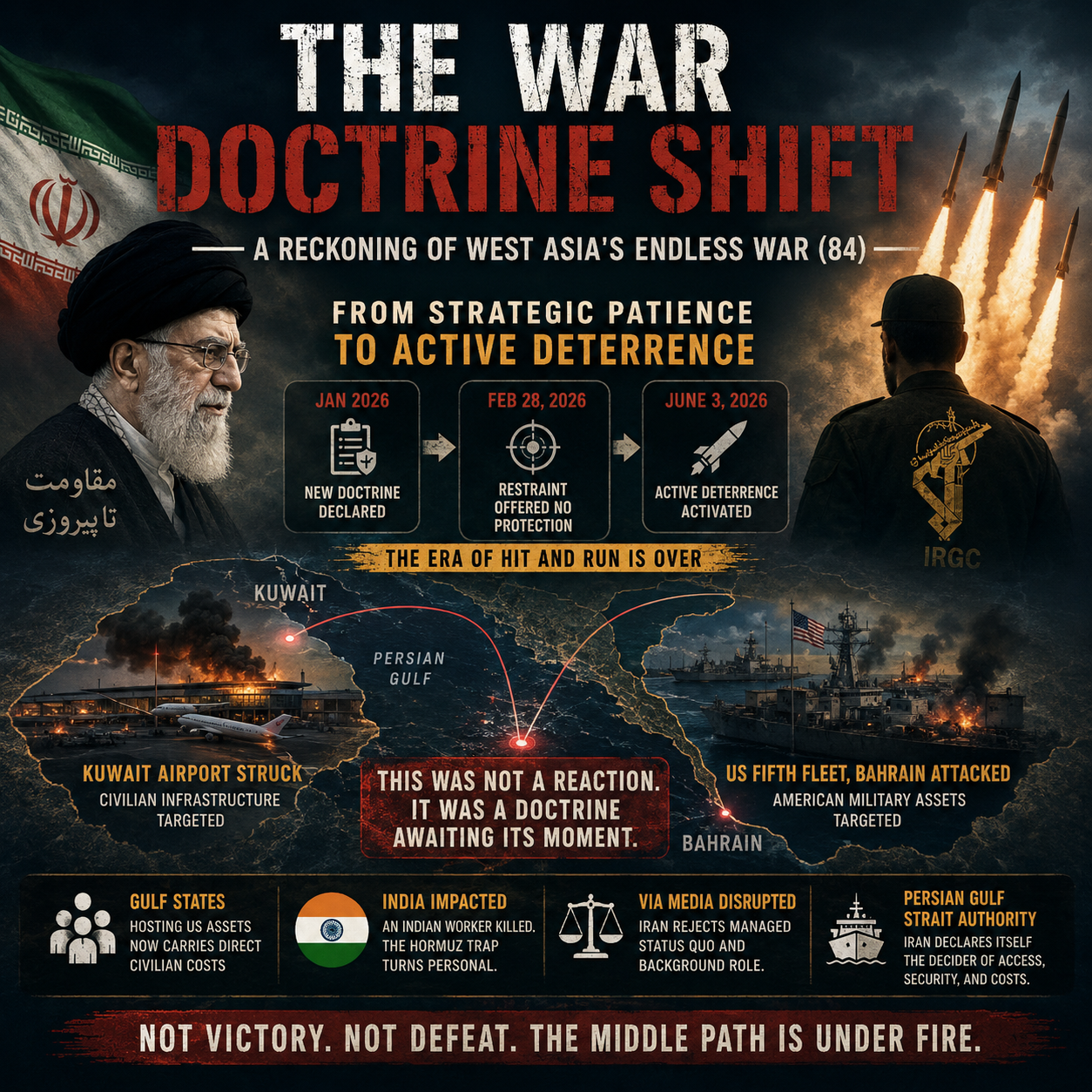
Iran Formally Declared a New Doctrine of Active and Unprecedented Deterrence in January 2026. February 28 Confirmed That Restraint Offered No Protection. June 3 — Kuwait Airport Struck, US Fifth Fleet Bahrain Attacked, the Era of Hit and Run Declared Over. This Was Not a Response to Washington’s Exhaustion. It Was a Pre-Existing Doctrine Awaiting Its Moment.
Blog 83 (Who Decides Endgame) established that no actor currently positioned can deliver the endgame — and that time and exhaustion, rather than negotiation, will determine the outcome. Blog 84 examines the most significant single development since the series began: Iran’s formal doctrine shift from strategic patience to active deterrence, and what its June 3 2026 activation means for every argument the series has made about the war’s trajectory.
The War Doctrine Shift: From Strategic Patience to Active Deterrence
The War Doctrine Shift did not begin on June 3 2026. It began in January 2026 — six weeks before Operation Epic Fury’s first strike. Al Jazeera’s analysis documented the sequence precisely: following the 12-day war of June 2025, Iran formally declared a new doctrine of “active and unprecedented deterrence” in January 2026 — a strategic pivot from the reactive, defence-first posture that had governed Iranian military behaviour since 1979. The doctrine was not announced in response to February 28. It was in place before February 28. What February 28 did was confirm what the doctrine’s architects had calculated: that restraint offered no protection and would likely offer none in the future.
Al Jazeera’s feature on the 2025 blueprint documented Iran’s Foreign Minister Araghchi’s statement posted on March 1 2026 — the day after the opening strikes: “We’ve had two decades to study defeats of the US military to our immediate east and west. We’ve incorporated lessons accordingly. Bombings in our capital have no impact on our ability to conduct war. Decentralised Mosaic Defence enables us to decide when — and how — war will end.” This is not a statement made in response to an unexpected attack. It is a statement made by a military establishment that had prepared for this specific scenario and declared its readiness before the war’s first week was complete.
The War Doctrine Shift’s three phases are documented:
Phase One — Strategic patience (1979-2025):
Iran absorbed external pressure through proxy warfare, calibrated retaliation, and the distributed architecture Blog 39 (IRGC Mosaic Reckoning) documented. Each Iranian action was measured, proportional, and designed to avoid triggering escalation beyond Iran’s manageable threshold. The doctrine was reactive by design — absorb, distribute, survive.
Phase Two — Active deterrence declared (January 2026):
Defence analysts told Al Jazeera that Iran revised its military strategy after the 12-day war to a more aggressive posture focused on the Islamic Republic’s survival — prioritising speed, reach, and initiative, signalling readiness to strike first when danger is imminent rather than waiting to absorb an attack. The shift was framed domestically as deterrence through demonstrated offensive capability.
Phase Three — Active deterrence activated (February 28 – June 3 2026): ‘
The February 28 strikes on the Supreme Leader during ongoing negotiations confirmed the doctrine’s foundational premise — that restraint had not protected Iran and would not protect it. From that moment the doctrine moved from declared to operational.
📌 The Organism That Built This Doctrine
47 years of strategic patience — the distributed architecture, the constitutional mandate, the proxy network — that made the doctrine shift possible when Iran determined the moment had come.
The War Doctrine Shift: June 3 and the Engine Room Decision
The June 3 2026 escalation is the War Doctrine Shift’s most visible single expression — but its trigger requires precise documentation. The IRGC’s statement on June 3 stated: “Late last night, the aggressive US military struck an Iranian oil tanker with an aerial projectile in the vicinity of the Strait of Hormuz, causing damage to the vessel’s engine room. In response to this aggression and violation of the regulations governing the Strait of Hormuz, an American-Zionist enemy vessel named Panaya was targeted by missiles launched by the IRGC Navy.”
The trigger was the engine room attack on an Iranian tanker. But the trigger requires context: this was not the first time Washington had fired on Iranian vessels during the ceasefire. NPR documented that US forces had previously fired on and disabled Iranian oil tankers in the Strait of Hormuz — actions that Iran had absorbed without the scale of response it delivered on June 3. The June 3 response was categorically different from previous responses to similar provocations. Iran did not merely retaliate against the US action. It struck Kuwait’s international airport passenger terminal, the US Fifth Fleet headquarters in Bahrain, and an American airbase — simultaneously — and declared the era of hit and run over.
The analytical question your observation raises is precise: why did the June 3 engine room attack produce a response that previous similar attacks had not? The documented context suggests the answer is not the severity of the June 3 provocation — it is the accumulation of signals about Washington’s position that made this the moment Iran’s active deterrence doctrine chose to demonstrate its full operational expression. CNBC documented that peace talks had largely stalled as both countries rejected each other’s proposals — with Iran’s June 1 suspension of talks and the ceasefire’s functional breakdown providing the context in which the June 3 escalation occurred.
The War Doctrine Shift’s June 3 expression produced four simultaneous consequences the series’ existing framework predicts:
First: Kuwait’s international airport passenger terminal was damaged, one person killed, dozens wounded — civilian and commercial infrastructure targeted deliberately for the first time in the war. This is the active deterrence doctrine’s psychological pressure dimension: demonstrating that Gulf states hosting American assets bear civilian costs they have been told by US they would not bear.
Second: the Gulf monarchies’ security calculus shifted in a single day. Defence Security Asia documented that regional Gulf monarchies now face increasingly complex security calculations — hosting American military assets simultaneously strengthens deterrence while elevating their exposure to Iranian strikes. Blog 31 (Gulf Betrayal Reckoning) established the Praetorian Guard’s conditionality. The June 3 strikes demonstrated the cost of the arrangement more visibly than any previous action in the war.
Third: an Indian worker was killed. Blog 24 (India Hormuz Trap) established India’s nine-contradiction position. The Indian casualty in Kuwait activates the India dimension of the war in its most immediate human form — India’s citizens in the Gulf working economies that Iran’s strikes are now directly targeting.
Fourth: the Via Media Reckoning (Blog 80) argued Washington was hoping Iran’s toll authority would become normalised background reality. The War Doctrine Shift’s June 3 expression demonstrates Iran has no interest in becoming background reality. The Kuwait airport strike is not the action of a state accepting managed status quo.
The War Doctrine Shift: What It Means for the Series’ Arguments
The War Doctrine Shift does not invalidate the series’ core arguments. It confirms several of them while modifying one.
Confirmed: Blog 78 (The Art of Not Fighting) argued that the entity that chooses when to fight and when not to fight defeats the entity that fights every time. Iran practiced strategic patience for 47 years — choosing not to fight directly while building the distributed architecture. The War Doctrine Shift does not contradict this. It represents Iran choosing, after 47 years of strategic patience, that the moment for active deterrence had arrived. The choice of when to activate the new doctrine is itself the Art of Not Fighting’s most complete expression.
Confirmed: Blog 65 (Iran’s War Logic) established that Iran’s constitutional architecture converts external pressure into legitimacy demonstrations. The War Doctrine Shift’s activation — striking US assets, declaring the era of hit and run over, introducing the Persian Gulf Strait Authority simultaneously — is the Velayat-e Faqih model’s legitimacy demonstration in its most operationally complete form.
Modified: Blog 80 (Via Media Reckoning) argued Washington was constructing an exit from the Iran trap through managed status quo. The War Doctrine Shift’s June 3 expression complicates that exit — Iran is not cooperating with the via media. The status quo Washington is trying to manage is not the status quo Iran’s new doctrine will permit. The Hormuz Logical Trap (Blog 56) identified five walls with no exit. The War Doctrine Shift has added pressure to all five walls simultaneously — making the via media harder to construct precisely when Washington needs it most.
📌 The Via Media the Doctrine Shift Is Disrupting
Not victory. Not defeat. The middle path Washington was constructing — now under pressure from an Iran that has chosen this moment to demonstrate active deterrence rather than accept managed background status.
Next: The War Ledger — Blog 85 in West Asia’s Endless War examines which side’s constraints run out first: Washington’s institutional and electoral clocks — War Powers, midterms, the 2028 succession — against Iran’s economic and demographic pressures. The endgame will be decided not by negotiation but by exhaustion. The question is whose ledger closes first. Part of the West Asia’s Endless War Series on hinduinfopedia.com.
Feature Image: Click here to view the image.
Videos
Glossary of Terms
- The War Doctrine Shift: The key phrase of Blog 84, describing Iran’s transition from decades of strategic patience to a doctrine of active deterrence formally declared in January 2026.
- Active Deterrence: A military doctrine emphasizing initiative, speed, reach, and the willingness to strike first when threats are perceived as imminent rather than waiting to absorb attacks.
- Strategic Patience: Iran’s long-standing post-1979 approach of absorbing pressure, relying on proxies, calibrated retaliation, and avoiding direct escalation.
- Operation Epic Fury: The military campaign referenced in the series that began with the February 28, 2026 strikes and accelerated the current phase of the conflict.
- Mosaic Defence: Iran’s decentralized military architecture designed to ensure continuity of command, operations, and retaliation even when key facilities or leaders are targeted.
- IRGC: Islamic Revolutionary Guard Corps, the powerful military and ideological institution responsible for safeguarding Iran’s political system and conducting many of its regional operations.
- IRGC Mosaic Reckoning: A concept developed in Blog 39 explaining how Iran’s distributed military structure reduces vulnerability to decapitation strategies.
- Hormuz Logical Trap: A series concept from Blog 56 describing the strategic deadlock in which all major actors face severe costs regardless of the path chosen.
- Via Media: A Latin phrase meaning “middle path,” used in the series to describe Washington’s attempt to manage the conflict without either decisive victory or withdrawal.
- Velayat-e Faqih: Iran’s governing doctrine granting ultimate political and religious authority to the Supreme Leader and shaping the state’s strategic behavior.
- Persian Gulf Strait Authority: A series term describing Iran’s effort to establish itself as the effective regulator of maritime access and security in the Gulf region.
- Praetorian Guard Model: A concept from Blog 31 describing Gulf monarchies’ reliance on external security guarantees, particularly from the United States.
- Strategic Endgame: The eventual resolution of a conflict through exhaustion, victory, collapse, or settlement after available options narrow.
- Decapitation Strategy: A military approach focused on eliminating senior leadership and command structures to cripple an adversary’s ability to fight.
- Fifth Fleet: The United States Navy formation headquartered in Bahrain and responsible for naval operations across the Persian Gulf, Arabian Sea, and surrounding waters.
#Iran #USA #MiddleEast #Hormuz #War #Geopolitics #IRGC #Bahrain #Kuwait #Deterrence #Conflict #Strategy #Military #Oil #HinduinfoPedia
West Asia’s Endless War: Why This Series Exists
Refer to Various Arks Referred to in the Blog
https://hinduinfopedia.com/proof-of-endless-war-master-reference-table/
[…] भारत / GB […]
[…] https://hinduinfopedia.com/the-war-doctrine-shift-a-reckoning-of-west-asias-endless-war-84/ […]