

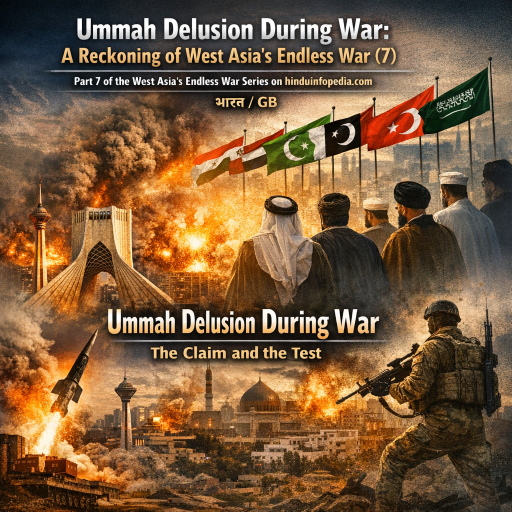
Ummah Delusion During War: A Reckoning of West Asia’s Endless War (7)
Part 7 of the West Asia’s Endless War Series on hinduinfopedia.com
भारत / GB
Iran Invoked Islamic Solidarity When Struck. Fifty-Seven Muslim States Watched. Not One Moved.
Ummah Delusion During War: The Claim and the Test
Ummah Delusion During War: Iran invoked Islamic solidarity when struck. Fifty-seven Muslim states watched. Not one moved.
Iran has sustained its revolutionary project for forty-five years on a single theological claim — that it is the defender of the global Muslim community against Western imperialism and Zionist aggression. Every proxy war it has funded, every militia it has armed, every dollar spent on Hezbollah, the Houthis, Hamas-aligned groups, and a host of lesser-known or now-vanished outfits — such as the Fatemiyoun Brigade (Afghan Shia fighters), Zaynabiyoun Brigade (Pakistani Shia fighters), Liwa al-Imam al-Baqir and other local Syrian Shia militias in Aleppo, Homs, and Daraa, as well as reported cross-border cells and the nascent Islamic Resistance in Jordan — has been justified under this claim. On February 28 2026, when the United States and Israel struck Iran, that claim met its test. The test lasted one news cycle.
Ummah Delusion During War: Fifty-Seven States, Zero Responses
The OIC fifty-seven states — the Organisation of Islamic Cooperation — describe themselves as the collective voice of the Muslim world and the second largest intergovernmental organisation after the United Nations. When Iran was struck, not one activated a mutual defence clause. Not one broke diplomatic relations with Washington. Not one expelled the US ambassador. The OIC issued a statement. Statements are the diplomatic equivalent of silence with paperwork.
The geography of the silence is the Ummah Delusion During War made visible. US CENTCOM — the command that planned and executed the Iran strikes — is headquartered in Doha, Qatar. The US Fifth Fleet operates from Manama, Bahrain. Al Dhafra air base is in the UAE. Prince Sultan air base is in Saudi Arabia. Every one of these is an Arab, Muslim-majority state. The strikes on the Islamic Republic of Iran were planned from facilities hosted by Islamic states. The Ummah did not merely fail to defend Iran. It provided the infrastructure for the attack.
Ummah Delusion During War: The Shia-Sunni Fracture
The silence of the Gulf monarchies was not betrayal. It was consistency. From the Battle of Siffin in 657 CE to the Iran-Iraq War that killed one million Muslims, to the Yemen conflict that has killed hundreds of thousands, the defining pattern of Muslim political history is Muslims killing Muslims. The Shia-Sunni fracture is a 1,400-year theological dispute about legitimate succession — and it has produced more Muslim casualties than the Crusades, the colonial era, and the current war combined.
Saudi Arabia and Iran have been running a cold proxy war since 1979 — with Iran’s proxy network competing for influence in Lebanon, Iraq, Syria, Bahrain, and Yemen. Hezbollah has spent more of its military capacity fighting Sunni factions in Syria than fighting Israel. The Gulf monarchies did not stay silent because they feared Washington. They stayed silent because Tehran’s destruction was a strategic outcome they had spent decades working toward. The Ummah Delusion asks them to mourn an enemy.
Ummah Delusion During War: Pakistan’s Silence
Pakistan presents the starkest single case. The world’s only nuclear-armed Muslim-majority state shares a border with Iran. It has a substantial Shia minority — approximately ten to fifteen percent of its population, among the largest Shia communities in the world. In January 2024, Iran and Pakistan exchanged missile strikes on each other’s territory — two Islamic republics in open military hostilities. When Iran was struck in February 2026, Pakistan said nothing. Its security relationship with Washington weighed more than Islamic solidarity. This is not a failure of Pakistani foreign policy. It is the concept operating exactly as it always has — invoked when useful, discarded when it conflicts with national interest.
Ummah Delusion During War: The Palestinian Proof
The most durable evidence is not the 2026 Iran war. It is seventy-five years of Palestinian statelessness. The Palestinian question has been the defining cause of Muslim political rhetoric for three generations — and not one of the fifty-seven OIC states has offered Palestinians permanent citizenship, meaningful resettlement, or the subordination of national interest to Islamic solidarity. Jordan, which hosts the largest Palestinian refugee population, has maintained a peace treaty with Israel since 1994. Egypt sealed its border with Gaza. The Gulf states, sitting on the world’s largest oil wealth, have naturalised virtually zero Palestinians.
The concept has been most visibly absent in the one cause it claims most loudly. If it could not produce solidarity for Palestinians across seventy-five years of documented Palestinian statelessness, it was never going to produce solidarity for Iran across seventy-two hours.
Ummah Delusion: The Deeper Fracture — Muslims Killing Muslims, Even Within the Same Sect
The silence on Iran in 2026 is not merely a Shia-Sunni betrayal. The Ummah’s dysfunction runs far deeper: even among Sunnis, and even among Shias, political ambition, tribal rivalries, and power grabs produce relentless bloodshed without remorse. Among Sunnis, the pattern dates to the first fitna (656–661 CE), where Uthman and Ali were assassinated over succession.
In Syria’s civil war, Sunni rebels — Free Syrian Army factions, al-Qaeda affiliates, ISIS — slaughtered each other for territory and ideology. ISIS itself targeted mainstream Sunnis who refused bay’ah. In Yemen, Sunni-on-Sunni clashes between government forces and tribal and Islamist groups continue amid the broader war.
The most glaring current case is the ongoing Pakistan-Afghanistan conflict, escalated February 2026: two Sunni-majority powers — Pakistan’s military and the Afghan Taliban — now wage open war with airstrikes on Kabul and Kandahar, cross-border shelling, and heavy casualties. Rooted in Pakistan’s accusations that the Taliban harbours Tehreek-e-Taliban Pakistan militants launching attacks inside Pakistan, this pits former allies against each other over border control and security. Among Shias, rival PMF militias in Iraq engage in assassinations and turf wars over dominance. These cases demolish any illusion of inherent brotherhood. Muslims kill Muslims across sects and within them — far more than external foes ever achieve — because national calculation, revenge, and survival always prevail.
Ummah Delusion During War: The Verdict
The concept is not only Iran’s. It is the delusion of every actor who treats the Islamic world as a unified geopolitical bloc — Western analysts warning of coordinated Muslim retaliation, Indian commentators who model OIC as a coherent threat, Israeli strategists projecting pan-Islamic solidarity. All are operating inside the same fiction Iran uses to recruit proxies.
The Islamic world is fifty-seven separate states with fifty-seven separate national interests, a 1,400-year theological fracture, and a shared vocabulary that masks a complete absence of shared political will. The Ummah has theological meaning. It has never had geopolitical operational content. February 28 2026 confirmed what every prior crisis had already shown — national calculation, strategic silence, and the concept intact for the next speech, the next fundraising appeal, the next proxy war.
Next: Western Narrative War — A Reckoning of West Asia’s Endless War (8). How the Iran war was sold to Western publics — the media template, the language of democracy and human rights, the familiar arc from villain to liberation. The narrative machinery examined against the facts of Blogs 3 through 7.
Feature Image: Click here to view the image.
Glossary of Terms
- Ummah: The global community of Muslim believers — invoked as Islamic solidarity but examined in this series as a political claim contradicted by state behaviour.
- Gulf Monarchies: The oil-rich Arab monarchies of the Persian Gulf — Saudi Arabia, UAE, Qatar, Kuwait, Bahrain, and Oman.
- OIC (Organisation of Islamic Cooperation): The intergovernmental body of fifty-seven Muslim-majority states, headquartered in Jeddah. Describes itself as the collective voice of the Muslim world and the second largest intergovernmental organisation after the United Nations. Founded in 1969 following the arson attack on Al-Aqsa Mosque. Issues statements and resolutions on matters affecting Muslim communities globally. Has no mutual defence clause and no enforcement mechanism.
- Hezbollah: The Lebanese Shia political and paramilitary organisation founded in 1982 with Iranian Revolutionary Guard Corps support following Israel’s invasion of Lebanon. Funded, trained, and armed by Iran. Designated a terrorist organisation by the US, EU, UK, and other states. Operates both as a political party with seats in the Lebanese parliament and as a military force. Has fought both Israel and Sunni factions in Syria on Iran’s behalf.
- Houthis (Ansar Allah): The Yemeni Shia rebel movement controlling northern Yemen including the capital Sanaa. Backed by Iran with weapons, training, and strategic direction. Have launched drone and missile attacks against Saudi Arabia, UAE, Israel, and commercial shipping in the Red Sea. Part of Iran’s proxy network — the so-called Axis of Resistance.
- Fatemiyoun Brigade: An Iranian-backed Shia militia composed primarily of Afghan refugees and migrants recruited, trained, and deployed by the IRGC to fight in Syria on behalf of the Assad government from 2013 onwards. Estimated at its peak strength of ten to twenty thousand fighters. Named after Fatimah, daughter of the Prophet Muhammad. Offered residency permits in Iran and financial payments in exchange for service.
- Zaynabiyoun Brigade: An Iranian-backed Shia militia composed of Pakistani Shia fighters recruited and deployed by the IRGC to fight in Syria. Smaller than the Fatemiyoun Brigade. Named after Zaynab, granddaughter of the Prophet Muhammad. Recruitment focused on Pakistani Shia communities in Karachi and southern Punjab.
- PMF (Popular Mobilisation Forces): The umbrella organisation of Iraqi Shia paramilitary groups formed in 2014 in response to the ISIS advance and the religious decree — fatwa — of Grand Ayatollah Ali al-Sistani. Formally incorporated into Iraq’s state security apparatus in 2016. Many factions receive direction, funding, and weapons from Iran’s IRGC. The more Iran-aligned factions — Kata’ib Hezbollah, Asaib Ahl al-Haq — operate as an extension of Iran’s regional proxy network.
- Shia-Sunni Fracture: The 1,400-year theological and political division within Islam originating from the dispute over legitimate succession to the Prophet Muhammad following his death in 632 CE. Shias hold that succession should have passed to Ali ibn Abi Talib, the Prophet’s cousin and son-in-law. Sunnis accepted the elected caliphs. The fracture has produced recurring military conflict — from the Battle of Siffin in 657 CE through the Iran-Iraq War to the current Yemen conflict — making it the most consequential internal division in Islamic political history.
- Proxy War: A military conflict in which a major power funds, arms, trains, and directs a non-state or weaker-state actor to fight on its behalf, avoiding direct military engagement. Iran’s proxy network — Hezbollah, the Houthis, Hamas-aligned groups, the PMF, the Fatemiyoun and Zaynabiyoun Brigades — constitutes the most extensive proxy warfare infrastructure in the contemporary Middle East.
- Bay’ah: The Islamic oath of allegiance pledged to a ruler, caliph, or leader. In classical Islamic governance, bay’ah conferred political legitimacy on a ruler. ISIS demanded bay’ah from all Muslims in territories it controlled, executing those who refused. The concept is invoked by jihadist organisations to assert authority over Muslim populations beyond their immediate control.
- First Fitna (656–661 CE): The first major civil war within the Muslim community. Triggered by the assassination of the third Caliph Uthman in 656 CE and the disputed succession of Ali ibn Abi Talib. Culminated in the Battle of Siffin (657 CE) between Ali and Muawiyah ibn Abi Sufyan, governor of Syria. Ali’s assassination in 661 CE ended the conflict with Muawiyah establishing the Umayyad Caliphate. The Fitna created the foundational Shia-Sunni split.
- Iran-Iraq War (1980–1988): The eight-year war between the Islamic Republic of Iran and Ba’athist Iraq initiated by Saddam Hussein’s invasion of Iran in September 1980. Estimated one million killed — approximately equal casualties on both sides. Despite Iraq’s Shia majority, the Iraqi state fought against the Iranian Shia theocracy. The war is the most direct historical refutation of Ummah solidarity — two Muslim states in sustained total war.
- Iran-Pakistan Missile Exchange (January 2024): The mutual missile and drone strikes exchanged between Iran and Pakistan in January 2024. Iran struck alleged Jaish al-Adl militant positions in Pakistan’s Balochistan province. Pakistan responded with strikes inside Iran’s Sistan-Baluchestan province. The exchange marked the first direct military strikes between two Muslim-majority states in the contemporary period and the only instance of Iran targeting a nuclear-armed state.
- Pakistan-Afghanistan Conflict (2026): The open military confrontation between Pakistan and the Afghan Taliban government that escalated in February 2026. Pakistan conducted airstrikes on Kabul and Kandahar citing Taliban harboring of Tehreek-e-Taliban Pakistan militants conducting attacks inside Pakistan. Two Sunni-majority states — former close allies — in direct military confrontation, demonstrating the Shia-Sunni fracture is not the only fault line within the Muslim world.
- CENTCOM (US Central Command): The US military command responsible for operations across the Middle East, Central Asia, and parts of South Asia. Headquartered at Al Udeid Air Base in Doha, Qatar — a Muslim-majority state. Planned and executed the February 28 2026 strikes on Iran. Its presence in Arab Gulf states — Qatar, Bahrain, UAE, Saudi Arabia — means the infrastructure for attacking Iran was hosted by Muslim-majority governments throughout the operation.
- Palestinian Statelessness: The condition of the Palestinian people — denied citizenship, permanent residency, and political representation in a sovereign state since the 1948 Arab-Israeli War. Approximately 5.9 million Palestinians are registered with UNRWA across Jordan, Lebanon, Syria, the West Bank, and Gaza. No OIC member state has offered mass naturalisation. The condition persists across three generations as the defining unresolved consequence of the 1948 conflict.
- Jordan-Israel Peace Treaty (1994): The Wadi Araba Treaty signed October 26 1994 between Jordan and Israel — the second Arab state to normalise relations with Israel after Egypt’s 1979 peace treaty. Jordan hosts the largest Palestinian refugee population of any state — approximately 2.3 million registered UNRWA refugees. The treaty has been maintained continuously despite repeated regional crises including the 2023 Gaza conflict and the 2026 Iran war.
#UmmahDelusionDuringWar #HormuzReckoning #WestAsiaEndlessWar #IranWar2026 #OICFiftySevenStates #ShiaSunniFracture #IranProxyNetwork #PalestinianStatelessness #MuslimPoliticalHistory #GulfMonarchies #PakistanTerrorism #USIsraelStrikesIran #Hezbollah #Houthis #WestAsiaWar #IranSanctions #UmmahDelusion #IslamicSolidarity #HinduinfopediaGeopolitics #ProxyWar
Relevant Links
Previous Blog
- https://hinduinfopedia.com/war-zone-in-hormuz-a-reckoning/
https://hinduinfopedia.in/?p=25537 - https://hinduinfopedia.com/hormuz-world-war-ladder-a-reckoning-of-west-asias-endless-war-2/
https://hinduinfopedia.in/?p=25545 - https://hinduinfopedia.com/west-asia-war-ethics-a-reckoning-of-west-asias-endless-war-3/
https://hinduinfopedia.in/?p=25550 - https://hinduinfopedia.com/west-asia-war-economics-a-reckoning-of-west-asias-endless-war-4/
https://hinduinfopedia.in/?p=25557 - https://hinduinfopedia.com/nuclear-pretext-of-west-asia-war-a-reckoning-of-west-asias-endless-war-5/
https://hinduinfopedia.in/?p=25588 - https://hinduinfopedia.com/nuclear-hypocrisy-of-usa-a-reckoning-of-west-asias-endless-war-6/
https://hinduinfopedia.in/?p=25593
FOR BLOGS ON US IMPERIAL MINDSET / OIL MOTIVE / DESTABILIZATION DOCTRINE
- Destabilization Doctrine: How America’s Foreign Policy Boomerang Is Striking Home
- Regime Change Playbook: A Manual for Color Revolution Operations
- America, Independence, 1776 to Modern Hegemony — US Hypocrisy Doctrine (via Great Deception)
- Target India: Action Phase — Doctrine in Motion
- Activation of Destabilization Doctrine: The India Deployment Begins
- Rupee Rebellion / De-dollarization (cross-reference via .org)
FOR BLOGS ON IRAN / RAKTBEEJ / DUMP TRUCK RESILIENCE
- Great Deception and Global Civilizational Warfare — five-stage playbook applies directly to Iran’s regenerative resistance
- Islamist Boomerang Effect — When Pakistan’s Cross-Border Strikes Vindicate India’s Doctrine — dump truck principle applied to Pakistan, parallel to Iran
- Demographic Reality Exposed: How High-Fertility Clusters Reshape Democracies — Raktbeej demographic dimension
FOR BLOGS ON GULF MONARCHIES / UMMAH DELUSION / SHIA-SUNNI DIVIDE
- Gulf States Refugee Policy: Why the Wealthy Arabs Said No to Palestinians — Gulf self-preservation over Ummah solidarity, directly applicable
- Palestinian Refugees: Why No Muslim Country Will Take Them — Ummah as myth
- Black September Jordan: The Forgotten War That Changed the Arab World — Sunni-Shia and Arab political fractures
- Lebanon Civil War: From Paris of the Middle East to Hezbollah State — Gulf-Iran-Hezbollah triangle
FOR BLOGS ON UN / RULE-BASED ORDER / NEW COLONIAL ORDER
- When Dictatorships Vote on Democracy — The UN Legitimacy Crisis
- Anti-Israel Obsession — The UN’s Statistical Evidence of Institutional Bias
- New York Declaration Deconstructed — September 2025’s Theatre of Absurd
- New York Declaration Proponents — Hypocrisy and Legal Theater
- New York Declaration Perspectives — History, Media, and Theatrical Mechanics
FOR BLOGS ON MEDIA / SELECTIVE OUTRAGE / MANUFACTURED NARRATIVE
- How Media Manipulation Works: The Global Template
- Media as Manipulator In Unrest: The False Causality Matrix
- Muslim Brotherhood France: Intelligence Report Media Ignored
FOR BLOGS ON INDIA’S NEUTRALITY / UPI / STRATEGIC AUTONOMY
- Unrest From Bangladesh to Nepal: Is India the Real Target?
- Narrative of Unrest: When Neighbors Become Examples
- Rahul’s Gen Z Call — Activation of Destabilization Doctrine
- Money Trail: Analyzing Financial Networks Behind Nepal’s Protests
FOR BLOGS ON ISRAEL / PALESTINE / DECAPITATION TEMPLATE
- October 7th Vindication: Egypt’s Prophetic Wall
- Two-State Delusion Exposed — Netanyahu’s 99-9 Vote
- Right of Return to Palestine: The Strategy Behind 75 Years of Refugees
- Egypt Gaza Wall: The Hidden Truth 57 Muslim Nations
FOR BLOGS ON NUCLEAR HYPOCRISY / MANUFACTURED EXTREMISM
- Islamist Boomerang Effect
- Destabilization Doctrine — How America’s Foreign Policy Boomerang Is Striking Home
FOR BLOGS ON RAKTBEEJ AND DAGDHABEEJ / PHILOSOPHICAL RESOLUTION THREAD
- Raktbeej And Starfish Thesis: The 1,400-Year Organism That No Modern Framework Can Contain (Part II)
- Raktbeej Thesis: The Ancient Diagnostic That Explains What No Modern Framework Can
- Gaza and the Starfish: Why Every Cut Creates
Follow us:
- English YouTube: https://www.youtube.com/@Hinduofficialstation
- Hindi YouTube: https://www.youtube.com/@HinduinfopediaIn
- X: https://x.com/HinduInfopedia
- Instagram: https://www.instagram.com/hinduinfopedia/
- Facebook: https://www.facebook.com/Hinduinfopediaofficial
- Threads: https://www.threads.com/@hinduinfopedia
[…] भारत / GB […]
[…] Ummah Delusion During War: A Reckoning of West Asia’s Endless War (7) […]
[…] https://hinduinfopedia.com/ummah-delusion-during-war-a-reckoning-of-west-asias-endless-war-7/ https://hinduinfopedia.in/?p=25614 […]
[…] […]
[…] […]
[…] https://hinduinfopedia.com/ummah-delusion-during-war-a-reckoning-of-west-asias-endless-war-7/ https://hinduinfopedia.in/?p=25614 […]
[…] https://hinduinfopedia.com/ummah-delusion-during-war-a-reckoning-of-west-asias-endless-war-7/ https://hinduinfopedia.in/?p=25614 […]
[…] […]
[…] https://hinduinfopedia.com/ummah-delusion-during-war-a-reckoning-of-west-asias-endless-war-7/ and https://hinduinfopedia.in/?p=25614 […]
[…] https://hinduinfopedia.com/ummah-delusion-during-war-a-reckoning-of-west-asias-endless-war-7/ and https://hinduinfopedia.in/?p=25614 […]
[…] https://hinduinfopedia.com/ummah-delusion-during-war-a-reckoning-of-west-asias-endless-war-7/ and https://hinduinfopedia.in/?p=25614 […]
[…] https://hinduinfopedia.com/ummah-delusion-during-war-a-reckoning-of-west-asias-endless-war-7/ and https://hinduinfopedia.in/?p=25614 […]
[…] https://hinduinfopedia.com/ummah-delusion-during-war-a-reckoning-of-west-asias-endless-war-7/ and https://hinduinfopedia.in/?p=25614 […]
[…] Ummah Delusion During War: A Reckoning of West Asia’s Endless War (7) […]
[…] […]
[…] https://hinduinfopedia.com/ummah-delusion-during-war-a-reckoning-of-west-asias-endless-war-7/ and https://hinduinfopedia.in/?p=25614 […]
[…] https://hinduinfopedia.com/ummah-delusion-during-war-a-reckoning-of-west-asias-endless-war-7/ and https://hinduinfopedia.in/?p=25614 […]
[…] https://hinduinfopedia.com/ummah-delusion-during-war-a-reckoning-of-west-asias-endless-war-7/ and https://hinduinfopedia.in/?p=25614 […]
[…] https://hinduinfopedia.com/ummah-delusion-during-war-a-reckoning-of-west-asias-endless-war-7/ and https://hinduinfopedia.in/?p=25614 […]
[…] https://hinduinfopedia.com/ummah-delusion-during-war-a-reckoning-of-west-asias-endless-war-7/ and https://hinduinfopedia.in/?p=25614 […]
[…] https://hinduinfopedia.com/ummah-delusion-during-war-a-reckoning-of-west-asias-endless-war-7/ and https://hinduinfopedia.in/?p=25614 […]
[…] https://hinduinfopedia.com/ummah-delusion-during-war-a-reckoning-of-west-asias-endless-war-7/ and https://hinduinfopedia.in/?p=25614 […]
[…] Ummah Delusion: A Reckoning of West Asia’s Endless War (7) https://hinduinfopedia.com/ummah-delusion-during-war-a-reckoning-of-west-asias-endless-war-7/ […]
[…] पढ़ें: उम्माह विश्लेषण → […]
[…] Read: Ummah Delusion → […]
[…] पढ़ें : उम्माह भ्रम → […]
[…] Read […]
[…] को उत्पीड़क शक्ति का साधन मानता है। उम्माह भ्रम (ब्लॉग 7) ने दिखाया था कि प्रत्येक संचालनात्मक […]
[…] https://hinduinfopedia.com/ummah-delusion-during-war-a-reckoning-of-west-asias-endless-war-7/ https://hinduinfopedia.in/?p=25614 […]