

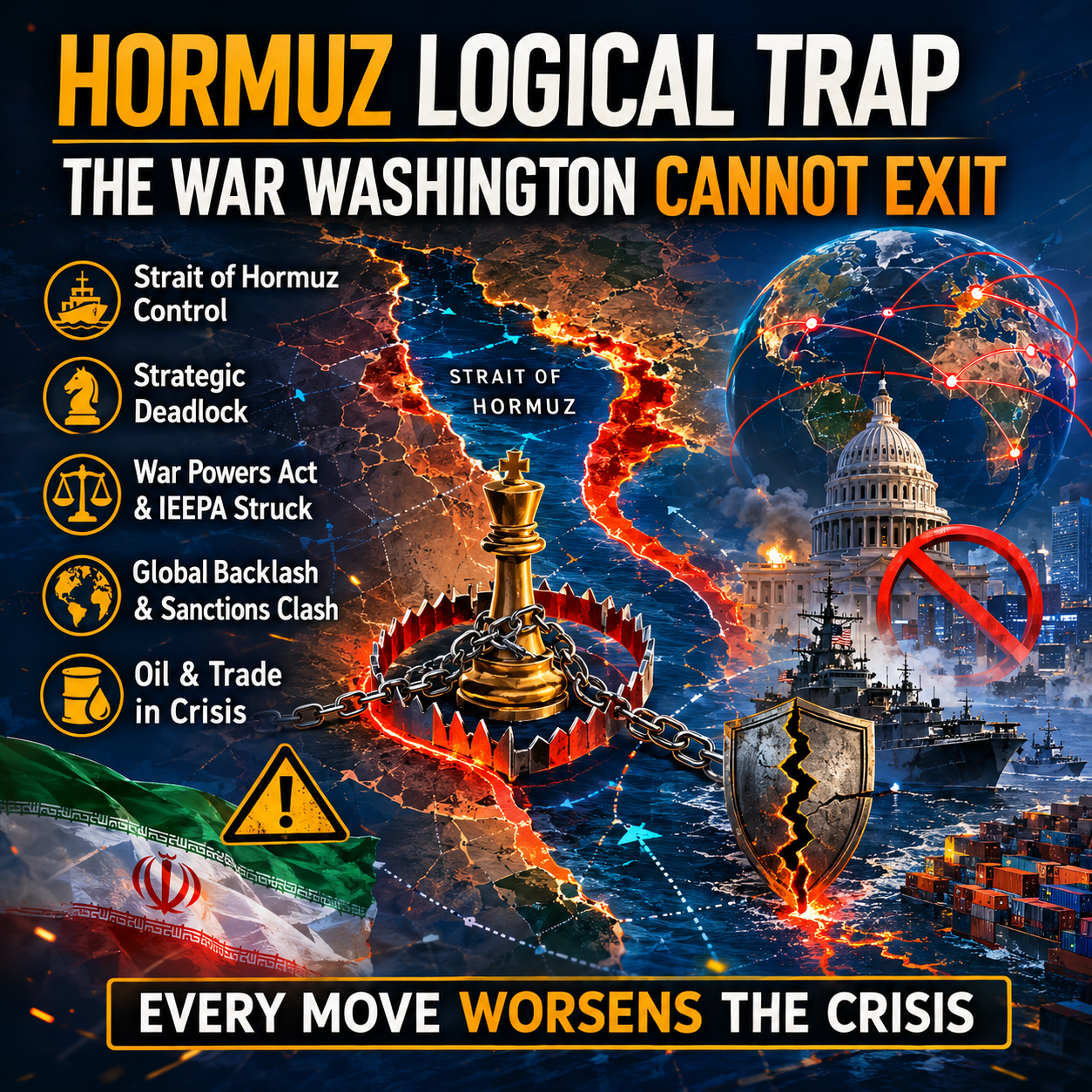
Hormuz Logical Trap: A Reckoning of West Asia’s Endless War (56)
Part 56 of the West Asia’s Endless War Series
भारत / GB
The War That Cannot Be Won, Cannot Be Lost, and Cannot Be Stopped. Washington Swallowed It. Now It Cannot Spit It Back.
Blog 55 (China Sanctions War) documented Beijing’s blocking order making compliance with Washington’s sanctions illegal under Chinese law — the Dollar Machine’s surveillance architecture meeting its first sovereign challenger. Blog 56 examines the stalemate that the Fujairah strikes of May 4 2026 have made undeniable: the Hormuz Logical Trap is a situation in which every available move produces a worse outcome than the current one — and the current one is already unsustainable. Washington swallowed this war on February 28 by launching Operation Epic Fury. It cannot achieve its objectives. It cannot withdraw without humiliation. And it cannot continue without fighting the entire world simultaneously.
Hormuz Logical Trap: The Bone Stuck in the Throat
Hormuz Logical Trap: Washington cannot swallow the war or spit it back. Every move available makes the position worse. The logic of the situation has trapped the actor inside it. The Hormuz Logical Trap has three sides — three objectives Washington stated publicly when it launched Operation Epic Fury on February 28, none of which have been achieved and none of which can be abandoned without confirming defeat.
— User (@Mutuyimana0787)
January 1, 2026
Objective One: eliminate Iran’s nuclear programme.
Iran’s nuclear infrastructure was damaged in the opening strikes. It was not destroyed. Iran restricted post-ceasefire IAEA access — meaning the post-war nuclear visibility is worse than pre-war. Iran’s nuclear programme is intact, less monitored, and now protected by the argument that engaging with inspectors produced a targeting opportunity. Washington entered the war to end the nuclear threat. The nuclear threat is larger and less visible than when the war began.
Objective Two: remove the Supreme Leader.
Khamenei was killed in the opening strikes. Blog 39 (IRGC Mosaic Reckoning) established that the distributed architecture was designed precisely to survive decapitation. The IRGC’s 31 independent commands continued operating. The Fujairah strikes of May 4 — 12 ballistic missiles, 3 cruise missiles, and 4 drones engaged by UAE air defences in a single day — demonstrate that removing the head did not remove the capability or regime’s philosophy. The snake was cut. The each part of it is still striking.
Objective Three: end Hormuz as a toll booth.
Blog 29 (Toll Booth Survives Reckoning) established that the toll booth survived the war. The ceasefire confirmed it. Washington’s Operation Project Freedom — escorting ships through Hormuz — is not the elimination of the toll. It is Washington collecting the toll through military escort rather than Iran collecting it through territorial waters authority. The difference is who collects. The toll booth remains. The Hormuz Logical Trap is that the war was launched to eliminate the toll booth and has produced a situation where two powers are fighting over who collects the toll — which is a worse position than the one the war was meant to remedy.
📌 Why Iran Will Not Blink
The civilisational depth, the distributed military architecture, and the strategic doctrine that makes Iran’s continued resistance rational — the argument that makes the Hormuz Logical Trap permanent rather than temporary.
Hormuz Logical Trap: Five Walls and No Exit
Wall One — Trump cannot back down.
Blog 54 (Confession of Superpower Pirate) documented Trump calling his Navy pirates and boasting the seizures are “a very profitable business.” Trump warned Iran that it will be “blown off the face of the earth” if it targets US ships protecting commercial vessels. A settlement that leaves Iran’s nuclear programme intact, recognises its Hormuz toll authority, and returns seized oil is the only settlement Iran will accept — and it is domestically unsellable in Washington as anything other than the humiliation the German Chancellor already named publicly. The Hormuz Logical Trap’s first wall: the domestic political cost of retreat exceeds the military cost of stalemate, so stalemate continues.
Wall Two — Iran is hungry but cannot surrender.
Forty-seven years of sanctions had compressed Iran’s economy before the war — pharmaceutical supply chains collapsed, household income fell, and the currency hit historic lows. The pharmaceutical collapse documented across the series has deepened under wartime conditions. Negotiations between Iran and the US have been deadlocked since the ceasefire started on April 8, with Tehran’s nuclear programme and its stranglehold on the Strait of Hormuz remaining as key points of contention. Iran’s civilian population is absorbing economic devastation that the IRGC’s operational resilience cannot offset. The hunger is real. But the minimum settlement Iran can present domestically as strategic victory — nuclear programme intact, Hormuz toll recognised, seized oil returned — is precisely the maximum concession Washington’s domestic politics cannot accept. The Hormuz Logical Trap’s second wall: both sides need a settlement, neither can accept the other’s minimum terms.
Wall Three — Congress is closing in.
The War Powers Act’s 60-day clock for unauthorised military engagements expired on April 28 — six days before the Fujairah strikes. Bipartisan resolutions requiring withdrawal have been filed. The Supreme Court has already struck down the IEEPA tariff authority. Reuters confirmed a bipartisan Senate resolution invoking the War Powers Act was advancing in committee as of April 28 — the day the 60-day clock expired. The Hormuz Logical Trap’s third wall: the institutional architecture of American constitutional government is constraining the war’s continuation from inside the American system simultaneously with every external pressure.
Wall Four — Washington is fighting the entire world simultaneously.
NATO is fracturing — Germany told publicly it is being humiliated, troops withdrawn as punishment. China has passed a blocking order making Washington’s sanctions unenforceable within Chinese jurisdiction. The EU is absorbing a 63% energy price spike from a war it was not consulted on. The Supreme Court has struck down the tariff architecture. Twenty-three states are suing. South Korean ships are being fired upon and Trump is asking South Korea to join the mission — to which South Korea’s response has been silence. The Hormuz Logical Trap’s fourth wall: the war that was supposed to demonstrate American resolve has demonstrated American isolation.
Wall Five — The ceasefire was always an illusion.
Iran’s state broadcaster attributed the May 4 strikes to “US military adventurism aimed at creating a passage for the illegal transit of ships through the restricted waterways of the Strait of Hormuz.” Operation Project Freedom — Washington’s attempt to escort ships through Hormuz — was the act that ended the ceasefire in practice. Iran had stated explicitly it would respond to any attempt to reopen Hormuz without negotiated terms. Washington chose to test that statement three days before the Fujairah strikes. Three Indian nationals were injured at Fujairah’s Petroleum Industries Zone — the Habshan-Fujairah pipeline terminus, UAE’s only partial Hormuz bypass. The India Hormuz Trap — documented in Blog 24 — has its human expression: Indian workers in UAE absorbing Iranian strikes in a war India had nothing to do with. The Hormuz Logical Trap’s fifth wall: the ceasefire was a pause between rounds, not a settlement, and both sides knew it.
It is a situation of a python, neither able to spit out a prey, nor able to swallow it.
The war to eliminate the nuclear threat has made the nuclear programme less visible and less constrained. The decapitation to end Iran’s military capacity has demonstrated the capacity’s irrelevance to leadership. The ceasefire to create negotiating space has produced the resumption of strikes the moment Washington used the space to advance its operational position. Washington’s Global Control War is consuming its own instruments. The bone is stuck. The throat cannot swallow it and cannot expel it. The Hormuz Logical Trap is what happens when a superpower launches a war it cannot win, frames it in terms it cannot abandon, and discovers that the only exit requires admitting that the war was a mistake — which is the one admission that the domestic politics of a superpower never permits.
📌 The War That Created the Trap
Washington’s Global Control War — Iran is the instrument, the war is against economic independence from Washington wherever it exists. Blog 46 named the design whose logical consequences Blog 56 documents.
Next: India Energy Exposure — Blog 57 in West Asia’s Endless War examines India’s position in the commercial architecture the Iran war has restructured: 90 lakh workers in Gulf states, Chabahar investment in Iran, defence partnership with Israel, energy dependency across four competing supply chains simultaneously, and a Strategic Defence Partnership with UAE signed nineteen days before the war began. Three Indian nationals were injured at Fujairah on May 4 — the Hormuz Logical Trap has its human expression. Part of the West Asia’s Endless War Series on hinduinfopedia.com.
Feature Image: Click here to view the image.
Videos
Glossary of Terms
- Hormuz Logical Trap: A term coined in this blog describing a strategic situation where every available option worsens the existing crisis, while the current situation itself remains unsustainable.
- Operation Epic Fury: The US-led military campaign launched on February 28 against Iran in the narrative framework of the series.
- Operation Project Freedom: The US naval escort mission intended to secure commercial shipping through the Strait of Hormuz after the ceasefire.
- Strait of Hormuz: A narrow maritime chokepoint between Iran and Oman through which a major portion of global oil trade passes.
- IRGC (Islamic Revolutionary Guard Corps): Iran’s powerful parallel military structure responsible for strategic, ideological, and regional military operations.
- Distributed Architecture: A decentralised command-and-control structure designed to survive leadership decapitation or communication disruption.
- IAEA (International Atomic Energy Agency): The United Nations nuclear watchdog responsible for monitoring nuclear facilities and compliance.
- IEEPA (International Emergency Economic Powers Act): A US law allowing the President to regulate economic activity during national emergencies.
- War Powers Act: A US federal law intended to limit presidential authority to conduct prolonged military operations without Congressional approval.
- Fujairah Strikes: Missile and drone attacks targeting the UAE’s Fujairah region on May 4, 2026, escalating tensions after the ceasefire.
- Hormuz Toll Booth: A recurring phrase in the series referring to strategic control over maritime passage through the Strait of Hormuz.
- Blocking Order: A legal mechanism used by states such as China to prohibit compliance with foreign sanctions inside their jurisdiction.
- Washington’s Global Control War: A concept developed in the series describing the conflict as a broader struggle over global economic and strategic dominance.
- Strategic Deadlock: A condition where opposing sides cannot secure victory, retreat, or acceptable compromise without severe consequences.
- Chabahar: An Iranian port developed with Indian involvement to expand regional trade connectivity while bypassing Pakistan.
#Iran #Hormuz #MiddleEast #Trump #Oil #Geopolitics #Sanctions #War #China #IAEA #IRGC #UAE #Israel #India #HinduinfoPedia
West Asia’s Endless War: Why This Series Exists
[…] भारत / GB […]
[…] Blog 56 (Hormuz Logical Trap) documented Washington’s stalemate — five walls, no exit, a war that cannot be won, cannot be lost, and cannot be stopped. Blog 57 examines India’s position inside the same trap, which India entered not through its own strategic choices but through the structural architecture of its energy dependency, its diaspora, and its relationship network. India Energy Exposure is the argument that India’s nine simultaneous relationships with West Asia’s principal actors have placed India at the intersection of every competing interest in the conflict — friend to all, committed to none, exposed to each. […]
[…] https://hinduinfopedia.com/hormuz-logical-trap-a-reckoning-of-west-asias-endless-war-56/ […]
[…] Read […]
[…] by UAE air defences — were the Mosaic architecture’s operational proof after decapitation. Blog 56 (Hormuz Logical Trap) established that this produces the trap’s second wall: Iran is hungry but cannot surrender, […]
[…] War) established that the war is against economic independence from Washington wherever it exists. Blog 56 (Hormuz Logical Trap) established that Washington cannot win, cannot withdraw, and cannot […]
[…] seventy-three-year breeding programme for the most resilient expression of Iranian resistance. The Hormuz Logical Trap is the organism’s current form — the product of every decapitation the template has applied […]
[…] — and most consequential: the Hormuz Logical Trap the organism produced in 72 hours has no exit through the template. Washington cannot apply a […]
[…] — और सबसे महत्वपूर्ण: होरमुज तार्किक जाल, जिसे इस जीवित व्यवस्था ने 72 घंटों में […]
[…] every time — 230 interventions, three decapitations, Operation Epic Fury, the War on Terror. The Hormuz Logical Trap (Blog 56) is what happens when an entity that fights every battle encounters an entity practicing the Art of […]
[…] Read: Hormuz Logical Trap → […]
[…] पढ़ें: होरमुज तार्किक जाल → […]
[…] Read: Hormuz Logical Trap → […]
[…] पढ़ें: होरमुज का तार्किक जाल → […]
[…] Read: Hormuz Logical Trap → […]
[…] पढ़ें: होरमुज लॉजिकल ट्रैप → […]
[…] किया था जो इस टकराव को बनाए रखती है। होरमुज़ तार्किक जाल (ब्लॉग 56) ने उन पाँच बाधाओं का वर्णन किया था जो […]
[…] Read: Hormuz Logical Trap → […]
[…] Read: Hormuz Logical Trap → […]
[…] पढ़ें: होरमुज तार्किक जाल → […]
[…] Read: Hormuz Logical Trap → […]