

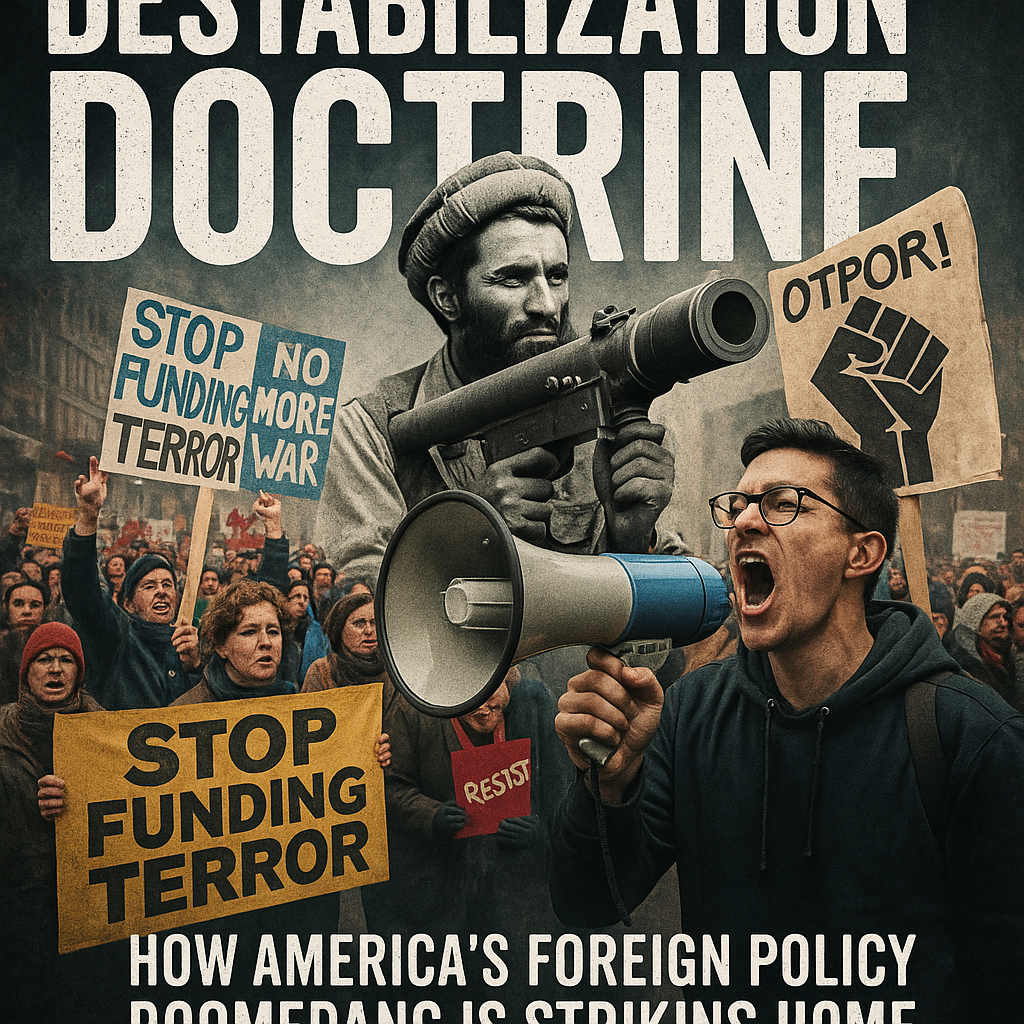
Destabilization Doctrine: How America’s Foreign Policy Boomerang Is Striking Home
Part 1: Destabilization Doctrine of America
The Pattern of Blowback
History has a peculiar way of turning strategies against their architects. What begins as calculated geopolitical maneuvering in distant lands often returns with devastating consequences to the nations that initiated it. From the icy mountains of Afghanistan to the streets of Western capitals, from the tribal regions of Pakistan to the boulevards of Dhaka and Kathmandu, a disturbing pattern has emerged: the tools of destabilization, once wielded with surgical precision against adversaries, eventually find their way back home.
This is the story of blowback—not just as isolated incidents, but as a systematic phenomenon where foreign intervention tactics, proxy warfare strategies, and regime-change playbooks ultimately become weapons against their creators.
The Afghanistan Template: Creating Monsters to Fight Enemies
The most documented and catastrophic example of blowback began in the frigid valleys of Afghanistan in 1979. When the Soviet Union invaded Afghanistan to prop up its communist ally, the United States saw an opportunity to deliver a strategic blow to its Cold War adversary.

Through Operation Cyclone, the CIA funneled approximately $20 billion worth of arms and training to Afghan mujahideen fighters, transforming them from tribal militias into a formidable force. The strategy worked brilliantly—the Soviets were bled dry, eventually withdrawing in 1989, contributing to the USSR’s eventual collapse.
But the victory came with an invisible price tag.
The same mujahideen fighters, armed with American weapons and trained in guerrilla warfare, became the breeding ground for the Taliban. More critically, the infrastructure and ideology nurtured during this period gave birth to al-Qaeda and Osama bin Laden, who would eventually orchestrate the September 11, 2001 attacks—the deadliest terrorist attack on American soil.
The Taliban’s takeover of Kabul in 1996 marked the consolidation of a regime that would provide sanctuary to the very terrorists who attacked their former benefactor. The chickens had come home to roost.
The irony is profound: American funds intended to counter Soviet influence created the ideological and material foundation for global jihadism. Osama bin Laden’s journey from a CIA-supported fighter to America’s most wanted enemy epitomizes the dangers of short-term tactical thinking without consideration of long-term consequences.
Pakistan’s Terror Infrastructure: The Scorpion That Stings Its Master
If Afghanistan represents American blowback, Pakistan embodies a nation consumed by its own creation. Throughout the 1990s and 2000s, Pakistan’s Inter-Services Intelligence (ISI) systematically created, funded, and directed terrorist infrastructure aimed at India—particularly to destabilize Kashmir and bleed India through a “thousand cuts.”

Groups like Lashkar-e-Taiba, Jaish-e-Mohammed, and others became Pakistan’s “strategic assets,” executing operations like the Indian Parliament attack and the 1993 World Trade Center bombing, extending global jihad’s reach even to Africa.
But the scorpion eventually stung its keeper.
The same terrorist ecosystem spawned the Tehrik-i-Taliban Pakistan (TTP), which has now turned its guns on the Pakistani state itself. In 2023, Pakistan recorded the highest number of terrorist incidents globally, with 490 attacks. The monster that Pakistan nurtured to fight India has now become an existential threat to Pakistan’s own stability.
India’s decisive response through the Balakot airstrike demonstrated that victims of Pakistan’s terror infrastructure were no longer willing to absorb attacks passively. Yet Pakistan finds itself trapped—unable to dismantle the infrastructure without risking violent blowback, yet unable to control groups that have developed their own momentum and agenda.
The establishment of Pakistan on the premise of the Lahore Resolution and its Islamic identity created ideological foundations that made it vulnerable to the very extremism it weaponized. The “strategic depth” doctrine has become strategic quicksand.
The Color Revolution Playbook: From Foreign Streets to Domestic Upheaval
While the Afghanistan and Pakistan cases involve military and terrorist blowback, a more sophisticated form of intervention has emerged since the early 2000s: the “color revolution” model.
An infographic circulating online illustrates the standardized protest choreography—hand gestures, color coding, and slogan sequencing—used in multiple “democracy” movements across continents.
Hundreds of protests are taking place today across the U.S. from 50501, Tesla Takedown, No Kings, Hands Off, Indivisible, etc.
Make your voices heard! pic.twitter.com/hhXKeQ8kHm
— Art Candee 🍿🥤 (@ArtCandee) April 19, 2025
The Perfected Formula
The regime-change playbook developed by Western intelligence agencies and democracy-promotion organizations follows a predictable pattern:
- Identify legitimate grievances within a target nation
- Fund civil society organizations through entities like USAID, National Endowment for Democracy (NED), and International Republican Institute (IRI)
- Train youth activists in protest tactics, social media mobilization, and organizational strategies
- Amplify discontent through funded media outlets and social networks
- Coordinate sustained protests that create ungovernable situations
- Facilitate regime collapse or force leadership changes favorable to Western interests
This model achieved spectacular success in Ukraine (Orange Revolution, 2004; Euromaidan, 2014), Georgia (Rose Revolution, 2003), Kyrgyzstan (Tulip Revolution, 2005), and numerous other locations.
Bharat: The Ultimate Target?
Before examining how this playbook succeeded in Nepal and Bangladesh, it’s crucial to understand that India appears to be the ultimate target of these destabilization efforts. The encirclement strategy is unmistakable: regime changes in neighboring countries weaken India’s strategic position, while simultaneous internal pressure points are activated to create instability within Bharat itself.
The playbook’s application within India follows the familiar pattern with disturbing precision:
Step 1: Identifying and Engineering Flashpoints
The “I Love Mohammad” incident represents a textbook example of manufactured communal tension designed to trigger mass mobilization. Using social media to inflame religious sentitivities, testing whether a seemingly minor provocation can cascade into widespread unrest—this is straight from the color revolution manual.
Similarly, the protests in Ladakh—a strategically critical region bordering China and Pakistan—follow suspicious patterns. Legitimate local concerns about environmental protection and tribal rights are amplified and directed toward destabilizing central government authority, precisely when geopolitical tensions in the region are highest. When neighbors become examples, the contagion effect is intentional.
Step 2: Grooming Acceptable Leadership
Perhaps most revealing is the systematic cultivation of specific political figures as acceptable alternatives to current leadership. A prominent opposition figure making regular pilgrimages to Washington and Oxford every 3-6 months—not to promote India, but to systematically undermine Indian democracy in Western capitals—represents the quintessential “our man in Delhi” strategy.
This individual’s function mirrors that of Western-approved opposition leaders cultivated before regime changes elsewhere: establish credibility with Western power centers, internalize their critiques of the current government, and position oneself as the “democratic” alternative that Western governments can work with. The frequency and consistency of these visits—combined with the content of speeches that align perfectly with Western talking points against India—reveals a grooming process for potential future leadership aligned with Western interests rather than Indian sovereignty.
Step 3: The Infrastructure Is Already There
The apparatus for regime change is already embedded within India:
- NGOs with foreign funding pursuing strategic objectives disguised as social causes
- Media outlets amplifying specific narratives aligned with external interests
- Academic networks in premier institutions pushing post-colonial, anti-national frameworks
- “Civil society” organizations coordinating protests with sophisticated social media strategies
- Legal activism using courts to obstruct governance and create paralysis
The toolkit gang exposure during the farmers’ protests revealed glimpses of this coordination—but that was merely one visible instance of a much larger, persistent infrastructure.
Why India Matters Differently
India represents a unique challenge and opportunity for the destabilization doctrine:
- Geopolitical Prize: A democratic counterweight to China that refuses to align with Western bloc politics, instead pursuing strategic autonomy and sovereignty
- Economic Threat: India’s rupee rebellion and efforts to build post-dollar trade architecture directly challenge Western financial hegemony
- Ideological Resistance: India’s civilizational consciousness and democratic depth make it resilient to regime-change tactics, yet this resilience itself becomes a target—if India can’t be changed, it must be destabilized
- Demonstration Effect: If India succeeds in maintaining sovereignty while achieving development, it provides a model for other nations to resist Western diktat, undermining the entire rules-based order that selectively punishes peacemakers
The attempts in Bharat haven’t succeeded at the scale seen in Bangladesh or Nepal—yet. But make no mistake: the attempts are persistent, the infrastructure is in place, and the playbook is being tested repeatedly. Each “I Love Mohammad” incident, each Ladakh protest, each internationally-coordinated campaign against India represents another test run, another probe for weaknesses, another effort to find the formula that will work.
South Asia: The New Testing Ground
Recent years have witnessed an alarming pattern of this playbook being deployed across South Asia—a region critical to both Chinese Belt and Road ambitions and Indian regional influence.
Nepal 2025: The Documentary Evidence
❗️#America has risen up against @POTUS
Thousands of protesters have already flooded the streets of #Boston
Go USA! 🔥🔥🔥 pic.twitter.com/eyPcL96h1s
— Aurora Borealis 🤫 (@aborealis940) April 5, 2025
Public grant records show that the National Endowment for Democracy (FY 2024 Asia Grants) includes a $350,000 core-institute grant to the International Republican Institute for “Empowering Youth to Strengthen Democratic Foundations for Transformative Change.” Although another $65,000 grant titled “Promoting Youth Civic Engagement and Movement Building” appears in the same document, its country header is listed under Thailand, not Nepal. Several analysts nonetheless link similar youth training and mobilization efforts to Nepal’s 2025 protests that unseated PM Oli. Whether those movements were authentically grassroots or encouraged through foreign programs remains debated—but the financial trail demonstrates how external funding for “democratic capacity building” often coincides with political transitions in strategic regions.
Since NED reports annually to the US Congress, Washington was fully aware of anti-India activities being supported on Indian borders.
Bangladesh 2024: A $1.73 Billion Investment
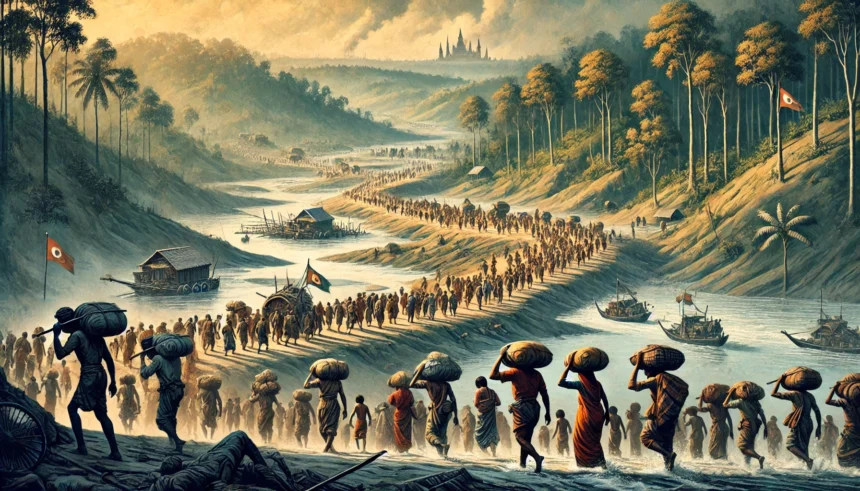
According to the U.S. foreign-assistance database (ForeignAssistance.gov, compiled by USAFacts), Washington obligated approximately $490 million in FY 2023 and $490.5 million in FY 2024 to Bangladesh across USAID and State Department programs. A broader USAID 2021-2026 framework agreement committed $954 million toward development and governance projects, making total U.S. support over $1 billion in the 2020-24 period. Within this ecosystem, the NED acknowledged funding Netra News, an exile-run outlet that has regularly criticized the Hasina government. While some observers argue that these civil-society and media grants constituted an attempt to shape Bangladesh’s political trajectory, the causal chain linking U.S. aid to Hasina’s eventual ouster remains contested. Reports in regional media cite Hasina’s claim that she faced pressure to grant a U.S. military presence on Saint Martin’s Island, but the White House has formally denied any role in her removal, and Hasina’s son later disputed the exact statement attributed to her. The episode nevertheless illustrates how strategic aid, information operations, and local grievances can intersect to produce rapid political shifts in South Asia.
Street visuals from Dhaka reveal how youth mobilization and foreign-funded messaging converged under Western-style “democracy” slogans—mirroring the same color revolution blueprint applied elsewhere.
Anti-Trump demonstrators crowd streets, parks and plazas across the US. Millions of protesters decried Trump’s authoritarianism.#NoKings 🇺🇸
10/12 pic.twitter.com/WWQCtAOiv9
— 𝐀𝐧𝐧𝐚 𝐊𝐎𝐌𝐒𝐀 | 🇪🇺🇫🇷🇵🇱🇺🇦 (@tweet4Anna_NAFO) June 15, 2025
Moldova 2024: The Western Success
In Moldova, pro-Western President Maia Sandu won re-election in November 2024 amid heavy Western support and Russian accusations of interference. The playbook had delivered another win for Western interests in Russia’s near-abroad.
Turkey and Iran: Containment Through Chaos
Turkey’s 2013 Gezi Park protests—ostensibly about environmental concerns—escalated into a challenge to Erdoğan’s rule. While Turkish prosecutors claimed links to “color revolution” tactics and George Soros funding, the protests followed familiar patterns of seemingly organic movements amplified by external networks.
Iran’s Mahsa Amini protests in 2022, triggered by the death of a Kurdish-Iranian woman in morality police custody, represented genuine anger at authoritarian repression. Yet the sophisticated social media coordination, Western media amplification, and sustained pressure bore hallmarks of movements that receive external support to maximize impact.
The Domestic Boomerang: Tactics Turning Inward
Here lies the most profound and recent blowback: the same tactics perfected abroad are now being deployed domestically within Western nations.

The BLM Catalyst and Electoral Impact
The Black Lives Matter protests of 2020 followed the tragic death of George Floyd and tapped into legitimate grievances about racial injustice and police brutality. However, the characteristics of these protests differed markedly from traditional American civil rights demonstrations.
Academic studies confirm that BLM protests significantly increased Democratic vote share and contributed to Biden’s victory in 2020, particularly in swing states. The protests caused progressive shifts in political preferences, with the effects most pronounced in counties that experienced protests.
What raised eyebrows was the organized nature of the violence. The arson, looting, and coordinated chaos that accompanied many protests bore striking similarities to the destabilization tactics employed in color revolutions abroad. 88% of riots during BLM protests involved BLM activists, suggesting organizational coordination beyond spontaneous unrest.
Open Society Foundations and related networks funded organizations within the racial justice ecosystem, though direct funding amounts remain disputed. The question isn’t whether every protester was directed from above, but whether existing anger was weaponized and amplified through the same networks that operate internationally.
The electoral impact was undeniable: Trump lost. Whether this was purely organic or involved the same sophisticated amplification techniques used in Nepal and Bangladesh remains a matter of analysis and conviction.
The Resistance Infrastructure
After the 2024 election, reports began surfacing of an informal network of former USAID and State Department officials quietly organizing “non-cooperation” workshops for sympathetic federal employees. Investigative outlet NOTUS detailed how ex-officials fired under the Trump administration were “holding workshops on a tactic called non-cooperation,” teaching office slow-downs and procedural resistance drawn partly from the CIA’s historic Simple Sabotage Manual.
Anti-Trump demonstrators crowd streets, parks and plazas across the US. Millions of protesters decried Trump’s authoritarianism.#NoKings 🇺🇸
10/12 pic.twitter.com/WWQCtAOiv9
— 𝐀𝐧𝐧𝐚 𝐊𝐎𝐌𝐒𝐀 | 🇪🇺🇫🇷🇵🇱🇺🇦 (@tweet4Anna_NAFO) June 15, 2025
A watchdog profile on InfluenceWatch identifies this network as “DemocracyAID,” describing it as a proposed organization that had no public website or IRS registration as of mid-2025, yet was already reported to be facilitating these sessions. Complementary reporting from PBS / AP NewsHour documented concurrent investigations into internal resistance within USAID — illustrating the wider atmosphere in which such efforts took shape.
Although DemocracyAID remains an unregistered entity, the pattern it represents is unmistakable: the same regime-change and civic-disruption expertise once exported abroad now reappears as “bureaucratic resistance” within the very government that honed it.
The Meta-Pattern: Tools of Empire Becoming Tools of Chaos
Across these cases—from Afghanistan to Bangladesh, from Pakistan to Portland—a disturbing meta-pattern emerges:
Phase 1: Foreign Deployment (1980s-2020s)
- Develop sophisticated intervention toolkit
- Fund proxies and train activists
- Achieve tactical victories (Soviet withdrawal, regime changes)
- Ignore long-term consequences
Phase 2: Unintended Consequences (1990s-2020s)
- Created forces develop independent agendas
- Former proxies become adversaries
- Regional instability spreads beyond control
- Blowback manifests in terrorism and conflict
Phase 3: The Domestic Turn (2020-Present)
- Same networks apply tactics domestically
- Former regime-change operatives resist domestic leadership
- The tools perfected abroad become tools against home governments
- The boomerang completes its arc
Why Blowback Is Inevitable
Several factors make blowback not just possible but inevitable:
1. The Autonomy of Created Forces Groups funded and trained for specific purposes develop their own ideologies, interests, and momentum. The mujahideen didn’t remain American proxies; they became independent actors with their own agendas.
2. Ideological Contagion Extremist ideologies, whether jihadist or revolutionary, spread beyond their intended targets. Pakistan’s Kashmir-focused militants inspired TTP. Protest tactics used in Ukraine inform movements in Nepal.
3. Network Effects The infrastructure created for interventions—funding channels, training programs, media networks—persists beyond specific operations and can be redirected toward new targets, including the creators themselves.
4. Moral Hazard Success in one intervention encourages more interventions, creating a cycle where tools become normalized and eventually applied without considering who might wield them next.
5. The Principle of Reciprocity In international relations, what one power does establishes precedent for others. Color revolution tactics used by the West are studied and adapted by adversaries—and by domestic opposition movements.
India: The Recurring Target
Throughout this pattern, India emerges as a consistent target of destabilization attempts:
- Global jihad spreading to Kashmir through Pakistan’s terror infrastructure
- The War on Terror’s legacy creating persistent regional instability
- Nepal and Bangladesh regime changes weakening India’s strategic neighborhood
- Repeated attempts to engineer protests and instability within India itself
The “I Love Mohammad” and similar incidents represent ongoing attempts to import color revolution tactics into Indian streets, using communal sensitivities as the grievance to be amplified.
Yet India’s democratic resilience and civilizational depth have thus far prevented successful regime-change operations—making it a fascinating case study in resistance to external manipulation.
The Cycle Continues
The pattern is clear, the evidence compelling, and the consequences mounting. Nations that deploy destabilization tactics abroad—whether through arming militants, funding protests, or orchestrating regime changes—invariably face blowback. The tools of intervention become tools of chaos, returning to haunt their creators.
Afghanistan’s mujahideen became al-Qaeda. Pakistan’s jihadists became TTP. Color revolution techniques perfected in Eurasia are now applied in South Asia—and increasingly within Western nations themselves.
The most recent manifestation—resistance networks within the US government itself, trained in regime-change tactics and now deploying them domestically—represents the completion of the blowback cycle.
The lesson is ancient but perpetually ignored: those who live by destabilization die by destabilization. The scorpion will sting, the boomerang will return, and the tools of empire will eventually be turned against their wielders.
As this pattern accelerates and spreads, the question is no longer whether blowback will occur, but how devastating it will be when it does. The chickens, it seems, always come home to roost.
Update – 20 November 2025:
The mayhem created by Congress workers in Jaipur, despite zero public grievance or organic mobilisation, offers a fresh demonstration of the destabilization pattern discussed in this blog. The deliberate youth-driven confrontation, absence of public participation, and engineered escalation closely mirror the same political-unrest templates once exported abroad. What was once a foreign policy tool has now become an internal playbook.
This analysis is part of an ongoing series examining global terrorism, foreign intervention, and regional security dynamics. For deeper exploration of specific events and their implications, see the linked articles throughout this piece.
Feature Image: Click here to view the image.
Videos
Glossary of Terms
1. Operation Cyclone: A covert CIA program (1979–1989) that funded and armed Afghan mujahideen to fight Soviet forces during the Cold War.
2. Mujahideen: Islamic guerrilla fighters who resisted Soviet occupation in Afghanistan, later forming the ideological roots of Taliban and Al-Qaeda.
3. Inter-Services Intelligence (ISI): Pakistan’s premier intelligence agency, often accused of supporting and managing jihadist groups in South Asia for strategic purposes.
4. Tehrik-i-Taliban Pakistan (TTP): A coalition of Islamist militant groups targeting Pakistan’s own state and security forces, emerging from its own terror ecosystem.
5. Lashkar-e-Taiba (LeT): Pakistan-based militant organization responsible for numerous terrorist attacks, including the 2008 Mumbai attacks.
6. Jaish-e-Mohammed (JeM): A Pakistan-based extremist group involved in multiple attacks in India, including the 2019 Pulwama suicide bombing.
7. Color Revolution: A term for non-violent protest movements—often externally supported—that lead to regime change in post-Soviet and developing nations.
8. USAID (United States Agency for International Development): A U.S. government agency funding international development, democracy promotion, and at times, alleged regime-change activities.
9. National Endowment for Democracy (NED): A U.S.-funded organization promoting democracy abroad, frequently accused of supporting opposition movements in target nations.
10. International Republican Institute (IRI): A U.S. non-profit affiliated with NED that trains activists and political groups to advance “democratic governance” overseas.
11. Euromaidan: The 2013–2014 protests in Ukraine that led to the ouster of President Viktor Yanukovych, seen as a Western-backed color revolution.
12. Gezi Park Protests: A 2013 protest movement in Turkey that began over environmental issues and evolved into widespread anti-government demonstrations.
13. Mahsa Amini Protests: Nationwide Iranian protests in 2022 sparked by the death of Mahsa Amini, blending genuine anger with international amplification.
14. Black Lives Matter (BLM): A U.S. social movement advocating racial justice; its large-scale protests in 2020 also reflected organized mobilization tactics.
15. Balakot Airstrike: India’s 2019 airstrike inside Pakistan in response to the Pulwama attack, marking a shift in India’s counter-terrorism posture.
16. Strategic Depth Doctrine: Pakistan’s military policy of controlling Afghanistan to gain advantage over India, which ultimately backfired internally.
17. Strategic Autonomy: India’s foreign policy principle of maintaining independence from global power blocs while pursuing its own national interests.
18. Color Revolution Playbook: A set of protest, media, and funding strategies used to orchestrate regime change through civic movements rather than direct war.
19. Open Society Foundations: Philanthropic organization founded by George Soros, known for funding civil society and protest movements globally.
20. Blowback: A CIA-coined term describing unintended negative consequences of covert operations that return to harm the initiator.
#Blowback #Geopolitics #ForeignPolicy #Destabilization #HinduinfoPedia
#DestabilizationDoctrineofAmerica
Later Blog of the Series
- https://hinduinfopedia.com/activation-of-destabilization-doctrine-the-india-deployment-begins/
- https://hinduinfopedia.com/rahuls-gen-z-call-activation-of-destabilization-doctrine/
- https://hinduinfopedia.com/target-india-action-phase-doctrine-in-motion/
Our Related Blogs
- https://hinduinfopedia.org/india-pakistan-relations-under-i-k-gujral-impact-of-his-policies-on-dharma-and-national-security
- https://hinduinfopedia.org/civilization-under-siege-why-hindu-communities-face-an-existential-crisis/
- https://hinduinfopedia.org/bangladesh-hindu-killings-politics-of-massacre-part-iii/
- https://hinduinfopedia.org/bangladesh-hindu-killings-marichjhapi-the-untold-story-part-i/
- https://hinduinfopedia.org/afghanistan-soviet-war-the-world-peace-disrupter/
- https://hinduinfopedia.org/mumbai-attacks-reflections-on-november-26ths-impact-on-indias-path/
- https://hinduinfopedia.org/taliban-takeover-of-afghanistan-1996/
- https://hinduinfopedia.org/riots-in-kohat-and-forgotten-exodus-kashmir-exodus-1-0-2/
- https://hinduinfopedia.org/indo-pak-war-and-operation-grand-slam/
- https://hinduinfopedia.org/madrasa-education-in-india/
- https://hinduinfopedia.org/article-370-path-to-insertion-and-revocation/
- https://hinduinfopedia.org/radcliffe-line-elusive-boundary-that-crafted-chaos/
- https://hinduinfopedia.org/afghanistan-and-taliban/
- https://hinduinfopedia.org/direct-action-day-1946-and-partition-of-india/
- https://hinduinfopedia.org/terrorist-attack-and-chamba-massacre-a-tragic-event/
- https://hinduinfopedia.org/terrorism-in-india-bangalore-serial-blasts-2008/
- https://hinduinfopedia.org/amarnath-yatra-ethical-reflections-on-the-2017-attack/
- https://hinduinfopedia.org/extremism-the-7-7-london-bombings-and-global-terror-infrastructure/
- https://hinduinfopedia.org/jammu-and-kashmir-massacre-at-chapnari/
- https://hinduinfopedia.org/pokhran-ii-stragetic-assertion-of-india/
- https://hinduinfopedia.in/lahore-resolution-review-pakistans-islamic-path/
- https://hinduinfopedia.in/pulwama-terror-attack-pakistan-sponsored-act/
- https://hinduinfopedia.in/indo-pak-war-1965-revelation-of-sinister-design-of-pakistan-22-sep/
https://hinduinfopedia.in/war-on-terror-the-legacy-of-osama-bin-laden/ - https://hinduinfopedia.in/osama-bin-laden-life-journey-through-terror/
- https://hinduinfopedia.in/kargil-conflict-history-of-indo-pak-religious-tensions/
- https://hinduinfopedia.in/kargil-war-a-turning-point-in-indo-pak-relations/
- https://hinduinfopedia.in/doda-massacre-2006-context-execution-and-aftermath/
- https://hinduinfopedia.in/gujral-doctrine-consequences-of-bharats-diplomatic-experiment/
- https://hinduinfopedia.in/prankote-massacre-1998-a-dark-day-in-jk-history/
- https://hinduinfopedia.in/raghunath-temple-attack-display-of-extremism/
- https://hinduinfopedia.in/global-jihad-impact-and-terrorism-in-kashmir/
- https://hinduinfopedia.in/nadimarg-massacre-tragedy-in-the-heart-of-kashmir/
- https://hinduinfopedia.in/lingering-shadows-of-violence-from-partition-to-terrorism/
- https://hinduinfopedia.in/mumbai-terror-attacks-1993-impact-and-legacy/
- https://hinduinfopedia.in/navigating-extremism-and-resilience-and-testing-tolerance/
- https://hinduinfopedia.in/1993-world-trade-center-bombing-day-of-remembrance/
- https://hinduinfopedia.in/the-balakot-airstrike-a-decisive-blow-in-modern-warfare/
- https://hinduinfopedia.in/islamic-extremism-linked-murder-of-delhi-police-officer-ratan-lal/
- https://hinduinfopedia.in/bridging-divides-the-lahore-declarations-impact/
- https://hinduinfopedia.in/shifting-borders-of-gilgit-baltistan/
- https://hinduinfopedia.in/ahmedabad-railway-station-bombing/
- https://hinduinfopedia.in/wandhama-massacre-1998/
- https://hinduinfopedia.in/global-terrorism-insight-the-indian-parliament-attack-anniversary/
- https://hinduinfopedia.in/akshardham-temple-terrorist-attack-2002/
- https://hinduinfopedia.in/mumbai-terrorist-attack-year-2000-to-2020/
Follow us:
- English YouTube: Hinduostation – YouTube
- Hindi YouTube: Hinduinfopedia – YouTube
- X: https://x.com/HinduInfopedia
- Instagram: https://www.instagram.com/hinduinfopedia/
- Facebook: https://www.facebook.com/Hinduinfopediaofficial
- Threads: https://www.threads.com/@hinduinfopedia
Explore more similar blogs
- https://hinduinfopedia.com/international-law-under-siege/
- https://hinduinfopedia.com/human-rights-paradox/
- https://hinduinfopedia.com/abrahamic-religions-alliance-how-global-networks-target-indias-democracy/
- https://hinduinfopedia.com/religious-tolerance-algorithms/
- https://hinduinfopedia.com/rights-based-solutions-breaking-free-from-strategic-deception-frameworks/
- https://hinduinfopedia.com/fastest-growing-religion/
- https://hinduinfopedia.com/religious-demographics-in-action/
- https://hinduinfopedia.com/religious-demographics-in-action-part-ii/
[…] https://hinduinfopedia.com/destabilization-doctrine-how-americas-foreign-policy-boomerang-is-strikin… […]
[…] https://hinduinfopedia.com/destabilization-doctrine-how-americas-foreign-policy-boomerang-is-strikin… […]
[…] Destabilization Doctrine: How America’s Foreign Policy Boomerang Is Striking Home — The international dimension of domestic unrest […]
[…] Destabilization Doctrine: America’s Foreign Policy Boomerang How regime-change tactics perfected abroad are now being redeployed at home. Target India: Doctrine in Motion Tracking the transition from theory to active destabilization on Indian soil. Domestic Blowback: US Regime Change Replays at Home When tools of foreign intervention return to fracture domestic stability. […]
[…] डेस्टैबिलाइज़ेशन डॉक्ट्रिन: अमेरिका… विदेशों में परिपक्व की गई शासन-परिवर्तन रणनीतियाँ अब घरेलू स्तर पर कैसे पुनः तैनात हो रही हैं। टार्गेट इंडिया: डॉक्ट्रिन क्रियान्वयन में सिद्धांत से सक्रिय अस्थिरता तक के संक्रमण का ट्रैक। डोमेस्टिक ब्लोबैक: अमेरिका का शासन-परिवर्तन घर में दोहराया गया विदेशी हस्तक्षेप के औज़ार जब घरेलू स्थिरता को तोड़ने लौटते हैं। […]
[…] Destabilization Doctrine Series (7 blogs) […]
[…] Iranian proxies, and Palestinian Islamic Jihad. India faces Pakistan-sponsored terrorism (Lashkar-e-Taiba, Jaish-e-Mohammed), domestic radicalization networks, and Kashmir insurgency. The same theological […]
[…] सामना पाकिस्तान-प्रायोजित आतंकवाद (लश्कर-ए-तैयबा, जैश-ए-मुहम्मद), घरेलू कट्टरपन्थी […]
[…] […]
[…] Destabilization Doctrine: How America’s Foreign Policy Boomerang Is Striking Home […]
[…] […]
[…] Destabilisation Doctrine: The Global Framework […]
[…] https://hinduinfopedia.com/destabilization-doctrine-how-americas-foreign-policy-boomerang-is-strikin… […]
[…] https://hinduinfopedia.com/destabilization-doctrine-how-americas-foreign-policy-boomerang-is-strikin… […]
[…] विदेशी नीति का पलटवार […]
[…] The Foreign Policy Boomerang […]
[…] pattern mirrors how destabilization doctrine operates when deployed domestically—targeted states face escalating pressure until […]
[…] Destabilization Doctrine Series (7 blogs) […]
[…] Destabilization Doctrine Series (7 blogs) […]
[…] received in full from 2019–2024. The kinetic operation is what happens when the toolkit fails. America’s Boomerang Policy: The Foreign Policy That Strikes Home — How the doctrines tested abroad return domestically. The Venezuela operation is this thesis […]
[…] वही है जो उपकरण विफल होने पर होता है। अमेरिका की प्रत्यागामी नीति: जो विदेश … — विदेश में परखे गए सिद्धांत कैसे […]
[…] Destabilization Doctrine: How America’s Foreign Policy Boomerang Is Striking Home The parent doctrine of which coordinated Palestine recognition pressure is one chapter — the mechanisms documented here applied globally […]
[…] […]
[…] […]
[…] in a supply crisis hurting every Asian economy including its own. There is no clean exit. The Destabilization Doctrine operating at full pressure — force a choice, make both options costly, extract maximum leverage […]
[…] रही है। कोई स्वच्छ निकास नहीं है। अस्थिरीकरण सिद्धांत पूरे दबाव में क्रियाशील है — एक […]
[…] to eliminate al-Qaeda and remove the Taliban. Twenty years and over three trillion dollars later, the Taliban governs Afghanistan again, ISIS-Khorasan conducts regular attacks, and al-Qaeda affiliat… The mission’s stated objective was not […]
[…] […]
[…] No military invasion — but the full apparatus of the destabilization doctrine applied through other means: sanctions, asset sei… Venezuela holds the world’s largest proven oil reserves — over three hundred billion […]
[…] […]
[…] This is the destabilization doctrine’s core mechanism — create the conditions that generate the justification, then deploy the justification to justify the force. In Iraq it was WMD. In Iran it is the nuclear pretext of West Asia War. The product differs. The mechanism is identical. […]
[…] […]
[…] pattern across all cases reveals the operating principle of NPT selective enforcement precisely. Nuclear weapons in the hands of states that serve or do not threaten US strategic and economic inter… Nuclear weapons in the hands of states that control strategic resources and refuse compliance face […]
[…] […]
[…] Destabilization Doctrine: How America’s Foreign Policy Boomerang Is Striking Home […]
[…] clearest evidence that the Western Narrative War operates independently of outcomes is Afghanistan. The 2001 invasion was sold on liberation, democracy, and the elimination of al-Qaeda. Twenty years and over three trillion dollars later, the Taliban governs Afghanistan, ISIS-Khorasan […]
[…] Global South War Narrative did not begin in 2026. It was constructed over two decades of documented US interventions that left Iraq dismembered, Libya destroyed, Venezuela sanctioned into collapse, and Syria […]
[…] Destabilization Doctrine: How America’s Foreign Policy Boomerang Is Striking Home […]
[…] Destabilization Doctrine: How America’s Foreign Policy Boomerang Is Striking Home […]
[…] Destabilization Doctrine: How America’s Foreign Policy Boomerang Is Striking Home […]
[…] Destabilization Doctrine: How America’s Foreign Policy Boomerang Is Striking Home […]
[…] Read: Destabilization Doctrine → […]
[…] 1951. Mohammed Mossadegh, the democratically elected Prime Minister, nationalised the Anglo-Iranian Oil Company — the British enterprise that had been extracting Iranian oil since 1913 while returning a […]
[…] प्रधानमंत्री मोहम्मद मोसद्देघ ने Anglo-Iranian Oil Company का राष्ट्रीयकरण किया। ब्रिटेन 1913 से ईरानी तेल निकाल रहा था […]
[…] This pattern is also visible in parts of Africa and Europe, as demonstrated in Libya and Kosovo. That doctrine has been documented, applied, and refined with each successive […]
[…] गठन करने के लिए पर्याप्त सुसंगत है। वह सिद्धांत प्रलेखित, लागू, और हर उत्तरवर्ती तैनाती के साथ […]
[…] Its armed forces, while equipped, had no track record of sustained independent operations. The American security umbrella offered the Saudi monarchy something no oil revenue alone could purchase: regime continuity in a […]
[…] […]
[…] Iran brings to every confrontation. An Iranian leadership that has absorbed decades of sanctions, military strikes, and regime-change efforts is doing so with the psychological ballast of a civilisation that has been occupied, conquered, and […]
[…] […]
[…] Destabilization Doctrine: How America’s Foreign Policy Boomerang Is Striking Home […]
[…] डेस्टेबलाइजेशन डॉक्ट्रिन: कैसे अमेरि… […]
[…] https://hinduinfopedia.com/destabilization-doctrine-how-americas-foreign-policy-boomerang-is-strikin… […]
[…] https://hinduinfopedia.com/destabilization-doctrine-how-americas-foreign-policy-boomerang-is-strikin… […]
[…] pattern mirrors the destabilization doctrine where institutional mechanisms target vulnerable democracies while protecting authoritarian powers […]