

Saudi Petrodollar War: A Reckoning of West Asia’s Endless War (19)
Part 19 of the West Asia’s Endless War Series
भारत / GB
Why Washington Chose Riyadh Over Tehran — and What That Choice Built
Saudi Petrodollar War: Genesis of Endless War
In our 18 blogs we have established how the American success in Venezuela encouraged the ever growing hunger of the US for natural resources of other countries on the presumptive context of nuclear bomb threat, a replay of 2003 Iraq invasion and how the international systems are designed to perpetuate the colonial system long after its physical form ended in 1989 after freedom of last colony of South Africa. The last blog established the 1974 petrodollar agreement — the deal that re-anchored dollar hegemony to oil after the Nixon Shock ended Bretton Woods. Blog 19 goes deeper into the question that Blog 18 left open: why was it Saudi Arabia specifically that became the anchor of the Saudi Petrodollar War architecture — and not Iran, which was also a major producer, also a US ally, and held far larger reserves?
Saudi Petrodollar War: The Question Behind the Agreement
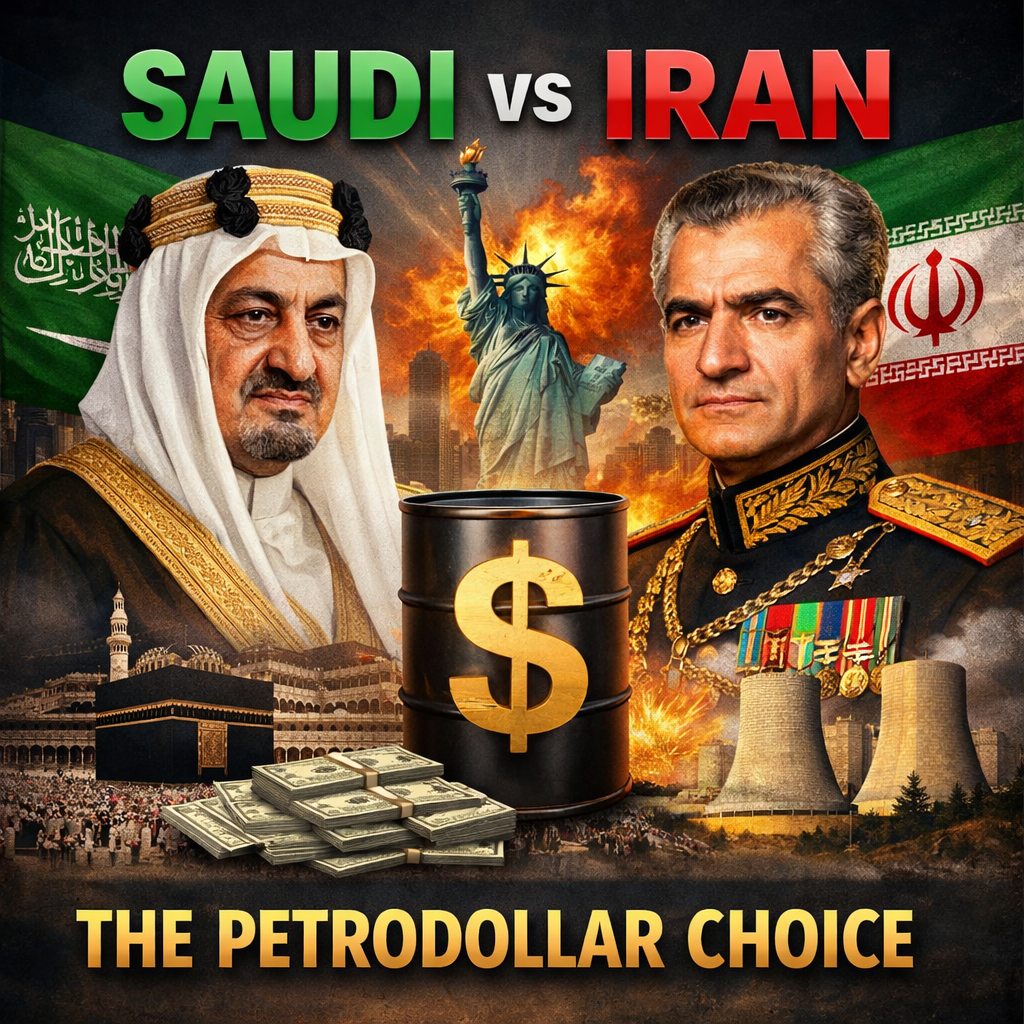
Saudi Petrodollar War: Regime survival bought with oil dollars — why Riyadh was Washington’s anchor and Tehran could never be. The 1974 petrodollar agreement required a partner with specific characteristics. It needed a producer with sufficient scale and spare capacity to stabilise global oil markets. It needed a government with the institutional continuity to honour commitments across decades. And it needed a state whose own survival interests were sufficiently aligned with American strategic objectives that the arrangement would hold under pressure. In 1974, Iran appeared to meet most of these criteria. In practice, it met none of them reliably. Saudi Arabia met all of them. It was not by accident, but because of a specific convergence of security vulnerability, political structure, economic capacity, and religious legitimacy. This was not a neutral selection between equal options. The system itself was already converging toward Saudi Arabia as its centre — as the only producer combining scale, spare capacity, and the ability to shape OPEC behaviour — making the 1974 arrangement less a choice than a formalisation of an existing reality. These factors made the Saudi Petrodollar War architecture the only arrangement that could actually work.
This arrangement did more than stabilise a financial system; it reinforced Saudi Arabia’s position within the Islamic world. The scale of petrodollar-driven economic expansion, combined with the post-1979 isolation of Iran, shifted the balance of influence decisively toward Riyadh. Through financial reach, religious infrastructure, and political leverage combined with US alignment, Saudi Arabia increasingly operated not just as a major oil producer but as a central node of influence across Muslim societies.
Regime Survival as the Primary Driver
The Saudi monarchy in 1974 faced an environment of profound vulnerability. The Arab world of the preceding two decades had been marked by coups, revolutions, and the rise of pan-Arab nationalist movements that were explicitly hostile to monarchical rule. Egypt’s Nasser had deposed a king. Iraq’s monarchy had been overthrown in 1958 in a coup of particular brutality. Yemen’s civil war had drawn Egyptian military intervention against the royalist side. The Ba’athist ideology that had taken root across the region was secular, nationalist, and anti-monarchical by definition.
The House of Saud, sitting atop the world’s largest proven oil reserves, lacked the military depth to secure itself independently against this environment. It had sparsely scattered relatively small population in its territory. Its armed forces, while equipped, had no track record of sustained independent operations. The American security umbrella offered the Saudi monarchy something no oil revenue alone could purchase: regime continuity in a region where regimes were being swept away by ideological currents the monarchy had no ideological counter to. Alignment with Washington was not merely a foreign policy preference. It was the primary mechanism of survival for a ruling family that understood its own vulnerability with clarity. This dependency extended into internal security as well. The Saudi state relied on American military presence not only for external defence but also for securing critical religious infrastructure around Mecca — a reliance that has drawn periodic criticism within the Muslim world, as the protection of Islam’s holiest site became indirectly tied to a non-Muslim power.
This existential dependency made Saudi Arabia the ideal petrodollar partner in a way that Iran could never be. A partner whose regime survival depends on the relationship will honour the relationship’s terms even when they are economically costly. A partner whose relationship is merely advantageous will renegotiate when circumstances shift. The Saudi Petrodollar War architecture was built on the former — a structural alignment rooted in existential necessity, not transactional calculation.
Structural vs Contingent Alignment — The Iran Contrast
Iran under Mohammad Reza Shah Pahlavi was simultaneously a US ally and a demonstration of exactly the kind of alignment Washington could not build a monetary system around. The Shah pursued an assertive, independent foreign policy. During the 1973 oil embargo, Iran did not join the Arab oil embargo against the West — but it pushed aggressively for higher oil prices through OPEC, using energy as an instrument of national leverage rather than as a contribution to a shared architecture. Iran under the Shah operated on the logic of maximising Iranian national power, not on the logic of sustaining a dollar-denominated global order.
External Constraints on the Choice
The choice was also constrained by structural realities beyond alignment logic. Iran’s large and politically active population, combined with an assertive leadership and a deep civilisational state identity, created constant pressure for independent policy assertion. These were not temporary conditions but embedded characteristics of the Iranian state. By contrast, Saudi Arabia’s smaller population, rentier structure, and regime-centric governance reduced internal pressure for strategic deviation — making alignment not just possible, but sustainable.
More fundamentally, Iranian alignment with Washington was contingent on the Shah’s internal control. The Shah’s modernisation programme — the White Revolution — had generated significant domestic opposition across the religious establishment, the left, and the traditional merchant class simultaneously. The internal fragility of the Shah’s position was visible to American intelligence throughout the 1970s. A monetary architecture that depended on Iran as its anchor would depend on the Shah’s continued grip on power — a grip that proved illusory in 1979. Saudi alignment was structural: the security needs, economic structure, and political system of the Saudi monarchy all pointed in the same direction simultaneously, creating a self-reinforcing arrangement that did not depend on any single individual’s political survival.
📌 The Deal That Built the Architecture
The 1974 petrodollar agreement and the existential dilemma it has now created for the Gulf states hosting American bases.
Saudi Petrodollar War: The Three Structural Advantages
Beyond the regime survival logic, three structural characteristics made Saudi Arabia uniquely capable of sustaining the petrodollar arrangement across decades.
The first was economic capacity for long-term consistency. Saudi Arabia’s reserves were — and remain — the largest in the world. Its production costs were among the lowest globally. Its spare capacity — the ability to increase or decrease production at relatively short notice — gave it the market power to stabilise prices when needed. Its domestic population was small relative to its revenue base, creating low fiscal pressure that allowed strategic patience. A state that needs every oil dollar immediately to fund domestic commitments cannot make long-term strategic sacrifices for a monetary arrangement. Saudi Arabia could afford to.
The second was institutional reliability. The centralised Saudi monarchy — under King Faisal at the time of the 1974 agreement — provided the continuity of decision-making that a multi-decade arrangement required. Faisal was personally committed to the arrangement and had the authority to enforce it. The monarchical succession system, whatever its internal tensions, maintained policy continuity across leadership transitions in a way that parliamentary or revolutionary governments could not. The petrodollar system required reliability across decades, not just influence in the moment.
The third was religious legitimacy as regime durability. As the custodian of Islam’s two holiest sites — Mecca and Medina — the Saudi monarchy possessed a form of civilisational authority that strengthened internal cohesion and regional standing independent of its political or military power. This legitimacy did not determine oil policy directly. But it contributed to regime durability in a region where most regimes lacked it — indirectly supporting the kind of stable alignment that the Saudi Petrodollar War architecture required. It also gave the Saudi monarchy a religious claim that no secular nationalist or Ba’athist movement could easily delegitimise on Islamic grounds. As a Sunni-majority monarchy, Saudi Arabia is able to influence neighbouring Gulf producers, giving it system-level weight beyond its own output.
What the Architecture Built — and What It Has Now Broken
The Saudi Petrodollar War arrangement built extraordinary prosperity for the Saudi monarchy and extraordinary leverage for Washington simultaneously. Saudi Arabia received security guarantees, both, internal and external, military hardware, and integration into the dollar-denominated global financial system. Washington received an anchor for dollar hegemony, a reliable swing producer to stabilise oil markets, and a partner who would recycle petrodollar surpluses into American financial instruments. The arrangement was genuinely reciprocal — both sides received what they structurally needed. The system held for decades—but its internal logic also defined the limits of its resilience.
What it also built, across fifty years, was a Saudi dependency so deep that the 2026 war has exposed its full cost. The monarchy that aligned with Washington for regime survival now finds that its security guarantor has launched a war from its territory, reportedly, without consultation, disrupted the strait through which 71% of its crude exports flow, and created a revenue catastrophe that the petrodollar arrangement was specifically designed to protect. The existential dependency that made Saudi Arabia Washington’s ideal partner in 1974 has become, in 2026, the trap that prevents it from responding to a betrayal it has no institutional capacity to confront.
📌 The Colonial Order That Preceded This Architecture
The petrodollar arrangement did not emerge from a neutral history. It was built on a century of external map-drawing and resource extraction.
Reflections on Saudi Petrodollar War
- Saudi Petrodollar War: The structural alignment between Saudi Arabia and the United States built through the 1974 petrodollar agreement — in which Saudi regime survival dependency, institutional reliability, economic capacity, and religious legitimacy converged to make Riyadh the only viable anchor for dollar hegemony after Bretton Woods. The 2026 war is the Saudi Petrodollar War architecture breaking under the weight of its own internal contradictions.
- Spare Capacity: The volume of oil production a state can bring online at short notice above its current output level. Saudi Arabia has historically maintained the world’s largest spare capacity — giving it unique power to stabilise or destabilise global oil markets and making it the swing producer on which the petrodollar system’s price stability depended.
- White Revolution: The modernisation programme imposed by Mohammad Reza Shah Pahlavi from 1963, including land reform, women’s suffrage, and industrialisation. Generated significant opposition from the Shia clergy, the traditional merchant class (bazaari), and the left simultaneously — creating the multi-faction coalition that produced the 1979 revolution and demonstrated the contingent nature of the Shah’s internal control.
- Swing Producer: An oil producer with sufficient spare capacity and market share to adjust output and stabilise global prices. Saudi Arabia has functioned as the world’s primary swing producer since the 1970s — a role central to the petrodollar arrangement’s ability to maintain orderly dollar-denominated oil markets.
- Hormuz Reckoning: The civilizational, economic, and geopolitical reckoning triggered by the Strait of Hormuz closure in the 2026 West Asia war.
- Petrodollar System: A global financial arrangement in which oil is traded primarily in United States dollars, strengthening the dollar’s role as the world’s reserve currency.
- Nixon Shock: The nineteen seventy one decision by President Richard Nixon to end dollar convertibility into gold, effectively dismantling the Bretton Woods system.
- Bretton Woods System: The post-World War Two international monetary framework that fixed currencies to the United States dollar, which was backed by gold until nineteen seventy one.
- OPEC: The Organization of the Petroleum Exporting Countries, a group of oil-producing nations that coordinate production policies to influence global oil markets.
- Ba’athist Ideology: A political movement in the Arab world promoting secular nationalism and socialism, often opposing traditional monarchies.
- Rentier State: A country that derives a significant portion of its revenue from natural resources like oil, reducing dependence on domestic taxation.
- Dollar Hegemony: The dominance of the United States dollar in global trade and finance, supported by its central role in oil transactions.
- Regime Survival Logic: The principle where a government prioritises its own continuity and stability, shaping its foreign policy decisions accordingly.
- Structural Alignment: A long-term, system-level compatibility between two countries based on economic, political, and security interests rather than temporary agreements.
- Contingent Alignment: A conditional partnership dependent on specific leaders or short-term interests, lacking long-term stability.
- Hormuz Dependency: The reliance of oil-exporting countries on the Strait of Hormuz for transporting crude oil to global markets, making it a strategic vulnerability.
#HormuzReckoning #SaudiPetrodollarWar #PetrodollarBetrayal #IranWar2026 #WestAsiaEndlessWar #SaudiArabia #GulfMonarchies #DollarHegemony #ColonialOrderEndlessWar #ChokeHoldOilEconomics #Dedollarisation #HinduinfopediaGeopolitics #Sarvananda
Previous Blog
- https://hinduinfopedia.com/war-zone-in-hormuz-a-reckoning/
and https://hinduinfopedia.in/?p=25537 - https://hinduinfopedia.com/hormuz-world-war-ladder-a-reckoning-of-west-asias-endless-war-2/
and https://hinduinfopedia.in/?p=25545 - https://hinduinfopedia.com/west-asia-war-ethics-a-reckoning-of-west-asias-endless-war-3/
and https://hinduinfopedia.in/?p=25550 - https://hinduinfopedia.com/west-asia-war-economics-a-reckoning-of-west-asias-endless-war-4/
and https://hinduinfopedia.in/?p=25557 - https://hinduinfopedia.com/nuclear-pretext-of-west-asia-war-a-reckoning-of-west-asias-endless-war-5/
and https://hinduinfopedia.in/?p=25588 - https://hinduinfopedia.com/nuclear-hypocrisy-of-usa-a-reckoning-of-west-asias-endless-war-6/
and https://hinduinfopedia.in/?p=25593 - https://hinduinfopedia.com/ummah-delusion-during-war-a-reckoning-of-west-asias-endless-war-7/
and https://hinduinfopedia.in/?p=25614 - https://hinduinfopedia.com/western-narrative-war-a-reckoning-of-west-asias-endless-war-8/
and https://hinduinfopedia.in/?p=25650 - https://hinduinfopedia.com/global-south-war-narrative-a-reckoning-of-west-asias-endless-war-9/
and https://hinduinfopedia.in/?p=25680 - https://hinduinfopedia.com/israel-survival-logic-a-reckoning-of-west-asias-endless-war-10/
and https://hinduinfopedia.in/?p=25755 - https://hinduinfopedia.com/chokehold-oil-economics-a-reckoning-of-west-asias-endless-war-11/
and https://hinduinfopedia.in/?p=25763 - https://hinduinfopedia.com/chokehold-food-security-a-reckoning-of-west-asias-endless-war-12/
and https://hinduinfopedia.in/?p=25786 - https://hinduinfopedia.com/chokehold-industrial-chain-a-reckoning-of-west-asias-endless-war-13/
and https://hinduinfopedia.in/?p=25816 - https://hinduinfopedia.com/gulf-war-responsibility-blockade-a-reckoning-of-west-asias-endless-war-14/
and https://hinduinfopedia.in/?p=25854 - https://hinduinfopedia.com/un-institutional-paralysis-a-reckoning-of-west-asias-endless-war-15/
and https://hinduinfopedia.in/?p=25885 - https://hinduinfopedia.com/colonial-order-endless-war-a-reckoning-of-west-asias-endless-war-16/
and https://hinduinfopedia.in/?p=25935 - https://hinduinfopedia.com/new-colonial-enforcement-in-war-a-reckoning-of-west-asias-endless-war-17/
and https://hinduinfopedia.in/?p=25953 - https://hinduinfopedia.com/petrodollar-betrayal-and-west-asia-war-a-historical-reckoning-18/
and https://hinduinfopedia.in/?p=25965
Follow us:
- English YouTube: https://www.youtube.com/@Hinduofficialstation
- Hindi YouTube: https://www.youtube.com/@HinduinfopediaIn
- X: https://x.com/HinduInfopedia
- Instagram: https://www.instagram.com/hinduinfopedia/
- Facebook: https://www.facebook.com/Hinduinfopediaofficial
- Threads: https://www.threads.com/@hinduinfopedia
[…] भारत / GB […]
[…] […]
[…] Saudi Petrodollar War: A Reckoning of West Asia’s Endless War (19) […]
[…] https://hinduinfopedia.com/saudi-petrodollar-war-a-reckoning-of-west-asias-endless-war-19/ and https://hinduinfopedia.in/?p=25992 […]
[…] https://hinduinfopedia.com/saudi-petrodollar-war-a-reckoning-of-west-asias-endless-war-19/ and https://hinduinfopedia.in/?p=25992 […]
[…] https://hinduinfopedia.com/saudi-petrodollar-war-a-reckoning-of-west-asias-endless-war-19/ and https://hinduinfopedia.in/?p=25992 […]
[…] https://hinduinfopedia.com/saudi-petrodollar-war-a-reckoning-of-west-asias-endless-war-19/ and https://hinduinfopedia.in/?p=25992 […]
[…] https://hinduinfopedia.com/saudi-petrodollar-war-a-reckoning-of-west-asias-endless-war-19/ and https://hinduinfopedia.in/?p=25992 […]
[…] https://hinduinfopedia.com/saudi-petrodollar-war-a-reckoning-of-west-asias-endless-war-19/ and https://hinduinfopedia.in/?p=25992 […]
[…] https://hinduinfopedia.com/saudi-petrodollar-war-a-reckoning-of-west-asias-endless-war-19/ and https://hinduinfopedia.in/?p=25992 […]
[…] Saudi Petrodollar War: A Reckoning of West Asia’s Endless War (19) https://hinduinfopedia.com/saudi-petrodollar-war-a-reckoning-of-west-asias-endless-war-19/ […]
[…] Four — US Treasury investment. The structural dependency Blog 19 documented — the existential alignment that made Saudi Arabia Washington’s ideal petrodollar partner […]
[…] Read: Saudi Petrodollar War → […]
[…] of Mecca and Medina — shattered the House of Saud’s primary source of religious legitimacy. The monarchy’s claim to rule rested on its role as Custodian of the Two Holy Mosques. Inviting non-Muslim troops to defend that custody was an admission that the monarchy could not […]
[…] […]
[…] seize. The Petrodollar Duress Reckoning rewrites the origin story of the arrangement that Blogs 18, 19, 32, and 34 have built […]
[…] Read […]