

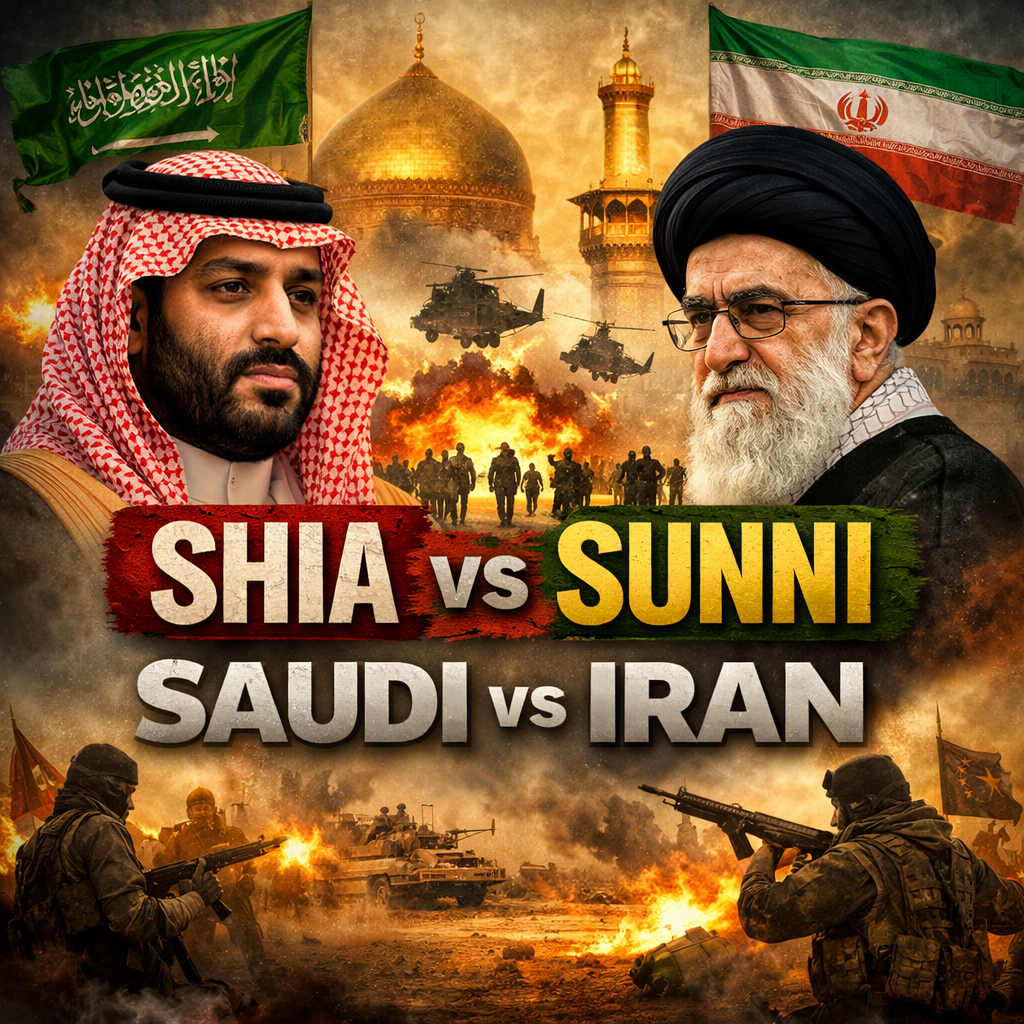
Shia Sunni War Roots: A Reckoning of West Asia’s Endless War (20)
Part 20 of the West Asia’s Endless War Series
भारत / GB
Why the Saudi-Iran Rivalry Cannot Be Negotiated Away — It Is a War Over Who Speaks for Islam
Tracing The History: Shia Sunni War Roots
This series has tracked the mechanics of the Hormuz crisis — the oil leverage, the food chains, the industrial chokepoints, and the petrodollar architecture that made Saudi Arabia America’s anchor in the Gulf. What has threaded through every argument is a rivalry between Riyadh and Tehran that no ceasefire, no deal, and no diplomatic handshake has ever genuinely resolved. To understand why, we must go beneath the geopolitics and into the theology — because the Shia Sunni war roots of this conflict are not a backdrop to the crisis. They are the crisis.
Introduction: The Shia Sunni War Roots Run Deeper Than Any Map
Shia Sunni war roots: the oldest unresolved question in Islam — who has the right to lead the faithful — is now detonating across the most strategically critical waterway on earth. Most Western analysis of the Saudi-Iran rivalry treats it as a geopolitical competition dressed in religious language. That framing is wrong. The Shia Sunni war roots of this conflict are not rhetorical decoration. They are the load-bearing structure. Strip away the theology and the rivalry makes no sense. Understand it, and everything — the proxy wars, the oil politics, the refusal to negotiate — falls into place.
The Wound That Predates Nations: Karbala and the Birth of the Shia Sunni Split
These roots do not begin in 1979. They begin in 632 CE, the moment the Prophet Muhammad died without leaving an unambiguous line of succession. The Muslim community split immediately: one faction believed leadership should pass by community consensus; another believed Muhammad had designated his cousin and son-in-law Ali ibn Abi Talib as his divinely appointed successor. The consensus faction won politically. The Ali faction — the Shia, from Shiat Ali, the partisans of Ali — lost.
The theological consequences were permanent. For Shia Muslims, the Imam is not merely a political leader but a divinely guided figure — sinless, chosen by God, from the bloodline of the Prophet. For Sunni Islam, the caliph is a human administrator elected or appointed by community process, fallible, replaceable. These are not minor doctrinal differences. They produce entirely different theories of who holds legitimate authority over Muslim life. In Twelver Shia theology, the Imam is described as the “Proof of God” on earth — a metaphysical necessity, not a political convenience.
In 680 CE, the fracture deepened permanently. Ali’s son Husayn led a small band to Karbala in Iraq and was massacred by the forces of the Umayyad caliph Yazid. Karbala did not just kill Husayn. It created the moral architecture of Shia identity — a theology of martyrdom, resistance against oppression, and the conviction that legitimate authority had been stolen and must eventually be restored. Every subsequent confrontation between Shia and Sunni power carries this template.
The Shia Sunni War Roots: 1979 as Theological Event
These roots had existed for 1,300 years. What 1979 did was give them a state actor with revolutionary ideology and oil money. Iran declared itself an Islamic Revolution first and an Islamic Republic second — meaning the revolution was the point, and the state was merely the instrument to defend and export it. Iran’s constitution enshrined the pledge to export the revolution, and Khomeini discussed this theme in 80 per cent of his speeches. This was not foreign policy improvisation. It was theological obligation.
The Velayat-e Faqih — the Guardianship of the Islamic Jurist — was Khomeini’s doctrinal innovation. Since the Twelfth Imam was in occultation, Khomeini argued that a senior Shia cleric must govern in his place to implement Islam as God intended. No Sunni-majority state has an equivalent structure. The entire edifice of the Islamic Republic is built on a Shia jurisprudential principle that Sunni Islam explicitly rejects — that religious scholars must exercise direct political power until the hidden Imam returns.
Saudi Arabia’s response to this doctrinal challenge was immediate and structural. Before 1979, the Saudi religious establishment had primarily looked inward; after the revolution, the Al Saud poured hundreds of billions of dollars into support for Salafism in Europe, the United States, Asia, and across the Muslim world to undermine Iranian influence. From 1982 to 2005, the Saudi government spent over $75 billion to establish 200 Islamic colleges, 210 Islamic centres, 1,500 mosques, and 2,000 schools globally. This was not charity. It was theological warfare — an attempt to inoculate the Sunni world against the Shia revolutionary message by saturating it with Wahhabi doctrine.
This transformation turned a centuries-old theological dispute into a full-spectrum state-to-state war — one that continues to fuel the current conflict in the Gulf. As explored in the Ummah Delusion During War series, 1979 marked the moment when the myth of Islamic unity fractured decisively into open ideological and proxy confrontation.
Read also: Iranian Revolution: How 1979 Reshaped Global Oil Politics and The Ummah Delusion: Muslims Killing Muslims for 1,400 Years.
1979 as Theological Event: Shia Sunni War Roots At Display
These roots had existed for 1,300 years. What 1979 did was give them a state actor with revolutionary ideology and oil money.
Iran declared itself an Islamic Revolution first and an Islamic Republic second — meaning the revolution was the point, and the state was merely the instrument to defend and export it.
Iran’s constitution enshrined the pledge to export the revolution, and Khomeini discussed this theme in 80 per cent of his speeches. He declared it not as foreign policy improvisation. It was declared as the theological obligation.
The Velayat-e Faqih — the Guardianship of the Islamic Jurist — was Khomeini’s doctrinal innovation. Since the Twelfth Imam was in occultation, Khomeini argued that a senior Shia cleric must govern in his place to implement Islam as God intended. No Sunni-majority state has an equivalent structure. The entire edifice of the Islamic Republic is built on a Shia jurisprudential principle that Sunni Islam explicitly rejects — that religious scholars must exercise direct political power until the hidden Imam returns.
Saudi Arabia’s response to this doctrinal challenge was immediate and structural. Before 1979, the Saudi religious establishment had primarily looked inward; after the revolution, the Al Saud poured hundreds of billions of dollars into support for Salafism in Europe, the United States, Asia, and across the Muslim world to undermine Iranian influence.
This was not charity. It was theological warfare — an attempt to inoculate the Sunni world against the Shia revolutionary message by saturating it with Wahhabi doctrine.
Why Not Ignore Shia Sunni War Roots
Territorial disputes can be settled by drawing borders. Resource disputes can be resolved by sharing revenue. This rivalry cannot be negotiated because the dispute is not about territory or resources. It is about who speaks for Islam.
The Sunni caliphate model holds that legitimate Islamic leadership is determined by community consensus and political capacity. The Shia imamate model holds that legitimate leadership is divinely designated through the Prophet’s bloodline and can only be properly exercised by those with specific theological qualifications. In Shia doctrine, the Imam must be appointed by God; in Sunni doctrine, the caliph can be elected, nominated, or can even seize power by force and still be recognized. These are not interpretive variations on the same theme. They are irreconcilable frameworks for what authority in Islam means.
This means every Iranian gain is a Saudi theological loss. If Iran successfully positions itself as the protector of the oppressed Muslim world — through Hezbollah in Lebanon, the Houthis in Yemen, Shia militias in Iraq — it validates the Shia revolutionary claim that Sunni monarchies are collaborators with imperialism, not custodians of Islam. Saudi Arabia responded to every Iranian advance with counterrevolution — funding Iraq during the Iran-Iraq war, financing the crushing of Shia uprisings in Bahrain, backing Sunni forces across Syria. Each side’s defensive move is the other side’s existential provocation.
The 2016 Saudi execution of prominent Shia cleric Sheikh Nimr al-Nimr — which triggered the storming of the Saudi embassy in Tehran and the severance of diplomatic relations for years — illustrates the dynamic precisely. To Riyadh, Nimr was a seditious Iranian agent. To Tehran, his execution was confirmation that Saudi Arabia suppresses the Shia wherever it can. Both readings were theologically framed, not diplomatically negotiable.
The Architect of Strike: Saudi Arabia’s “Finish the Job” Mandate
Recent developments in March 2026 point to a noticeable shift in Gulf strategy. Despite public calls for de-escalation, Saudi Arabia — along with United Arab Emirates and Kuwait — appears to be leaning toward a more decisive approach against Iran.
In discussions with the Trump administration, Gulf leadership has reportedly pushed the view that limited strikes may prolong instability rather than resolve it. Reports suggest a preference for outcomes that significantly degrade Iran’s military and strategic capacity.
This position reflects a broader shift toward security-first decision-making, where strategic concerns outweigh broader religious or ideological narratives. Coordination with the United States — including military and intelligence alignment — indicates a pragmatic rather than symbolic approach.
As also noted in The Times of India, the divergence between public rhetoric and strategic behavior highlights a consistent pattern: when state interests are directly at stake, geopolitical priorities take precedence over the idea of a unified Muslim political front.
The Shia Sunni War Roots Today: Hormuz as Theological Battlefield
The Shia Sunni war roots of this conflict are not ancient history being replayed. They are active architecture shaping every move in the current crisis. Iran’s willingness to threaten Hormuz closure is inseparable from its self-understanding as a revolutionary Shia state that has nothing to lose from confrontation with powers it regards as illegitimate. Saudi Arabia’s calculation about how far to align with Washington against Tehran is inseparable from its fear that any sign of weakness will validate the Shia revolutionary argument that the House of Saud cannot defend Islam.
They also explain why the Gulf monarchies examined in Blog 19 — Saudi Petrodollar War — are caught in a trap with no exit. To align fully with America against Iran is to confirm Iran’s accusation. To distance themselves from America is to risk losing the security umbrella that keeps their monarchies intact. Every move they make is read through the theological lens. This is not a conflict between two foreign policies. It is a conflict between two civilisational claims about who holds the mandate of heaven in the Muslim world.
What no analyst who frames this as a “geopolitical rivalry” can explain is why the two sides have spent over four decades in proxy war across Lebanon, Yemen, Iraq, Syria, and Bahrain without ever finding a durable settlement — even when it would have been economically rational to do so.
The Shia Sunni war roots explain it: because a settlement would require one side to concede the other’s theological legitimacy. And that concession, for either side, would be existential.
The next blog in this series is Persian Civilisation War: A Reckoning of West Asia’s Endless War (21) — which takes the argument one level deeper. The Saudi-Iran rivalry is not only a Shia-Sunni theological contest. It is also a civilisational one: Iran does not experience West Asia as an Arab state, because Iran is not an Arab state. 2,500 years of Persian imperial memory — predating Islam entirely — gives Iran a strategic depth and a sense of historical identity that no Gulf monarchy can match. Understanding that civilisational layer is the key to understanding why Iran has absorbed 47 years of sanctions without capitulating.
Feature Image: Click here to view the image.
Video
Glossary of Terms
- Strait of Hormuz: A strategically critical waterway connecting the Persian Gulf to the Arabian Sea, through which a significant portion of global oil supply passes.
- Petrodollar System: An arrangement where global oil trade is conducted primarily in U.S. dollars, reinforcing the dollar’s dominance in international finance.
- Shia-Sunni Divide: The historical and theological split within Islam over leadership and religious authority following the death of Prophet Muhammad.
- Battle of Karbala (680 CE): A निर्णायक event in Islamic history where Husayn ibn Ali was killed, shaping Shia identity around martyrdom and resistance.
- Imamate (Shia Doctrine): The belief in Shia Islam that leadership belongs to divinely appointed Imams from the Prophet’s lineage.
- Caliphate (Sunni Model): A system of leadership in Sunni Islam where the Caliph is chosen or accepted by the community and governs political affairs.
- Velayat-e Faqih: A governing doctrine in Iran where a senior Islamic jurist holds political authority in the absence of the hidden Imam.
- Occultation (Ghaybat): The Shia belief that the Twelfth Imam is in a state of hidden existence and will return in the future.
- Salafism: A Sunni Islamic movement advocating a return to the practices of the earliest generations of Muslims.
- Wahhabism: A conservative Sunni Islamic doctrine originating in Saudi Arabia, emphasizing strict monotheism and religious purity.
- Proxy War: A conflict where major powers support opposing sides indirectly rather than engaging in direct warfare.
- Iranian Revolution (1979): The overthrow of Iran’s monarchy and establishment of an Islamic Republic under clerical leadership.
- Ummah: The global community of Muslims, often invoked as a symbol of religious unity.
- Theological Warfare: Conflict driven by religious doctrine and ideological legitimacy rather than purely political or territorial goals.
- Gulf Monarchies: The hereditary ruling systems in countries like Saudi Arabia, UAE, and Kuwait, where power is held by royal families.
#ShiaSunni #Iran #SaudiArabia #MiddleEast #Islam #Geopolitics #Hormuz #ProxyWar #Oil #HinduinfoPedia
Previous Blog
- https://hinduinfopedia.com/war-zone-in-hormuz-a-reckoning/
and https://hinduinfopedia.in/?p=25537 - https://hinduinfopedia.com/hormuz-world-war-ladder-a-reckoning-of-west-asias-endless-war-2/
and https://hinduinfopedia.in/?p=25545 - https://hinduinfopedia.com/west-asia-war-ethics-a-reckoning-of-west-asias-endless-war-3/
and https://hinduinfopedia.in/?p=25550 - https://hinduinfopedia.com/west-asia-war-economics-a-reckoning-of-west-asias-endless-war-4/
and https://hinduinfopedia.in/?p=25557 - https://hinduinfopedia.com/nuclear-pretext-of-west-asia-war-a-reckoning-of-west-asias-endless-war-5/
and https://hinduinfopedia.in/?p=25588 - https://hinduinfopedia.com/nuclear-hypocrisy-of-usa-a-reckoning-of-west-asias-endless-war-6/
and https://hinduinfopedia.in/?p=25593 - https://hinduinfopedia.com/ummah-delusion-during-war-a-reckoning-of-west-asias-endless-war-7/
and https://hinduinfopedia.in/?p=25614 - https://hinduinfopedia.com/western-narrative-war-a-reckoning-of-west-asias-endless-war-8/
and https://hinduinfopedia.in/?p=25650 - https://hinduinfopedia.com/global-south-war-narrative-a-reckoning-of-west-asias-endless-war-9/
and https://hinduinfopedia.in/?p=25680 - https://hinduinfopedia.com/israel-survival-logic-a-reckoning-of-west-asias-endless-war-10/
and https://hinduinfopedia.in/?p=25755 - https://hinduinfopedia.com/chokehold-oil-economics-a-reckoning-of-west-asias-endless-war-11/
and https://hinduinfopedia.in/?p=25763 - https://hinduinfopedia.com/chokehold-food-security-a-reckoning-of-west-asias-endless-war-12/
and https://hinduinfopedia.in/?p=25786 - https://hinduinfopedia.com/chokehold-industrial-chain-a-reckoning-of-west-asias-endless-war-13/
and https://hinduinfopedia.in/?p=25816 - https://hinduinfopedia.com/gulf-war-responsibility-blockade-a-reckoning-of-west-asias-endless-war-14/
and https://hinduinfopedia.in/?p=25854 - https://hinduinfopedia.com/un-institutional-paralysis-a-reckoning-of-west-asias-endless-war-15/
and https://hinduinfopedia.in/?p=25885 - https://hinduinfopedia.com/colonial-order-endless-war-a-reckoning-of-west-asias-endless-war-16/
and https://hinduinfopedia.in/?p=25935 - https://hinduinfopedia.com/new-colonial-enforcement-in-war-a-reckoning-of-west-asias-endless-war-17/
and https://hinduinfopedia.in/?p=25953 - https://hinduinfopedia.com/petrodollar-betrayal-and-west-asia-war-a-historical-reckoning-18/
and https://hinduinfopedia.in/?p=25965 - https://hinduinfopedia.com/saudi-petrodollar-war-a-reckoning-of-west-asias-endless-war-19/
and https://hinduinfopedia.in/?p=25992
Follow us:
- English YouTube: https://www.youtube.com/@Hinduofficialstation
- Hindi YouTube: https://www.youtube.com/@HinduinfopediaIn
- X: https://x.com/HinduInfopedia
- Instagram: https://www.instagram.com/hinduinfopedia/
- Facebook: https://www.facebook.com/Hinduinfopediaofficial
- Threads: https://www.threads.com/@hinduinfopedia
[…] भारत / GB […]
[…] Shia Sunni War Roots: A Reckoning of West Asia’s Endless War (20) […]
[…] Shia Sunni War Roots: A Reckoning of West Asia’s Endless War (20) […]
[…] https://hinduinfopedia.com/shia-sunni-war-roots-a-reckoning-of-west-asias-endless-war-20/ and https://hinduinfopedia.in/?p=26016 […]
[…] https://hinduinfopedia.com/shia-sunni-war-roots-a-reckoning-of-west-asias-endless-war-20/ and https://hinduinfopedia.in/?p=26016 […]
[…] https://hinduinfopedia.com/shia-sunni-war-roots-a-reckoning-of-west-asias-endless-war-20/ and https://hinduinfopedia.in/?p=26016 […]
[…] https://hinduinfopedia.com/shia-sunni-war-roots-a-reckoning-of-west-asias-endless-war-20/ and https://hinduinfopedia.in/?p=26016 […]
[…] https://hinduinfopedia.com/shia-sunni-war-roots-a-reckoning-of-west-asias-endless-war-20/ and https://hinduinfopedia.in/?p=26016 […]
[…] Shia Sunni War Roots: A Reckoning of West Asia’s Endless War (20) https://hinduinfopedia.com/shia-sunni-war-roots-a-reckoning-of-west-asias-endless-war-20/ […]
[…] in the Arab world, a Soviet-backed base actively working to destabilise its monarchical neighbours. Pan-Arabist republicanism under Nasser’s legacy was still calling for the overthrow of every G… In March 1975, King Faisal — the architect of the 1973 oil embargo and the primary Saudi […]
[…] Read […]
[…] Blog 20 (Shia Sunni War Roots) established 1,400 years of theological and political competition. The SMDA’s nuclear umbrella clause is the most institutionally explicit expression of the Sunni side of that competition since the Ottoman Caliphate’s collapse in 1924. Pakistan’s Shia population — historically among the most politically organised and economically integrated religious minorities in Pakistani society — will register the SMDA’s nuclear commitment as an existential threat dressed in alliance language. The domestic political consequences of Pakistan’s most explicit Sunni-vs-Shia strategic commitment are not yet visible. They will become visible at the first operational activation of the SMDA’s collective defence clause. […]
[…] ब्लॉग 20 (शिया-सुन्नी संघर्ष की जड़ें) ने 1400 वर्षों की धार्मिक और राजनीतिक प्रतिस्पर्धा को स्थापित किया था। एसएमडीए का परमाणु सुरक्षा-छत्र 1924 में उस्मानी खिलाफत के पतन के बाद सुन्नी पक्ष की सबसे स्पष्ट संस्थागत अभिव्यक्ति बनता है। पाकिस्तान का शिया समुदाय ऐतिहासिक रूप से वहां के सबसे संगठित और आर्थिक रूप से जुड़े धार्मिक समूहों में गिना जाता है। यह समुदाय एसएमडीए की परमाणु प्रतिबद्धता को अस्तित्वगत संकट के रूप में देखेगा। अभी इसके घरेलू राजनीतिक परिणाम स्पष्ट नहीं हैं। यह परिणाम उस समय स्पष्ट होंगे जब एसएमडीए की सामूहिक रक्षा धारा पहली बार संचालन स्तर पर सक्रिय होगी। […]