

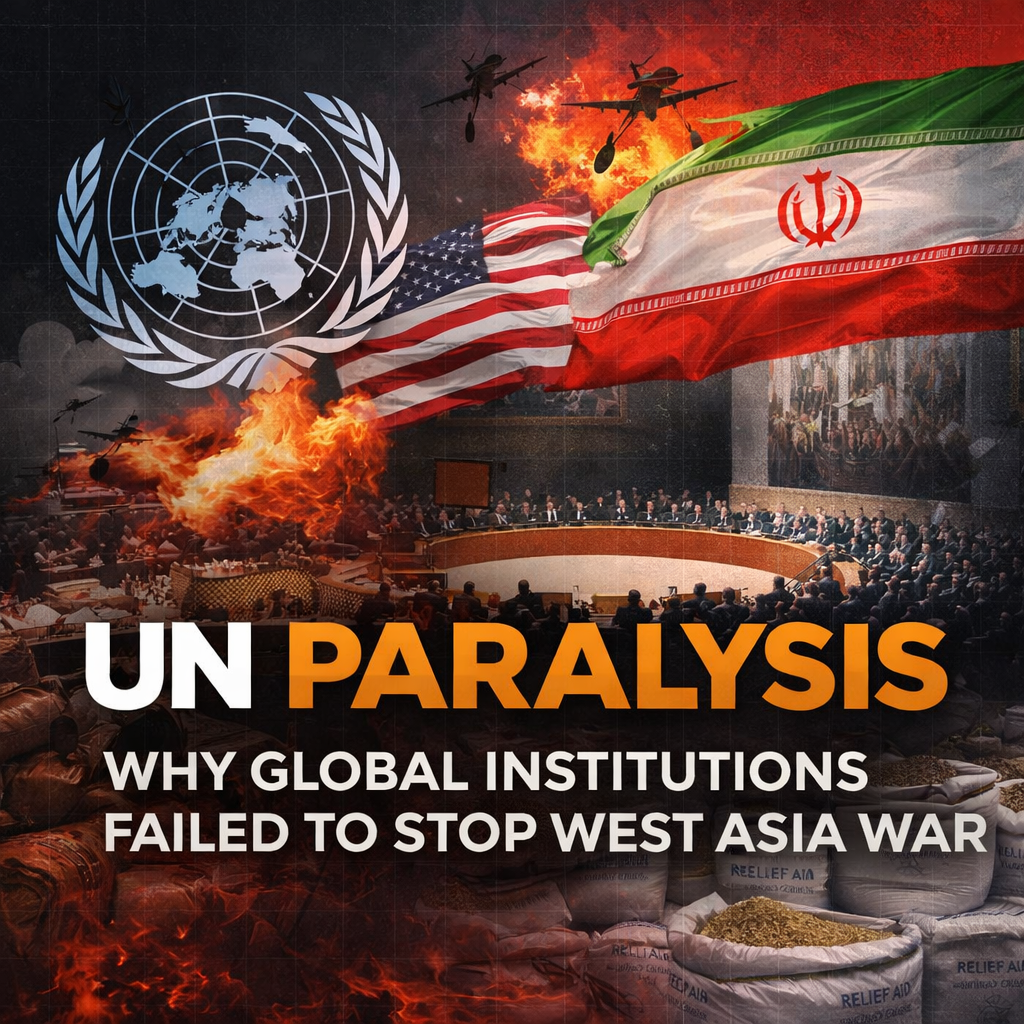
UN Institutional Paralysis: A Reckoning of West Asia’s Endless War (15)
Part 15 of the West Asia’s Endless War Series
भारत / GB
The Architecture of Impotence — How the Body Built to Prevent This War Watched It Happen
West Asia’s Endless War: UN Institutional Paralysis
This series has established the war’s trigger and escalation mechanics, its ethical and nuclear pretexts, the fracture of Islamic solidarity, the competing narrative wars, Israel’s survival calculus, the Global South’s reading of the strikes as resource imperialism, and the three-layer chokehold across oil, food, and industrial supply chains. Blog 15 reaches the institutional question: where was the body whose entire founding purpose was to prevent exactly this kind of war — and why was it constitutionally incapable of stopping it and how UN Institutional Paralysis plays out in public life.
UN Institutional Paralysis: Built for a World That No Longer Exists
UN Institutional Paralysis: The body built to prevent wars like this one watched it happen and has no mechanism to stop it. The United Nations was designed in 1945 by the victors of a world war to prevent another world war. Its Security Council architecture — five permanent members, each holding an absolute veto — encoded the power distribution of 1945 as a permanent constitutional feature. The assumption was that the five permanent members, having just fought together against fascism, would maintain sufficient alignment to act collectively when peace was threatened. That assumption had a half-life of approximately four years. By 1949 the Cold War had produced the first in an unbroken series of vetoes that would render the Security Council structurally incapable of acting against the direct interests of any permanent member. The 2026 Iran war is not a failure of the UN. It is the UN working precisely as its architecture dictates — which is the problem.
The Veto as a Structural Guarantee of Impunity
The United States and its allies launched the February 2026 strikes on Iran while IAEA negotiations were active. No Security Council resolution authorised the operation. No Chapter VII mandate existed. The strikes were conducted in direct violation of the UN Charter’s prohibition on the use of force against a member state’s sovereignty — a prohibition that the Charter’s founding text makes absolute except in cases of self-defence or Security Council authorisation.
The Security Council met in emergency session on 28 February — the same day as the strikes. The first detail worth noting is who called it: France, a NATO ally of Washington, requested the meeting first. The second detail is who chaired it: the United Kingdom held the presidency for February — another NATO ally. Russia and China had requested the session under the agenda item “Threats to international peace and security” — the framing that would have placed the strikes themselves as the primary threat under consideration. The UK presidency overrode that request and scheduled the session under “The situation in the Middle East” — the softer framing that dissolved the specific question of aggression into general regional instability. The meeting that was supposed to hold the aggressor to account was called by its allies, chaired by its ally, and had its agenda downgraded by its ally.
No resolution was tabled on 28 February. No vote was taken. The veto did not need to be cast — its existence made the vote pointless before it could happen. The paralysis operated silently: not through a veto exercised, but through a veto that pre-empted the entire process. Members delivered statements. The Secretary-General urged restraint. The US delegate said Washington had acted with moral clarity. The meeting ended. The war continued.
Eleven days later, on 11 March, the Security Council adopted Resolution 2817. It condemned Iran’s retaliatory strikes on Gulf states. It said nothing about the original US-Israel operation that had triggered those retaliations. China and Russia abstained rather than vetoed — because the resolution’s framing placed all condemnation on Iran, so blocking it would have looked like defending Iranian missile attacks on Arab neighbours. Russia separately tabled a neutral de-escalation draft that named no parties and simply called for an end to hostilities. The West voted it down: four in favour, two against, nine abstentions. The Security Council could not agree to stop a war even on neutral terms. And throughout March — as Hormuz was closed, as Gulf states declared force majeure, as the food and industrial shocks registered across Asia and Africa — the United States held the rotating presidency of the Security Council. The country that had launched the strikes was chairing the body constitutionally responsible for responding to them. This is not a malfunction of the UN system. It is the UN system operating exactly as its architecture permits.
The General Assembly: Too Late, Too Weak
When the Security Council is paralysed, the General Assembly can convene an Emergency Special Session under the Uniting for Peace resolution — a mechanism established in 1950 precisely to bypass Security Council deadlock. Civil society organisations and non-permanent members began calling for this mechanism on 2 March — four days after the strikes. Formal procedures moved. Consultations were held. Drafts circulated. By the time the General Assembly actually convened in emergency session, the war was already into its second week. Hormuz was already closed. The first ship attacks had already happened. The humanitarian consequences were already visible. The body designed to respond to emergencies took days to convene and longer to act — not because of procedural necessity but because the states that might have pushed for faster action were calculating their bilateral exposure to Washington before deciding how loudly to speak.
When the session finally convened, the vote was not close. A substantial majority of member states voted to condemn the operation and demand an immediate ceasefire. The resolution passed. It had no enforcement mechanism, no binding authority, and no consequence for non-compliance. The war did not pause for the vote. Iran did not halt its Hormuz closure. Washington did not acknowledge the resolution. The distance between the General Assembly vote and any operational consequence was not just legal — it was total. The majority of the world’s states voted one way. The war continued as if the vote had not happened. Because for the parties prosecuting it, it had not.
📌 The Theatre That Preceded the War
The September 2025 UN General Assembly provided the multilateral cover that the strikes would later require. Read how that performance was constructed.
UN Institutional Paralysis and the Mandate Progression
Blog 3 of this series established the mandate progression — the arc across successive US-led interventions showing the progressive erosion of legal constraint. Afghanistan had a UN mandate. Iraq had no mandate and a fabricated WMD pretext. Libya had a mandate that was exceeded for regime change. Kosovo had no mandate but set a precedent. The Iran 2026 strikes had no mandate, were launched mid-negotiation, and targeted a country’s supreme leader and military command structure in a operation that combined the characteristics of every previous intervention while dispensing with even the residual legal architecture that earlier operations had at least nominally maintained.
The UN’s response to each step of this progression has been identical: Security Council paralysis through veto, General Assembly condemnation without consequence, and a slow recalibration of what the international community is prepared to treat as normal. The mandate progression is not merely a record of individual decisions. It is a map of how the UN Institutional Paralysis has been systematically exploited to expand the range of permissible unilateral action with each successive intervention — each one establishing a precedent that the next can cite as normalised practice.
The September 2025 Dress Rehearsal
The September 2025 UN General Assembly — examined in detail elsewhere in the archive — deserves particular attention in the context of UN Institutional Paralysis. The New York Declaration of September 2025 was presented as a multilateral consensus document on global governance reform, nuclear non-proliferation, and rules-based order principles. It was adopted by acclamation. It made no reference to Iran’s nuclear programme by name. It contained no enforcement mechanism. It was, in the specific context of what followed five months later, a performance of multilateral legitimacy — providing the diplomatic backdrop against which the February 2026 strikes could be framed as a last resort after exhausting international channels.
The UN had been used as a stage prop. Its General Assembly proceedings in September 2025 were cited in the post-strike narrative as evidence that the international community had been engaged, that dialogue had been attempted, that the rules-based framework had been given every opportunity to function before military action became necessary. The body’s own proceedings were instrumentalised to legitimise the action that its architecture was constitutionally incapable of preventing. This is UN Institutional Paralysis in its most refined form: not merely failing to stop a war, but being used to provide the rhetorical cover for one.
UN Institutional Paralysis: What Reform Would Actually Require
The calls for UN reform that follow every major violation of the Charter’s prohibition on force are as predictable as the violations themselves. Expansion of the Security Council. Veto reform. Greater General Assembly authority. These proposals recur after every crisis and advance nowhere — because any reform that reduces the veto power of the five permanent members requires the consent of those same five members to be adopted. The reform mechanism is subject to the same veto as everything else.
The Global South’s engagement with this reality has shifted in the years preceding the Iran war. The six billion people who read the Iran war as resource imperialism are not waiting for UN reform. They are pursuing de-dollarisation, bilateral energy agreements, and regional security architectures that do not depend on a Security Council veto to function. The response to UN Institutional Paralysis is not, for the majority of the world’s states, a reform agenda. It is a workaround. The institution is not being reformed. It is being bypassed — slowly, bilaterally, and with increasing deliberateness by the states that have concluded that its architecture was never designed to constrain the five who hold the veto.
📌 The Doctrine That Operates Through This Vacuum
When the UN cannot act, the destabilisation doctrine fills the space. Read the documented framework through which American foreign policy operates in the absence of multilateral constraint.
Next: New Colonial Order History — Blog 16 in West Asia’s Endless War traces the historical architecture of colonial resource extraction that the 2026 Iran war replicates in updated form — same logic, updated instruments, new geography of resistance.
Feature Image: Click here to view the image.
Videos
Glossary of Terms
- UN Institutional Paralysis: The structural inability of the United Nations Security Council to act against the direct interests or actions of any of its five permanent members — a consequence of the absolute veto each holds. Not a malfunction of the UN system but its designed operating condition when P5 interests conflict.
- Chapter VII: The section of the UN Charter authorising the Security Council to take binding enforcement action — including the use of military force — in response to threats to peace, breaches of peace, or acts of aggression. All significant UN-authorised military operations derive their legal basis from Chapter VII. The 2026 Iran strikes had no Chapter VII mandate.
- Uniting for Peace Resolution: UN General Assembly Resolution 377 (1950), establishing a mechanism to convene an Emergency Special Session when the Security Council is deadlocked by veto. Allows the General Assembly to recommend collective measures including the use of force. Its recommendations are non-binding — member states cannot be compelled to comply.
- Mandate Progression: The arc across successive US-led military interventions showing progressive erosion of legal constraint — Afghanistan (UN mandate), Iraq (no mandate, fabricated WMD pretext), Libya (mandate exceeded), Kosovo (no mandate, precedent set), Iran 2026 (no mandate, mid-negotiation, leadership decapitation). Each step less legally constrained than the last.
- Veto: The power held by the five permanent Security Council members — the United States, United Kingdom, France, Russia, and China — to unilaterally block any substantive resolution regardless of how many other members support it. A single negative vote by any P5 member defeats a resolution. No amendment to the veto system can be adopted without the consent of all five veto holders.
- Hormuz Reckoning: The civilizational, economic, and geopolitical reckoning triggered by the Strait of Hormuz closure in the 2026 West Asia war.
#HormuzReckoning #UNInstitutionalParalysis #IranWar2026 #WestAsiaEndlessWar #UNSecurityCouncil #MandateProgression #RulesBasedOrder #GlobalSouthWarNarrative #VetoReform #NewYorkDeclaration #HinduinfopediaGeopolitics #Sarvananda
Relevant Links
Previous Blog
- https://hinduinfopedia.com/war-zone-in-hormuz-a-reckoning/
and https://hinduinfopedia.in/?p=25537 - https://hinduinfopedia.com/hormuz-world-war-ladder-a-reckoning-of-west-asias-endless-war-2/
and https://hinduinfopedia.in/?p=25545 - https://hinduinfopedia.com/west-asia-war-ethics-a-reckoning-of-west-asias-endless-war-3/
and https://hinduinfopedia.in/?p=25550 - https://hinduinfopedia.com/west-asia-war-economics-a-reckoning-of-west-asias-endless-war-4/
and https://hinduinfopedia.in/?p=25557 - https://hinduinfopedia.com/nuclear-pretext-of-west-asia-war-a-reckoning-of-west-asias-endless-war-5/
and https://hinduinfopedia.in/?p=25588 - https://hinduinfopedia.com/nuclear-hypocrisy-of-usa-a-reckoning-of-west-asias-endless-war-6/
and https://hinduinfopedia.in/?p=25593 - https://hinduinfopedia.com/ummah-delusion-during-war-a-reckoning-of-west-asias-endless-war-7/
and https://hinduinfopedia.in/?p=25614 - https://hinduinfopedia.com/western-narrative-war-a-reckoning-of-west-asias-endless-war-8/
and https://hinduinfopedia.in/?p=25650 - https://hinduinfopedia.com/global-south-war-narrative-a-reckoning-of-west-asias-endless-war-9/
and https://hinduinfopedia.in/?p=25680 - https://hinduinfopedia.com/israel-survival-logic-a-reckoning-of-west-asias-endless-war-10/
and https://hinduinfopedia.in/?p=25755 - https://hinduinfopedia.com/chokehold-oil-economics-a-reckoning-of-west-asias-endless-war-11/
and https://hinduinfopedia.in/?p=25763 - https://hinduinfopedia.com/chokehold-food-security-a-reckoning-of-west-asias-endless-war-12/
and https://hinduinfopedia.in/?p=25786 - https://hinduinfopedia.com/chokehold-industrial-chain-a-reckoning-of-west-asias-endless-war-13/
and https://hinduinfopedia.in/?p=25816 - https://hinduinfopedia.com/gulf-war-responsibility-blockade-a-reckoning-of-west-asias-endless-war-14/
and https://hinduinfopedia.in/?p=25854
FOR BLOGS ON US IMPERIAL MINDSET / OIL MOTIVE / DESTABILIZATION DOCTRINE
- Destabilization Doctrine: How America’s Foreign Policy Boomerang Is Striking Home
- Regime Change Playbook: A Manual for Color Revolution Operations
- America, Independence, 1776 to Modern Hegemony — US Hypocrisy Doctrine (via Great Deception)
- Target India: Action Phase — Doctrine in Motion
- Activation of Destabilization Doctrine: The India Deployment Begins
- Rupee Rebellion / De-dollarization (cross-reference via .org)
FOR BLOGS ON IRAN / RAKTBEEJ / DUMP TRUCK RESILIENCE
- Great Deception and Global Civilizational Warfare — five-stage playbook applies directly to Iran’s regenerative resistance
- Islamist Boomerang Effect — When Pakistan’s Cross-Border Strikes Vindicate India’s Doctrine — dump truck principle applied to Pakistan, parallel to Iran
- Demographic Reality Exposed: How High-Fertility Clusters Reshape Democracies — Raktbeej demographic dimension
FOR BLOGS ON GULF MONARCHIES / UMMAH DELUSION / SHIA-SUNNI DIVIDE
- Gulf States Refugee Policy: Why the Wealthy Arabs Said No to Palestinians — Gulf self-preservation over Ummah solidarity, directly applicable
- Palestinian Refugees: Why No Muslim Country Will Take Them — Ummah as myth
- Black September Jordan: The Forgotten War That Changed the Arab World — Sunni-Shia and Arab political fractures
- Lebanon Civil War: From Paris of the Middle East to Hezbollah State — Gulf-Iran-Hezbollah triangle
FOR BLOGS ON UN / RULE-BASED ORDER / NEW COLONIAL ORDER
- When Dictatorships Vote on Democracy — The UN Legitimacy Crisis
- Anti-Israel Obsession — The UN’s Statistical Evidence of Institutional Bias
- New York Declaration Deconstructed — September 2025’s Theatre of Absurd
- New York Declaration Proponents — Hypocrisy and Legal Theater
- New York Declaration Perspectives — History, Media, and Theatrical Mechanics
FOR BLOGS ON MEDIA / SELECTIVE OUTRAGE / MANUFACTURED NARRATIVE
- How Media Manipulation Works: The Global Template
- Media as Manipulator In Unrest: The False Causality Matrix
- Muslim Brotherhood France: Intelligence Report Media Ignored
FOR BLOGS ON INDIA’S NEUTRALITY / UPI / STRATEGIC AUTONOMY
- Unrest From Bangladesh to Nepal: Is India the Real Target?
- Narrative of Unrest: When Neighbors Become Examples
- Rahul’s Gen Z Call — Activation of Destabilization Doctrine
- Money Trail: Analyzing Financial Networks Behind Nepal’s Protests
FOR BLOGS ON ISRAEL / PALESTINE / DECAPITATION TEMPLATE
- October 7th Vindication: Egypt’s Prophetic Wall
- Two-State Delusion Exposed — Netanyahu’s 99-9 Vote
- Right of Return to Palestine: The Strategy Behind 75 Years of Refugees
- Egypt Gaza Wall: The Hidden Truth 57 Muslim Nations
FOR BLOGS ON NUCLEAR HYPOCRISY / MANUFACTURED EXTREMISM
- Islamist Boomerang Effect
- Destabilization Doctrine — How America’s Foreign Policy Boomerang Is Striking Home
FOR BLOGS ON RAKTBEEJ AND DAGDHABEEJ / PHILOSOPHICAL RESOLUTION THREAD
- Raktbeej And Starfish Thesis: The 1,400-Year Organism That No Modern Framework Can Contain (Part II)
- Raktbeej Thesis: The Ancient Diagnostic That Explains What No Modern Framework Can
- Gaza and the Starfish: Why Every Cut Creates
Follow us:
- English YouTube: https://www.youtube.com/@Hinduofficialstation
- Hindi YouTube: https://www.youtube.com/@HinduinfopediaIn
- X: https://x.com/HinduInfopedia
- Instagram: https://www.instagram.com/hinduinfopedia/
- Facebook: https://www.facebook.com/Hinduinfopediaofficial
- Threads: https://www.threads.com/@hinduinfopedia
[…] भारत / GB […]
[…] UN Institutional Paralysis: A Reckoning of West Asia’s Endless War (15) […]
[…] https://hinduinfopedia.com/un-institutional-paralysis-a-reckoning-of-west-asias-endless-war-15/ and https://hinduinfopedia.in/?p=25885 […]
[…] UN Institutional Paralysis: A Reckoning of West Asia’s Endless War (15) […]
[…] UN Institutional Paralysis: A Reckoning of West Asia’s Endless War (15) […]
[…] https://hinduinfopedia.com/un-institutional-paralysis-a-reckoning-of-west-asias-endless-war-15/ and https://hinduinfopedia.in/?p=25885 […]
[…] UN Institutional Paralysis: A Reckoning of West Asia’s Endless War (15) […]
[…] https://hinduinfopedia.com/un-institutional-paralysis-a-reckoning-of-west-asias-endless-war-15/ and https://hinduinfopedia.in/?p=25885 […]
[…] https://hinduinfopedia.com/un-institutional-paralysis-a-reckoning-of-west-asias-endless-war-15/ and https://hinduinfopedia.in/?p=25885 […]
[…] https://hinduinfopedia.com/un-institutional-paralysis-a-reckoning-of-west-asias-endless-war-15/ and https://hinduinfopedia.in/?p=25885 […]
[…] https://hinduinfopedia.com/un-institutional-paralysis-a-reckoning-of-west-asias-endless-war-15/ and https://hinduinfopedia.in/?p=25885 […]
[…] थी और जो तीन सप्ताह में नष्ट हो गई। संयुक्त राष्ट्र की संस्थागत संरचना इस कार्य को पूरा करने में विफल रही है — […]
[…] https://hinduinfopedia.com/un-institutional-paralysis-a-reckoning-of-west-asias-endless-war-15/ and https://hinduinfopedia.in/?p=25885 […]
[…] UN Institutional Paralysis: A Reckoning of West Asia’s Endless War (15) https://hinduinfopedia.com/un-institutional-paralysis-a-reckoning-of-west-asias-endless-war-15/ […]
[…] […]
[…] not an order at all—it is a preference, enforceable only when Washington chooses to enforce it. Blog 15 documented the UN’s institutional paralysis—the Security Council veto architecture that prevented any legal accountability for the […]
[…] of a Gulf conflict while being configured to defend the Rhine — this is not a weakened NATO. It is an alliance that has reached the same terminal point as the UN institutional framework the series documented earlier: a powerful claim with no coherent enforcement mechanism, serving a […]
[…] Read: UN Institutional Paralysis → […]
[…] […]
[…] Read […]