

Chokehold Oil Economics: A Reckoning of West Asia’s Endless War (11)
Part 11 of the West Asia’s Endless War Series
भारत / GB
Not a Disruption — a Weapon: How Trump Wields the Hormuz Chokehold
This series has moved from the war’s trigger and escalation mechanics, through its ethical and economic architecture, its nuclear dimensions, the fracture of Islamic solidarity, the competing narrative wars, Israel’s survival calculus, and the Global South’s reading of the strikes as resource imperialism. Blog 11 reaches the Chokehold Oil Economics at the structural core of why this war was always going to be fought: who controls what the world runs on, and who decides who gets access to it.
Chokehold Oil Economics: The Selective Access Weapon Washington Holds
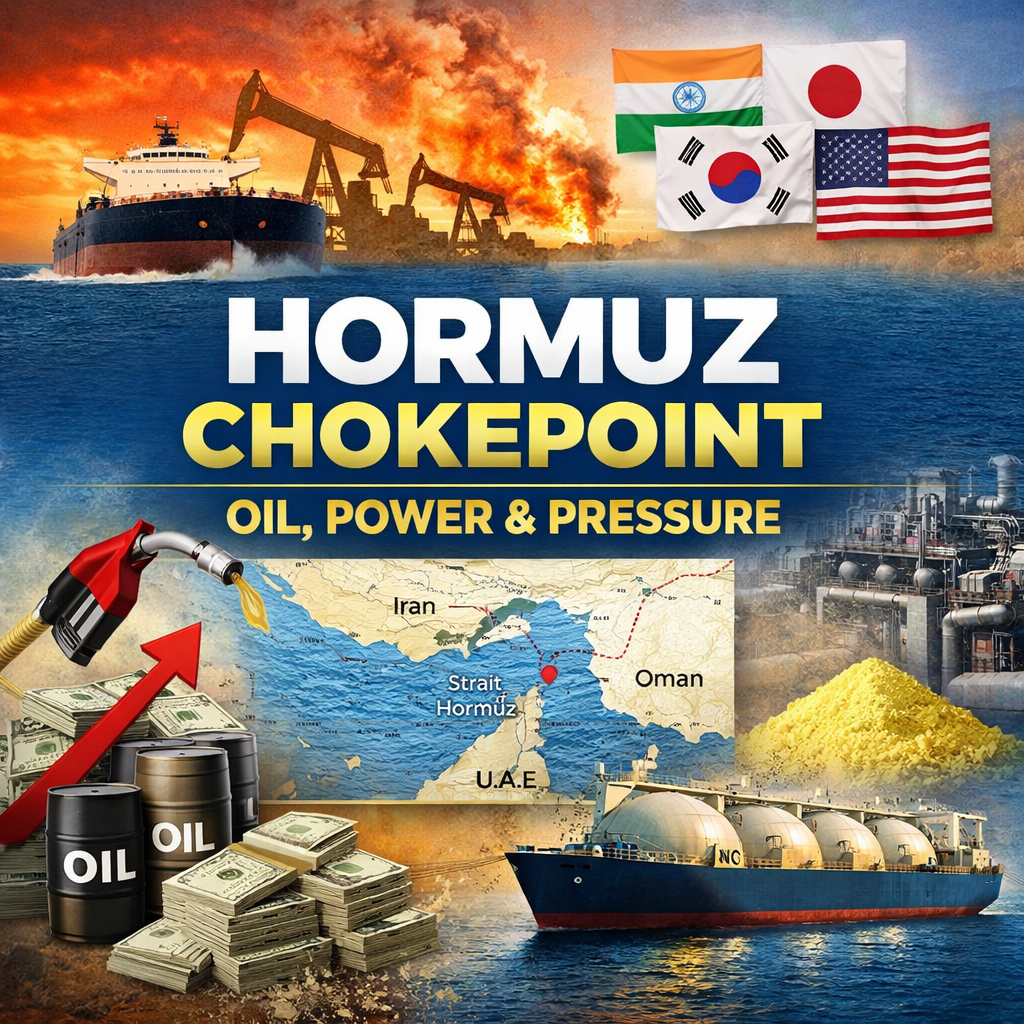
Chokehold Oil Economics: Trump does not need Hormuz open for America — he needs it open or closed depending on who is asking. The standard framing of the Hormuz closure as an oil supply disruption misses the more important fact. Twenty percent of global seaborne oil transiting the strait is the geography. The Chokehold Oil Economics of the 2026 war is something different: it is a selective access weapon in the hands of an actor who does not need the strait open for himself. The United States became a net energy exporter in 2019. Washington does not import Gulf crude. It does not need Hormuz to stay open for its own economy. It needs Hormuz open or closed depending on what Japan, South Korea, China, and India are willing to do this week.
There is a structural contradiction embedded in this position that the Gulf monarchies are beginning to calculate. Saudi Arabia, the UAE, Qatar, and Bahrain host American military bases — CENTCOM’s forward headquarters, the Fifth Fleet, Al Udeid Air Base — precisely because Washington guarantees their security and the uninterrupted flow of their oil revenues. That is the deal: bases in exchange for protection. But the Hormuz closure does not only hurt Asia. Approximately 71% of total GCC crude exports are physically locked to the Strait of Hormuz with no alternative route. The remaining 29% bypass capacity exists in only two countries — Saudi Arabia’s East-West pipeline to Yanbu on the Red Sea, and the UAE’s Fujairah pipeline to the Arabian Sea. Kuwait, Qatar, Bahrain, and Iraq have zero bypass. Every barrel they produce exits through the Persian Gulf and through Hormuz, or it does not exit at all. And Qatar’s LNG — the entirety of it — is 100% Hormuz-locked with no pipeline alternative to global markets of any kind. Even the Saudi and UAE bypass routes are constrained: Saudi Arabia’s Red Sea exit at Yanbu sits in Houthi missile range, and neither pipeline operates near full capacity. The bases exist to protect the energy flow. Four of the six GCC states have no energy flow without the strait Washington has now made a war zone.
The loss of Hormuz transit is not only a supply disruption for the world’s buyers. It is a revenue catastrophe for the states that host the bases that made the war possible. The GCC generated approximately $561 billion in oil industry revenue in 2024 — the majority of it Hormuz-dependent. Four of the six GCC states have no energy revenue without the strait Washington has now made a war zone. The bases exist to protect that revenue. They are now sitting inside the disruption they were supposed to prevent.
The Repricing Mechanism Nobody Is Discussing
The twenty percent figure has appeared in every headline. What has not appeared is the repricing mechanism it triggers. Brent crude — the global benchmark against which virtually all oil contracts on earth are priced — is priced on the assumption that Hormuz is open. When the strait closes, it does not simply remove twenty percent of supply from the market. It reprices one hundred percent of global oil against a scarcity assumption. Every barrel on earth becomes more expensive the moment Hormuz closes — including barrels produced in Texas, Norway, and Alberta that never came within three thousand miles of the Persian Gulf.
This is the first layer of Chokehold Oil Economics: the closure does not create a regional price shock. It creates a global repricing event with no geographic boundary. Every economy that consumes oil — which means every economy on earth — absorbs the shock simultaneously regardless of where their oil physically comes from.
The Refinery Problem No Waiver Can Solve
The oil that transits Hormuz is not generic crude. It is primarily Arab Light and similar Gulf grades — medium-sour crude with specific sulphur content, density, and yield characteristics. The majority of Asian refinery infrastructure — across Japan, South Korea, China, and India — was physically configured and built over decades to process these specific grades. Switching a refinery from Arab Light to North Sea Brent or West Texas Intermediate is not a procurement decision. It requires capital investment, operational retooling, and months of adjustment — assuming the alternative grades are even available in the volumes required. The Gulf states themselves hold approximately 8% of global refining capacity — a significant industrial base built to process their own sour crude output. Their domestic consumption is a fraction of this capacity. The closure therefore creates a refining gap on both ends simultaneously: Asian refineries cannot easily switch grades, and Gulf refinery output itself is stranded inside the Persian Gulf with no export route for refined products either.
Trump can issue a sanctions waiver. He cannot issue a refinery waiver. This is the structural floor of Chokehold Oil Economics that no bilateral deal can resolve quickly: the hardware of Asian energy infrastructure is locked to Gulf crude grades in ways that take years to change.
Japan and South Korea — the two most exposed large economies — face this constraint simultaneously while also managing the Korean Peninsula risk that a Hormuz deployment demand from Washington would create. There is a further consequence that receives almost no coverage: sulphur. Medium-sour Gulf crude produces sulphur as a refining byproduct, and the Gulf region accounts for nearly a quarter of the world’s sulphur supply. Sulphur is the feedstock for sulphuric acid, which is essential for phosphate fertiliser production and for leaching critical minerals in mining operations across Africa and Asia. A Hormuz closure does not only cut oil and gas. It cuts the sulphur supply chain that runs through agriculture and critical mineral extraction — compounding the food security shock that follows the fertiliser cost spike from the LNG disruption.
The LNG Multiplier
Qatar is the world’s largest LNG exporter. Every cubic metre of Qatari LNG exits through the Strait of Hormuz. Twenty-five to thirty percent of global LNG trade transits the strait — a share that has grown steadily as Asian gas demand expanded and Qatar built out its export capacity.
When the strait closes, the LNG multiplier activates a cascade that extends well beyond the energy sector. Gas prices spike. Electricity prices follow — gas-fired power generation is the marginal source of electricity pricing across most of Asia and Europe. When electricity prices spike, every energy-intensive industry faces an immediate cost shock in the same quarter: aluminium smelting, steel production, cement manufacturing, fertiliser synthesis, semiconductor fabrication.
The Chokehold Oil Economics of Hormuz is not an energy crisis in isolation. It is an industrial cost shock delivered simultaneously to every energy-intensive manufacturing sector across the global economy — timed precisely to a moment when those same sectors were already absorbing Trump’s tariff disruptions. LPG compounds this further.
Approximately 55% of global seaborne LPG trade transits Hormuz — the Gulf states collectively dominate LPG production, with Qatar alone the world’s largest producer at $31 billion annually. For India, with 332 million active domestic LPG connections and 90% of its LPG imports routed through the strait, the disruption is not an industrial input problem. It is a household fuel crisis affecting hundreds of millions of people who cook on nothing else.
📌 The War Behind the War
The oil motive did not begin in 2026. The template for resource-driven intervention has a twenty-year documented history.
The Chokehold Oil Economics Leverage Map
This is where the Chokehold Oil Economics of the 2026 war diverges sharply from any previous Hormuz crisis. The previous threat scenarios — 1980s tanker wars, Gulf War disruptions — involved an American administration that wanted the strait open for strategic stability. The 2026 situation is different in a more fundamental way: Iran is fighting this war with guerrilla tools. Washington and Israel decapitated its military leadership, destroyed its conventional war machine, and eliminated its command infrastructure. What remains is asymmetric — mines, drones, fast-attack craft, harassment of individual vessels. Iran cannot win a conventional naval engagement. It does not need to. It only needs to make the strait too dangerous and too expensive to use. The closure is not a military achievement. It is the residual capacity of a state that has been stripped of everything else. The 2026 situation therefore involves an administration that operates through bilateral transactional pressure, has demonstrated comfort using energy access as leverage, and is simultaneously demanding allied naval deployments, trade concessions, and political alignment from the same countries most exposed to a closure that Washington’s own strikes made inevitable.
The leverage map reads as follows. Japan imports approximately ninety percent of its oil from the Gulf. South Korea imports approximately seventy percent. India imports approximately sixty-five percent. China imports approximately forty percent from the Gulf with the remainder from Russia, Angola, and Brazil. The United States imports none — it is a net exporter.
The Trump Paradox
Washington therefore holds an asymmetric position of extraordinary leverage: maximum exposure for its primary strategic competitors, zero personal cost. This is the Trump paradox at its sharpest. He uses Gulf oil — priced in dollars, routed through a strait his forces police — to maintain global dollar dominance. He wants bases in every Gulf state to control both the oil and the military geography. But he does not want to ensure the smooth flow of oil. He does not need to. Disruption serves him as well as flow does — perhaps better, because disruption generates the bilateral pressure through which he extracts concessions. He does not care whether Gulf states can sell their goods. Their inability to sell is his leverage over them. Their dependency is his instrument. Trump’s use of this position is not constrained by institutional norms, alliance solidarity, or long-term strategic calculus in the way previous administrations were.
A sanctions waiver granted to India this week can be revoked next week if New Delhi does not cooperate on a separate trade demand. Japan’s escort commitment to the naval coalition can be linked explicitly to the question of whether Qatari LNG continues to flow to Tokyo. The Global South reads this architecture clearly — it is energy dependency as geopolitical submission dressed in the language of rules-based order.
Chokehold Oil Economics and the Strategic Reserve Illusion
The standard institutional response to a Hormuz disruption is strategic petroleum reserve release. IEA member states collectively hold approximately 1.5 billion barrels in strategic reserves — a figure that sounds substantial until measured against reality. Global oil consumption runs at approximately 100 million barrels per day. The entire IEA strategic reserve, released at full rate, covers fifteen days of complete supply replacement.
Strategic petroleum reserves were designed for short disruptions — a major hurricane shutting Gulf of Mexico production for two weeks, a tanker accident blocking a shipping lane for a few days. They were not designed for a war with no visible end date, driven by an actor whose decision-making timeline is determined by domestic political cycles rather than military objectives. The Chokehold Oil Economics of the 2026 war will outlast the strategic reserve buffer by months.
What comes after fifteen days is not a negotiated solution. It is rationing, recession, and the kind of political pressure on allied governments that Washington can then exploit for the next round of bilateral demands. This is not a side effect of the Trump strategy. It is the Trump strategy. An actor who does not need the oil, does not need the bases for defence, and does not need allied goodwill for re-election has no incentive to resolve the disruption quickly. The longer the chokehold holds, the more each government in Asia and the Gulf owes Washington for the relief it has not yet granted.
📌 The Escalation Ladder This Chokehold Sits On
The oil economics cannot be read without the military escalation architecture underneath them. Every rung on the ladder has its own economic trigger.
Next: Chokehold Food Security — Blog 12 in West Asia’s Endless War traces how the oil and gas shock travels through the fertiliser chain into global food prices, and why the same populations reading this war as resource imperialism will feel it first in what they eat. Part of the West Asia’s Endless War Series on hinduinfopedia.com.
Feature Image: Click here to view the image.
Videos
Glossary of Terms
- Strait of Hormuz: The thirty-three-kilometre waterway between the Persian Gulf and the Gulf of Oman through which approximately twenty percent of global seaborne oil trade passes daily.
- LNG (Liquefied Natural Gas): Natural gas cooled to liquid form for tanker transport. Twenty-five to thirty percent of global LNG trade transits the Strait of Hormuz.
- Gulf Monarchies: The oil-rich Arab monarchies of the Persian Gulf — Saudi Arabia, UAE, Qatar, Kuwait, Bahrain, and Oman.
- CENTCOM (US Central Command): The US military command responsible for operations across the Middle East, Central Asia, and parts of South Asia. Headquartered at Al Udeid Air Base in Doha, Qatar. Planned and executed the February 28 2026 strikes on Iran.
- LPG (Liquefied Petroleum Gas): Propane and butane gases compressed into liquid form for transport and domestic use. Approximately 55% of global seaborne LPG trade transits the Strait of Hormuz. For India’s 332 million domestic LPG connections, Hormuz closure is a household fuel crisis, not an industrial input problem.
- Naval Coalition at Hormuz: The US-led coalition of naval forces assembled at the Strait of Hormuz following the February 28 2026 strikes on Iran, tasked with ensuring freedom of navigation through the strait. India declined to join despite direct American pressure.
- Chokehold Oil Economics: The strategic framework examined in this blog — the use of Strait of Hormuz access as a selective weapon by an actor who does not personally depend on the strait remaining open, generating maximum leverage over energy-dependent competitors at zero domestic cost.
- GCC (Gulf Cooperation Council): The six-state economic and political bloc comprising Saudi Arabia, UAE, Qatar, Kuwait, Bahrain, and Oman. Collectively generated approximately $561 billion in oil industry revenue in 2024 — the majority Hormuz-dependent. Four of the six members have zero pipeline bypass capacity.
- Brent Crude: The global oil benchmark — North Sea crude whose spot price sets the reference against which virtually all oil contracts worldwide are priced. When Hormuz closes, Brent reprices globally, making every barrel on earth more expensive regardless of its physical origin.
- Arab Light: The medium-sour crude grade produced primarily by Saudi Arabia and widely across the Gulf — the dominant grade transiting Hormuz. Asian refinery infrastructure across Japan, South Korea, China, and India was built to process Arab Light specifically, making rapid grade substitution a capital and operational challenge measured in months.
- Repricing Mechanism: The chain reaction by which a Hormuz closure reprices 100% of global oil — not just the 20% transiting the strait. Brent crude is the global benchmark; closure triggers a scarcity assumption that applies to every barrel on earth simultaneously.
- Strategic Reserve Illusion: The gap between the apparent scale of IEA strategic petroleum reserves — 1.5 billion barrels — and their functional cover of approximately 15 days of global supply. Designed for short disruptions, not a war-driven closure with no negotiated end date.
- IEA Strategic Petroleum Reserve: The collective emergency oil stockpile held by International Energy Agency member states — approximately 1.5 billion barrels. Covers roughly 15 days of complete global supply replacement. Designed for acute short disruptions, not extended conflict-driven closures.
- Sulphur Supply Chain: The industrial chain linking Gulf crude refining — which produces sulphur as a byproduct — to sulphuric acid production, phosphate fertiliser synthesis, and critical mineral leaching. The Gulf accounts for nearly a quarter of global sulphur supply. Hormuz closure disrupts this chain, compounding the food security and mining sector shocks downstream.
- Yanbu: Saudi Arabia’s Red Sea oil export terminal — the western end of the East-West pipeline that provides Saudi Arabia’s only Hormuz bypass route. Capacity approximately 5 million barrels per day. Currently operates below full capacity and sits within Houthi ballistic missile range from Yemen.
- Fujairah: UAE port on the Arabian Sea coast — the exit point of the UAE’s Abu Dhabi Crude Oil Pipeline providing the UAE’s only Hormuz bypass route. Capacity approximately 1.5 million barrels per day. The only significant Gulf crude export infrastructure outside the Persian Gulf.
- Selective Access Weapon: The strategic posture in which control of a chokepoint is used not to keep it open uniformly, but to grant or deny access selectively as leverage — rewarding aligned states and penalising non-compliant ones. The core concept of Chokehold Oil Economics as applied to Hormuz in 2026.
#ChokeholdOilEconomics #HormuzReckoning #WestAsiaEndlessWar #OilChokepoint #BrentCrude #ArabLight #StrategicPetroleumReserve #GCCOilRevenue #LPGIndia #SulphurSupplyChain #IranWar2026 #EnergyCrisis2026 #OilSupplyDisruption #GulfMonarchies #DeDollarisation #ResourceImperialism #IndiaEnergy #LNG #HinduinfopediaGeopolitics #StraitOfHormuz
Relevant Links
Previous Blog
- https://hinduinfopedia.com/war-zone-in-hormuz-a-reckoning/
https://hinduinfopedia.in/?p=25537 - https://hinduinfopedia.com/hormuz-world-war-ladder-a-reckoning-of-west-asias-endless-war-2/
https://hinduinfopedia.in/?p=25545 - https://hinduinfopedia.com/west-asia-war-ethics-a-reckoning-of-west-asias-endless-war-3/
https://hinduinfopedia.in/?p=25550 - https://hinduinfopedia.com/west-asia-war-economics-a-reckoning-of-west-asias-endless-war-4/
https://hinduinfopedia.in/?p=25557 - https://hinduinfopedia.com/nuclear-pretext-of-west-asia-war-a-reckoning-of-west-asias-endless-war-5/
https://hinduinfopedia.in/?p=25588 - https://hinduinfopedia.com/nuclear-hypocrisy-of-usa-a-reckoning-of-west-asias-endless-war-6/
https://hinduinfopedia.in/?p=25593 - https://hinduinfopedia.com/ummah-delusion-during-war-a-reckoning-of-west-asias-endless-war-7/
https://hinduinfopedia.in/?p=25614 - https://hinduinfopedia.com/western-narrative-war-a-reckoning-of-west-asias-endless-war-8/
https://hinduinfopedia.in/?p=25650 - https://hinduinfopedia.com/global-south-war-narrative-a-reckoning-of-west-asias-endless-war-9/
https://hinduinfopedia.in/?p=25680 - https://hinduinfopedia.com/israel-survival-logic-a-reckoning-of-west-asias-endless-war-10/
https://hinduinfopedia.in/?p=25755
FOR BLOGS ON US IMPERIAL MINDSET / OIL MOTIVE / DESTABILIZATION DOCTRINE
- Destabilization Doctrine: How America’s Foreign Policy Boomerang Is Striking Home
- Regime Change Playbook: A Manual for Color Revolution Operations
- America, Independence, 1776 to Modern Hegemony — US Hypocrisy Doctrine (via Great Deception)
- Target India: Action Phase — Doctrine in Motion
- Activation of Destabilization Doctrine: The India Deployment Begins
- Rupee Rebellion / De-dollarization (cross-reference via .org)
FOR BLOGS ON IRAN / RAKTBEEJ / DUMP TRUCK RESILIENCE
- Great Deception and Global Civilizational Warfare — five-stage playbook applies directly to Iran’s regenerative resistance
- Islamist Boomerang Effect — When Pakistan’s Cross-Border Strikes Vindicate India’s Doctrine — dump truck principle applied to Pakistan, parallel to Iran
- Demographic Reality Exposed: How High-Fertility Clusters Reshape Democracies — Raktbeej demographic dimension
FOR BLOGS ON GULF MONARCHIES / UMMAH DELUSION / SHIA-SUNNI DIVIDE
- Gulf States Refugee Policy: Why the Wealthy Arabs Said No to Palestinians — Gulf self-preservation over Ummah solidarity, directly applicable
- Palestinian Refugees: Why No Muslim Country Will Take Them — Ummah as myth
- Black September Jordan: The Forgotten War That Changed the Arab World — Sunni-Shia and Arab political fractures
- Lebanon Civil War: From Paris of the Middle East to Hezbollah State — Gulf-Iran-Hezbollah triangle
FOR BLOGS ON UN / RULE-BASED ORDER / NEW COLONIAL ORDER
- When Dictatorships Vote on Democracy — The UN Legitimacy Crisis
- Anti-Israel Obsession — The UN’s Statistical Evidence of Institutional Bias
- New York Declaration Deconstructed — September 2025’s Theatre of Absurd
- New York Declaration Proponents — Hypocrisy and Legal Theater
- New York Declaration Perspectives — History, Media, and Theatrical Mechanics
FOR BLOGS ON MEDIA / SELECTIVE OUTRAGE / MANUFACTURED NARRATIVE
- How Media Manipulation Works: The Global Template
- Media as Manipulator In Unrest: The False Causality Matrix
- Muslim Brotherhood France: Intelligence Report Media Ignored
FOR BLOGS ON INDIA’S NEUTRALITY / UPI / STRATEGIC AUTONOMY
- Unrest From Bangladesh to Nepal: Is India the Real Target?
- Narrative of Unrest: When Neighbors Become Examples
- Rahul’s Gen Z Call — Activation of Destabilization Doctrine
- Money Trail: Analyzing Financial Networks Behind Nepal’s Protests
FOR BLOGS ON ISRAEL / PALESTINE / DECAPITATION TEMPLATE
- October 7th Vindication: Egypt’s Prophetic Wall
- Two-State Delusion Exposed — Netanyahu’s 99-9 Vote
- Right of Return to Palestine: The Strategy Behind 75 Years of Refugees
- Egypt Gaza Wall: The Hidden Truth 57 Muslim Nations
FOR BLOGS ON NUCLEAR HYPOCRISY / MANUFACTURED EXTREMISM
- Islamist Boomerang Effect
- Destabilization Doctrine — How America’s Foreign Policy Boomerang Is Striking Home
FOR BLOGS ON RAKTBEEJ AND DAGDHABEEJ / PHILOSOPHICAL RESOLUTION THREAD
- Raktbeej And Starfish Thesis: The 1,400-Year Organism That No Modern Framework Can Contain (Part II)
- Raktbeej Thesis: The Ancient Diagnostic That Explains What No Modern Framework Can
- Gaza and the Starfish: Why Every Cut Creates
Follow us:
- English YouTube: https://www.youtube.com/@Hinduofficialstation
- Hindi YouTube: https://www.youtube.com/@HinduinfopediaIn
- X: https://x.com/HinduInfopedia
- Instagram: https://www.instagram.com/hinduinfopedia/
- Facebook: https://www.facebook.com/Hinduinfopediaofficial
- Threads: https://www.threads.com/@hinduinfopedia
[…] भारत / GB […]
[…] Chokehold Oil Economics: A Reckoning of West Asia’s Endless War (11) […]
[…] Read: Chokehold Oil Economics → […]
[…] Chokehold Oil Economics: A Reckoning of West Asia’s Endless War (11) […]
[…] Read: Chokehold Oil Economics → […]
[…] Chokehold Oil Economics: A Reckoning of West Asia’s Endless War (11) […]
[…] https://hinduinfopedia.com/chokehold-oil-economics-a-reckoning-of-west-asias-endless-war-11/ and https://hinduinfopedia.in/?p=25763 […]
[…] […]
[…] https://hinduinfopedia.com/chokehold-oil-economics-a-reckoning-of-west-asias-endless-war-11/ and https://hinduinfopedia.in/?p=25763 […]
[…] […]
[…] […]
[…] https://hinduinfopedia.com/chokehold-oil-economics-a-reckoning-of-west-asias-endless-war-11/ and https://hinduinfopedia.in/?p=25763 […]
[…] […]
[…] a revenue catastrophe that the petrodollar arrangement was specifically designed to protect. The existential dependency that made Saudi Arabia Washington’s ideal partner in 1974 has become, in 2026, the trap that […]
[…] अरब के 71% कच्चे तेल का निर्यात होता है। इस युद्ध ने एक राजस्व संकट उत्पन्न किय… जिस अस्तित्ववादी निर्भरता ने 1974 में […]
[…] https://hinduinfopedia.com/chokehold-oil-economics-a-reckoning-of-west-asias-endless-war-11/ and https://hinduinfopedia.in/?p=25763 […]
[…] https://hinduinfopedia.com/chokehold-oil-economics-a-reckoning-of-west-asias-endless-war-11/ and https://hinduinfopedia.in/?p=25763 […]
[…] Read: Chokehold Oil Economics → […]
[…] Read: Chokehold Oil Economics → […]
[…] Read: Chokehold Oil Economics → […]
[…] https://hinduinfopedia.com/chokehold-oil-economics-a-reckoning-of-west-asias-endless-war-11/ and https://hinduinfopedia.in/?p=25763 […]
[…] https://hinduinfopedia.com/chokehold-oil-economics-a-reckoning-of-west-asias-endless-war-11/ and https://hinduinfopedia.in/?p=25763 […]
[…] https://hinduinfopedia.com/chokehold-oil-economics-a-reckoning-of-west-asias-endless-war-11/ and https://hinduinfopedia.in/?p=25763 […]
[…] Chokehold Oil Economics: A Reckoning of West Asia’s Endless War (11) https://hinduinfopedia.com/chokehold-oil-economics-a-reckoning-of-west-asias-endless-war-11/ […]
[…] mechanism is precise. Blog 11 established how Brent crude reprices all global oil — Hormuz closure affects not just Gulf oil but the global benchmark, which prices every barrel […]
[…] प्रक्रिया स्पष्ट है। ब्लॉग 11 ने बताया था कि Brent crude वैश्विक तेल …। होरमुज जलडमरूमध्य में बाधा केवल […]
[…] The Hormuz toll booth the series documented — Iran capturing a percentage of every barrel that passes through its territorial waters — is the same architecture. Cargill’s grain terminal is a toll booth. The difference is that one is called extortion and the other is called logistics. The difference is that one is called extortion and the other is called logistics. The background is traceable to Americans—whether government or corporate—engaged in the control and extraction of resources from around the world. […]
[…] हॉर्मुज़ टोल बूथ जिसे इस श्रृंखला ने दर्ज किया — ईरान अपने क्षेत्रीय जल से गुजरने वाले हर बैरल से प्रतिशत प्राप्त करता है — यही संरचना यहाँ भी है। कारगिल का अनाज टर्मिनल भी एक टोल बूथ है। अंतर केवल नाम का है। एक को जबरन वसूली कहा जाता है। दूसरे को लॉजिस्टिक्स कहा जाता है। यह अंतर केवल शब्दों का है। इसकी पृष्ठभूमि अमेरिकी नियंत्रण से जुड़ी है। इसमें सरकार और कॉर्पोरेट दोनों शामिल हैं। यह विश्व स्तर पर संसाधनों के नियंत्रण और निकासी की प्रक्रिया है। […]
[…] Read […]