

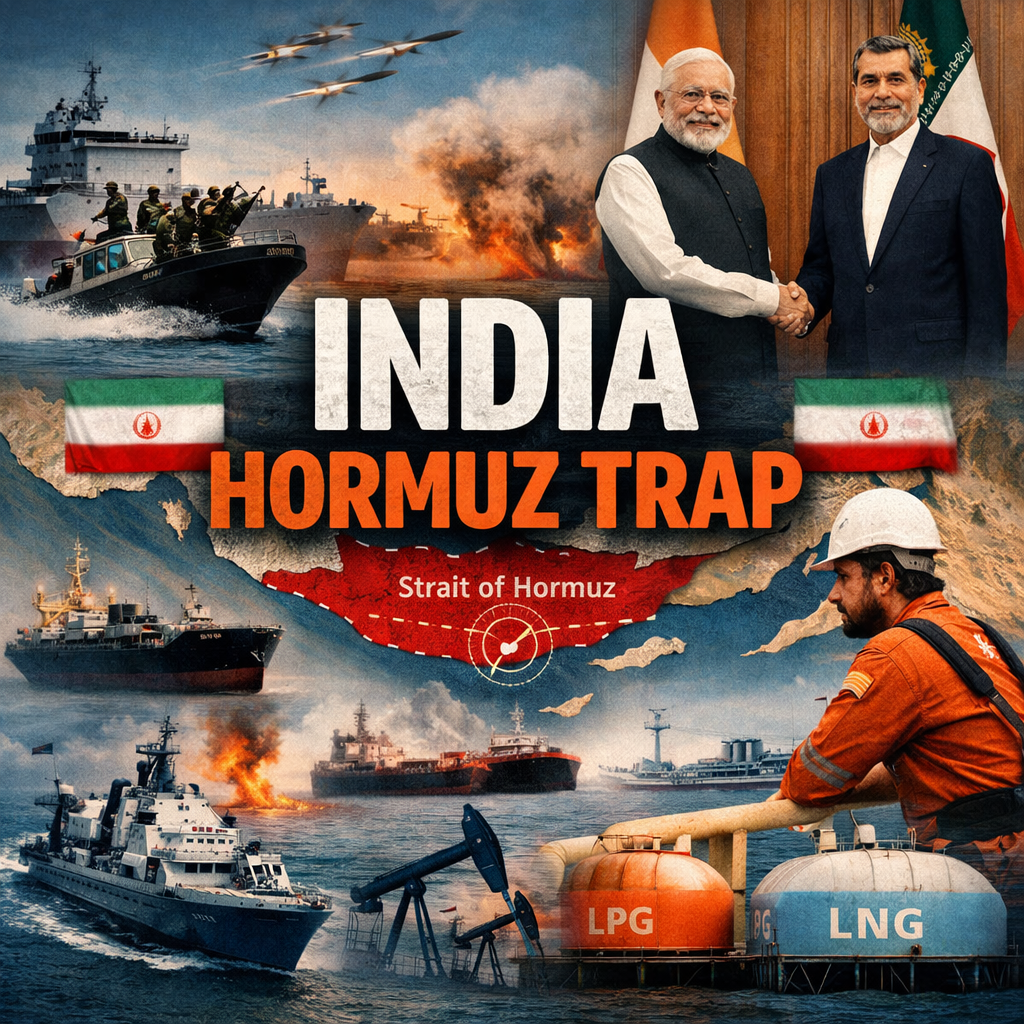
India Hormuz Trap: A Reckoning of West Asia’s Endless War (24)
Part 24 of the West Asia’s Endless War Series
भारत / GB
Ship by Ship, Cylinder by Cylinder — How India’s Strategic Autonomy Met the Hormuz Wall
India Hormuz Trap: The Tight Rope Walk
Scanning through various complexities and cultural aspects associated with the West Asia Endless war, in Blog 23 we established the Iran Selective Blockade — the toll booth architecture through which Tehran decides ship by ship, nation by nation, who gets access to the global oil highway. Blog 24 examines the country the India Hormuz Trap has hit hardest among non-aligned powers — a nation with 22 ships stranded, 611 seafarers exposed, half its energy imports blocked, and a medicines aircraft struck by the Americans while it tried to maintain relations with both sides simultaneously.
India Hormuz Trap: The Numbers Behind the Tightrope
India Hormuz Trap: 22 ships stranded, navy deployed, medicines aircraft hit — the tightrope that no doctrine prepared India for. When the Strait of Hormuz closed on 28 February 2026, India did not face an abstract geopolitical crisis. It faced a specific arithmetic problem with no clean solution. Twenty-two Indian-flagged vessels with 611 seafarers were stranded west of the strait, carrying 2.15 lakh metric tonnes of LNG, 3.21 lakh tonnes of LPG, and 16.76 lakh tonnes of crude oil. Twenty of the twenty-two were classified as essential to India’s energy security. India is the world’s fourth-largest importer of LNG and the second-largest buyer of LPG. About half of India’s crude oil and LNG imports transit the Strait of Hormuz. India has 332 million active domestic LPG connections — the cooking fuel of hundreds of millions of households. In addition. millions of commercial users of LPG depend for the businesses and eateries from a road side food vendor to paint shops in the automobile industries.
Beyond the stranded vessels lies a far wider, less visible exposure. Indian mariners crew thousands of foreign-flagged ships across global fleets — from Gulf oil tankers to Asian container lines. When Hormuz tightens, these Indians remain outside India’s direct reach, beyond naval escort or bilateral leverage, turning a contained shipping disruption into a dispersed and uncontrollable human vulnerability.
The India Hormuz Trap is not a diplomatic abstraction. It arrives at the kitchen cylinder.
Every Ship an Individual Happening
India’s response to the India Hormuz Trap has been a masterclass in constrained diplomacy — effective enough to move some ships, insufficient to resolve the underlying exposure. External Affairs Minister Jaishankar spoke four rounds with Iranian Foreign Minister Araghchi from the moment the conflict began. PM Modi spoke directly with Iran’s President Pezeshkian. The result of this sustained engagement was not a framework agreement. What emerged instead was not a negotiated corridor, but access contingent on approval. There was no blanket clearance to secure — only passage to be obtained, one vessel at a time.
Jaishankar confirmed in an interview with the Financial Times that India does not have a blanket arrangement with Iran for ship transit — that “every ship movement is an individual happening.” The most senior diplomat of the world’s most populous country, conducting four rounds of direct talks with the Iranian foreign minister, produced not a treaty but a queue. Each Indian vessel must present its case to the IRGC individually. Each transit is a separate negotiation.
Some movement followed. LPG carriers Shivalik and Nanda Devi crossed the strait on 14 March, escorted by Indian Navy warships under Operation Sankalp. Between 14 and 24 March, five Indian LPG carriers were evacuated from the strait in three separate operations — each escorted by Indian Navy destroyers and frigates through the Gulf of Oman once clear of Hormuz. On 25 March, India launched Operation Urja Suraksha — unlike the passive monitoring of previous years, the Navy implemented close-protection escorts for India-flagged LPG and crude tankers, conducted with the highest degree of caution and minimal publicity. India repatriated approximately 180 crew members of an Iranian warship that had sought sanctuary — a goodwill gesture designed to sustain the individual negotiation channel, ship by ship, indefinitely.
📌 The Toll Booth India Is Negotiating Through
The Iran Selective Blockade architecture that makes every Indian ship transit an individual IRGC negotiation — and what it is actually doing to international maritime law.
India Hormuz Trap: The Aircraft That Carried Medicines
The India Hormuz Trap reached its sharpest expression in a single incident that contained the entire contradiction of India’s position. India sent a civilian aircraft carrying medicines and medical equipment to Iran — an act consistent with the longstanding civilisational and humanitarian relationship between the two countries including those that are not friendly like Turkeya, and a signal of continued engagement at a moment when most Western nations had severed or frozen contact with Tehran. That aircraft was struck by American forces. Iran’s Civil Aviation Organisation condemned the attack as a war crime and a violation of international law. Iran’s mission in India confirmed the aircraft was carrying medicines sourced from various countries and was engaged in a humanitarian mission.
The incident is not a footnote. It is the India Hormuz Trap in its most concrete form. India was maintaining its relationship with Iran — as it has maintained relationships across every actor in this conflict simultaneously. Washington, prosecuting the war from bases in the Gulf, struck an Indian civilian aircraft performing a humanitarian function.
The country that is demanding India join its naval coalition to reopen Hormuz struck India’s medicine delivery to Iran. The country whose technology leverage India must manage, whose trade framework India cannot afford to antagonise, whose coalition demands India has diplomatically deflected — that country hit an Indian aircraft over Iranian territory. India has not formally condemned the strike.
The tightrope does not permit it. Each option triggers loss elsewhere.
Squeezed From Both Sides
The India Hormuz Trap is not only Iran’s toll booth. It is the pressure architecture operating from both directions simultaneously. Washington has urged major user nations to contribute naval assets to reopen the strait, with President Trump warning that countries benefiting from the route cannot remain passive indefinitely. India’s foreign ministry confirmed it has not engaged in bilateral discussions with the US regarding deploying naval vessels. India has not joined the American-led military operation. But it has joined UK-led talks on reopening the strait — a visible erosion of the strict neutrality position it had maintained in the war’s first weeks. Meanwhile 90 (9 million) lakh Indian workers remain in Gulf states that have been under Iranian missile attack — the largest Indian diaspora concentration in any conflict zone in the world, dependent on the continued functioning of states whose sovereignty Washington has compromised from bases on their soil.
India’s position is the Global South War Narrative made operational. The six billion people who read this war as the imposition of a Western order on nations that did not ask for it — India is their most instructive case study. India maintained non-alignment as doctrine.
It absorbed Khamenei’s repeated criticism on Kashmir without breaking the relationship. It maintained defence ties with Israel through the Gaza war and Hezbollah conflict without breaking the Gulf relationships while sending the humanitarian aid and medicines to Gazans.
It bought Russian oil under Washington’s sanctions pressure. It invested in Iran’s Chabahar port while Washington sanctioned Tehran. And at the moment when all of these relationships are activated by the same conflict simultaneously, the petrodollar trap springs: India’s neutrality is real as a doctrine and insufficient as an operational posture when both sides of a war control something it cannot survive without.
📌 The Abandonment Doctrine That Created This Trap
Trump’s declaration that Hormuz is the responsibility of user nations — the doctrine that placed India’s energy security in the middle of a war it chose not to fight.
Next: Why Iran Will Not Blink — Blog 25 in West Asia’s Endless War examines the strategic architecture underneath Iran’s refusal to accept any terms Washington has offered — a civilisational framework built across thousands of years, a chess game operating on a timescale no American administration can politically sustain, and the first hint of the question that will run through the remainder of this series: is anyone fighting the right war?
Feature Image: Click here to view the image.
Videos
[…] भारत / GB […]
[…] https://hinduinfopedia.com/india-hormuz-trap-a-reckoning-of-west-asias-endless-war-24/ and https://hinduinfopedia.in/?p=26126 […]
[…] https://hinduinfopedia.com/india-hormuz-trap-a-reckoning-of-west-asias-endless-war-24/ and https://hinduinfopedia.in/?p=26126 […]
[…] https://hinduinfopedia.com/india-hormuz-trap-a-reckoning-of-west-asias-endless-war-24/ and https://hinduinfopedia.in/?p=26126 […]
[…] https://hinduinfopedia.com/india-hormuz-trap-a-reckoning-of-west-asias-endless-war-24/ and https://hinduinfopedia.in/?p=26126 […]
[…] https://hinduinfopedia.com/india-hormuz-trap-a-reckoning-of-west-asias-endless-war-24/ and https://hinduinfopedia.in/?p=26126 […]
[…] https://hinduinfopedia.com/india-hormuz-trap-a-reckoning-of-west-asias-endless-war-24/ and https://hinduinfopedia.in/?p=26126 […]
[…] India Hormuz Trap: A Reckoning of West Asia’s Endless War (24) https://hinduinfopedia.com/india-hormuz-trap-a-reckoning-of-west-asias-endless-war-24/ […]
[…] The IRGC Mosaic Reckoning’s most precise illustration is not a historical case. It happened on April 18, 2026 — two days before this blog was published. Iran had declared Hormuz open. Two Indian-flagged vessels — the Sanmar Herald, a very large crude carrier loaded with nearly two million barrels of Iraqi crude bound for India, and the Jag Arnav, a bulk carrier travelling from Saudi Arabia’s Al Jubail — obtained prior clearance under that declaration and entered the strait. IRGC gunboats opened fire on both vessels without radio warning. Both ships were forced to reverse course and exit the strait. No crew were injured. India summoned the Iranian Ambassador, conveyed deep concern through Foreign Secretary Vikram Misri,… […]
[…] […]
[…] it maintained in the region; NATO fractured over a war its members were not consulted on; India walked the tightrope ship by ship; Pakistan brokered and hosted at diplomatic […]
[…] Industries Zone — the Habshan-Fujairah pipeline terminus, UAE’s only partial Hormuz bypass. The India Hormuz Trap — documented in Blog 24 — has its human expression: Indian workers in UAE absorbing Iranian […]
[…] what flows through Hormuz. It is about what flows back through the Gulf in the opposite direction. Blog 24 (India Hormuz Trap) established the nine-relationship architecture — the network of simultaneous Indian interests in […]
[…] India Hormuz Trap: A Reckoning of West Asia’s Endless War (24) […]
[…] […]
[…] Read […]
[…] Read: India Hormuz Trap → […]
[…] एक भारतीय श्रमिक की मृत्यु हुई। ब्लॉग 24 (भारत होरमुज जाल) ने भारत की नौ-विरोधाभास वाली स्थिति […]
[…] an Indian worker was killed. Blog 24 (India Hormuz Trap) established India’s nine-contradiction position. The Indian casualty in Kuwait activates the […]
[…] जाल (ब्लॉग 24) ने तर्क दिया था कि भारत की रणनीतिक […]