

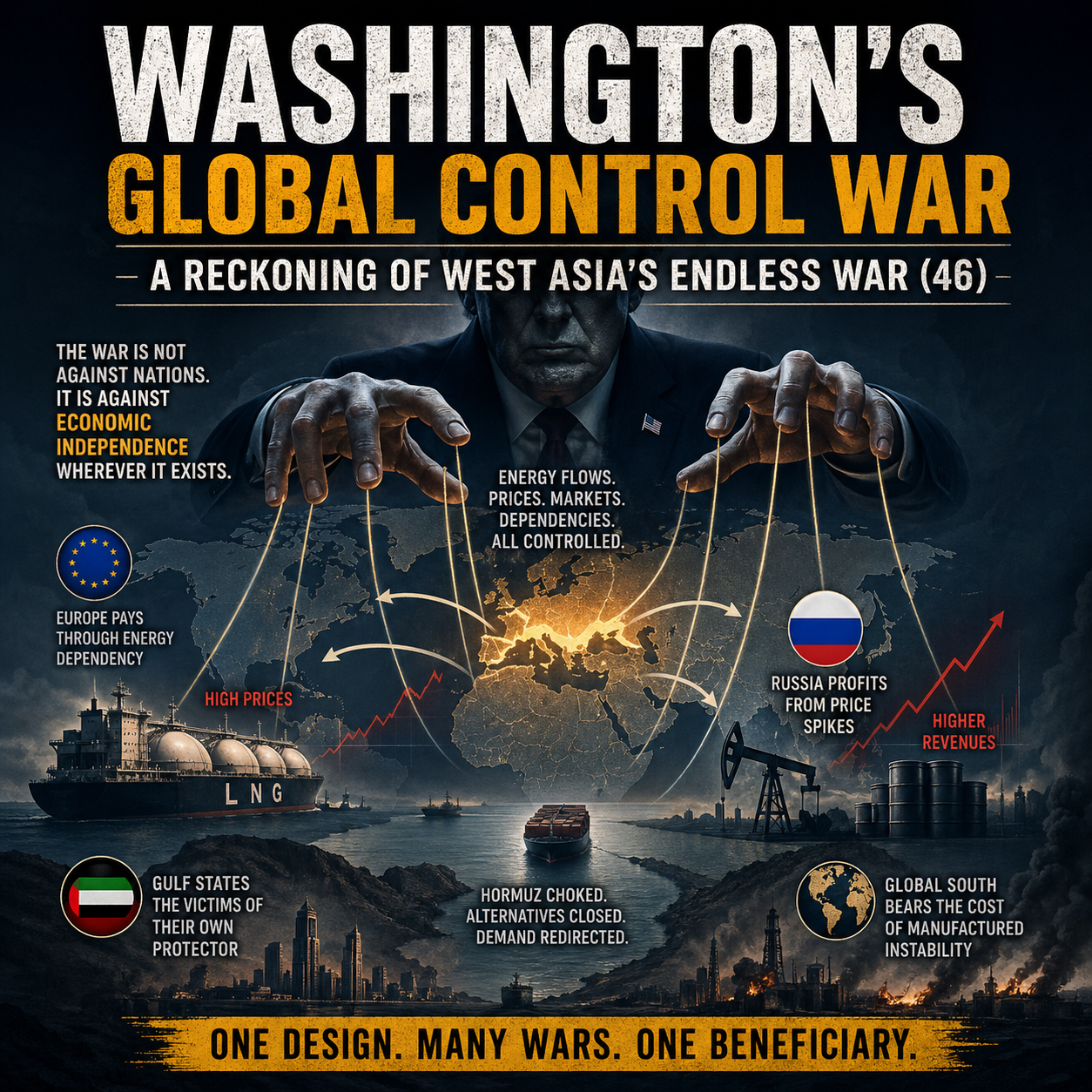
Washington’s Global Control War: A Reckoning of West Asia’s Endless War (46)
Part 46 of the West Asia’s Endless War Series
भारत / GB
The Series Has Documented 45 Consequences. Blog 46 Names the Single Design That Produced All of Them
Blogs 1 through 45 of this series have examined consequences: Hormuz closed, NATO fractured, the EU mediated nothing, the Gulf was betrayed, the petrodollar ended, African energy emerged, Russia collected its dividend, European energy was captured, Ukrainian agriculture was feudalised. Blog 46 asks the question the series has been building toward: what single design produced all of these consequences simultaneously? The answer is not Iran. Iran is the instrument. Washington’s Global Control War names the actual adversary in the West Asia’s Endless War — economic independence from Washington, wherever it exists, whoever holds it.
Washington’s Global Control War: The Confession in Three Statements
Washington’s Global Control War: Iran is the instrument. The war is against economic independence from Washington — wherever it exists, whoever holds it. It treats friends and foes alike. The evidence for this argument requires no intelligence sources, no leaked documents, no declassified cables. It is in three statements President Trump made publicly, without diplomatic packaging, in the course of the 2026 Iran war. Each statement requires no interpretation. Each statement is the policy stated plainly.
“Thanks” — Trump’s response when told that the IRGC had fired on Indian civilian vessels that held Iranian-issued transit clearance. Not outrage at the violation of shipping rights. Not concern for an ally whose civilian vessels were fired upon. Not condemnation of an adversary that had just attacked a neutral state’s commercial fleet. Gratitude. The IRGC Mosaic Reckoning established that the local naval node fired without central Tehran authorisation. Trump’s “thanks” was not for the act. It was for the outcome: Indian ships forced away from Iranian-tolled passage, away from a transit route that did not pass through American pricing, toward American-controlled alternatives. The redirection of Asian energy demand toward American terminals is commercially useful regardless of who caused the redirection. The IRGC local node and Washington’s strategic interest produced the same commercial outcome through entirely different logics.
“They have to open Hormuz. If I closed it, so what — it doesn’t impact me.” Stated at a White House press conference when asked about European energy price spikes caused by the Hormuz closure — the statement that European governments described in private as the moment they understood Washington’s strategic indifference to allied economic consequences. EU Energy Umbrella Reckoning in two sentences. Europe and Asia absorb the Hormuz closure through energy price spikes, supply disruption, and emergency LNG contracts at premium prices. America does not depend on Hormuz for its own energy supply. America benefits commercially from the closure because it fills the gap. The “so what” is not indifference to allies’ suffering. It is the acknowledgement — stated without diplomatic disguise — that the closure is commercially useful. The endless war produces the commercial conditions that fifty years of petrodollar architecture were designed to create: global energy demand flowing toward American supply at American prices.
“US ports are infested with vessels seeking and buying US energy.” Trump’s statement at a Pennsylvania energy rally, delivered to an audience of LNG industry executives and workers — framing commercial customers as an infestation, which in context was clearly meant as celebration of volume, not complaint. applied to paying commercial customers — vessels redirected from Hormuz, from Russian pipeline supply, from Qatari LNG, from every alternative that the accumulated wars, blockades, and pipeline destructions have systematically eliminated. It is the proof of concept stated as a boast. The Global Energy Reckoning documented the emergency LNG contracts flowing from the Hormuz disruption. The vessels infesting American ports are the commercial consequence of a strategic design. They did not arrive by accident. They arrived because the alternatives were closed.
Washington’s Global Control War: The Gulf as Victim of Its Own Protector
The sharpest illustration of Washington’s Global Control War is the Gulf itself — the states that built and paid for the entire arrangement, and whose commercial interests were the first to be destroyed by the war it produced. The Gulf monarchies paid protection money for fifty years: oil priced in dollars under a deal signed under the threat of invasion, surpluses recycled into US Treasuries, American military bases on Gulf soil, diplomatic cover for monarchy in a region that had every reason to overthrow it. In exchange they received the American military guarantee — the Praetorian Guard that would keep their regimes intact and their energy flowing.
In February 2026, the guarantee was activated. From their bases. Without their consultation. In a war that blocked the Strait of Hormuz — through which the Gulf states sold their marginal energy exports to India, China, Japan, and South Korea. The Gulf Betrayal Reckoning documented the diplomatic silence of monarchies that could not condemn a war launched from their territory. The commercial dimension of Washington’s Global Control War of that silence: the Gulf paid for the Praetorian Guard, the Praetorian Guard used the Gulf’s palace to launch a war that closed the strait through which the Gulf earned its marginal revenue, and the Gulf cannot object without triggering the very regime change threat that the protection arrangement was supposed to prevent. The protection racket has consumed its own client. Al Jazeera documented that Gulf state revenues from energy exports to Asian markets fell by an estimated 40% in the first six weeks of the Hormuz closure — losses borne by the states that provided the bases from which the war was launched.
📌 The Petrodollar Deal That Was Never a Partnership
Washington planned to invade. Saudi Arabia threatened to burn the oil fields. The 1974 deal was what happened next — and its fifty-year architecture is what the 2026 war was designed to protect.
Washington’s Global Control War: The Financing Loop
The financing loop that Washington’s Global Control War identifies is the most structurally consequential argument in the series. Europe is paying for the Ukraine war against Russia — funding Ukrainian defence, absorbing Ukrainian refugees, supplying weapons and financial support at a cost that is compressing European fiscal capacity and public patience simultaneously. NATO fractured over the Iran war while the Ukraine war was still ongoing — Europe managing two simultaneous consequences of Washington’s strategic decisions with no voice in either.
Washington’s Gulf blockade, launched simultaneously with the Ukraine war’s continuation, has produced elevated oil prices that generate $9 billion a month in additional Russian oil revenue. The Russia Passive Dividend documented this precisely: Urals crude from $44 per barrel in February to $116 at its peak, Russian state oil tax revenue doubling to $9 billion monthly. Russia uses that revenue to sustain the Ukraine war that Europe is paying to fight. Washington suspended its own Russia sanctions to manage the oil price spike its own Gulf war created — a direct financial transfer to the adversary that the sanctions were designed to contain, caused by the war that Washington designed and executed.
The complete loop: Washington designs the Ukraine war through the documented architecture Blog 44 established. Europe pays for the war. Washington destroys cheap Russian energy through Nord Stream destruction as well documented. Europe buys American LNG at premium prices to replace it. The EU Energy Umbrella Reckoning documented the 50-90% premium. Washington launches the Iran war. The Gulf blockade elevates oil prices globally. Russia collects $9 billion monthly in windfall revenue. Russia sustains the Ukraine war that Europe is paying to fight. Europe pays for both sides of the war it is fighting — its own defence through direct spending, and Russia’s war capacity through the energy price architecture Washington’s Gulf war created. Washington is simultaneously the arms supplier to Ukraine, the energy supplier to Europe at premium prices, and the involuntary financier — through its own Gulf war — of Russia’s continued military capacity. The Rogue Superpower Doctrine named this architecture. Washington’s Global Control War shows it operating in real time.
Washington’s Global Control War: The Enemies That Prospered
Washington designated Russia, Venezuela, and Iran as adversaries and constructed sanctions architectures designed to limit their energy revenues. Washington’s Gulf blockade created the exact commercial conditions in which all three prosper simultaneously: elevated oil prices that apply to sanctioned and unsanctioned producers alike, a global supply disruption that makes every alternative supplier commercially essential, and a rules-based order so visibly compromised that the sanctions architecture has lost the moral authority required to enforce compliance from Global South buyers.
The Global South War Narrative documented six billion people reading the conflict as resource imperialism. Those six billion people are also the buyers of sanctioned Russian oil, Venezuelan crude, and Iranian back-channel exports. They are buying it because the Gulf alternative is blocked, the American alternative is priced at a premium, and the moral authority Washington used to enforce sanctions compliance has been spent in a war that the Global South did not consent to — as documented by multiple G20 foreign ministers who voted against the US position at the UN in March 2026. The Manufactured Instability Reckoning established that African energy unfashionability was deliberately constructed across fifty years. The same Gulf blockade that commercially benefits American LNG terminals has simultaneously broken that fifty-year architecture — Nigeria, Algeria, Angola, Mozambique, and Equatorial Guinea are selling energy like hot cake to buyers who cannot access the Gulf alternative. Britain refused to join Washington’s naval blockade, citing that it would interdict allies more than adversaries — the most precise official confirmation of the Washington’s Global Control War argument from within the Western alliance itself. The architecture is consuming its own foundations.
Washington’s Global Control War — named precisely — leads the series to its central thesis, stated without qualification: the West Asia’s Endless War is not West Asia’s war. It never was. It is Washington’s war against the global energy and food market’s independence from American corporate pricing — conducted through the instrument of a regional conflict that conveniently closed the strait, disrupted the alternatives, redirected the demand, and generated the commercial conditions that the petrodollar architecture was designed to create and that fifty years of Gulf dependency, African instability, and European energy umbilical were designed to maintain. It is Washington’s war against the independent foreign policies of sovereign nations. Iran closed the toll booth. Washington adopted the toll booth and called it a blockade.
The difference between Iran’s toll and Washington’s blockade is that Iran’s toll had a legal basis in territorial waters that Britain declined to challenge, and Washington’s blockade has a legal basis that Britain refused to recognise and no country signed up to enforce.
The Islamabad Reckoning documented the blockade’s commercial absurdity — it interdicts Washington’s own allies more effectively than its designated adversaries. Washington’s Global Control War names why: the allies are the target.
📌 The Architecture This War Was Built On
From Blog 1 to Blog 45 — the complete series examining every dimension of the West Asia’s Endless War and the global order it is dismantling.
Next: China Oil Revenge — Blog 47 in West Asia’s Endless War examines China’s position in the conflict — not passive like Russia, not victimised like Europe, but actively and calculatedly positioned for the moment that Washington’s Global Control War has now named. China’s oil flowed through Hormuz under Iranian authorisation while American-allied shipping was blocked. China called for a ceasefire without joining one. China condemned the strikes without paying any price. The closing argument of Washington’s Global Control War — that every element of the commercial architecture Washington is defending through the endless war is the architecture China is building its alternative to. Part of the West Asia’s Endless War Series on hinduinfopedia.com.
Feature Image: Click here to view the image.
Videos
Glossary of Terms
- Washington’s Global Control War: A central thesis of the series describing a systemic strategy aimed at controlling global energy and economic flows rather than targeting specific nations.
- West Asia’s Endless War: The ongoing multi-theatre conflict examined across the series, interpreted as structurally driven rather than regionally confined.
- Economic Independence from Washington: The condition where nations operate outside US-aligned financial, energy, or pricing systems, identified in the blog as the underlying pressure point.
- IRGC (Islamic Revolutionary Guard Corps): Iran’s elite military force referenced in the context of naval actions affecting shipping routes in the Strait of Hormuz.
- IRGC Mosaic Reckoning: A prior analytical blog in the series explaining decentralized IRGC operational behavior and its implications.
- Hormuz Closure: The disruption or blocking of the Strait of Hormuz, a critical global energy transit chokepoint affecting oil and LNG flows.
- EU Energy Umbrella Reckoning: A series concept describing Europe’s dependency on external energy supplies and exposure to price shocks.
- Petrodollar Architecture: The global system where oil trade is denominated in US dollars, reinforcing American financial dominance.
- Praetorian Guard (Gulf Context): A metaphor describing US military protection arrangements for Gulf monarchies in exchange for economic alignment.
- Gulf Blockade: The strategic disruption of energy flows from Gulf states, impacting global supply chains and pricing.
- Financing Loop: The cyclical mechanism where war-driven energy price increases indirectly fund opposing sides in a conflict.
- Russia Passive Dividend: The increase in Russian revenue due to global oil price spikes triggered by geopolitical disruptions.
- Global Energy Reckoning: A framework within the series analyzing shifts in global energy demand, supply, and pricing power.
- Manufactured Instability Reckoning: The concept that long-term instability in regions like Africa was structurally shaped to control resource flows.
- Toll Booth vs Blockade: A key phrase contrasting Iran’s territorial transit control with US-led disruption framed as enforcement but functionally similar
#WestAsiaWar #EnergyCrisis #GlobalEconomy #Geopolitics #OilMarkets #USPolicy #RussiaUkraine #Petrodollar #LNG #GlobalTrade #HinduinfoPedia
[…] भारत / GB […]
[…] https://hinduinfopedia.com/washingtons-global-control-war-a-reckoning-of-west-asias-endless-war-46/ […]
[…] closing argument connects the transaction-level arithmetic to the series’ central thesis. Washington’s Global Control War (Blog 46) established that the endless war is not against Iran — it is against economic independence from […]
[…] Read: Washington’s Global Control War → […]
[…] […]
[…] Read […]
[…] War Logic closing argument connects the ideology arc back to the series’ central thesis. Washington’s Global Control War (Blog 46) established that the war is against economic independence from Washington wherever it exists. The […]
[…] Hardened) established that the global jihadist movement was created through Western covert policy. Blog 46 (Washington’s Global Control War) established that the war is against economic independence from Washington wherever it exists. Blog […]
[…] its affiliates. The Dar Al Harb Hardened tree is the Raktbeej demon at civilisational scale — and Washington’s Global Control War is being prosecuted against a theological infrastructure Washington built, using a military whose […]
[…] वाशिंगटन का वैश्विक नियंत्रण युद्ध वह परिस्थिति लेकर आया जिसने एसएमडीए को आवश्यक बनाया। एसएमडीए की आंतरिक संरचना वही परिस्थिति उत्पन्न करेगी जो इसे अप्रभावी बना देगी। इस्लामी नाटो समीक्षा यह तर्क नहीं रखती कि यह गठबंधन बनेगा नहीं। यह समीक्षा यह तर्क रखती है कि संचालन स्तर पर इसके अंतर्विरोध सक्रिय होने के बाद यह गठबंधन स्थिर नहीं रह सकेगा। […]
[…] that survived every previous application, selected and hardened by each successive attempt. Washington’s Global Control War has been, among its other functions, a seventy-three-year breeding programme for the most resilient […]
[…] Washington’s Global Control War has reached the template’s terminal point: the instrument has been fully applied, the organism has demonstrated its immunity, and the war continues without the primary mechanism Washington designed it around. The Raktbeej and Starfish Thesis on hinduinfopedia.com identified the organism’s property three decades before Operation Epic Fury tested it: the method of attack is the mechanism of replication. The Iran Decapitation Template did not destroy the organism. It confirmed its immunity — and in doing so, produced the most operationally capable, most constitutionally legitimate, and most internationally documented expression of Iranian resistance in the Islamic Republic’s forty-seven-year history. […]
[…] वाशिंगटन का वैश्विक नियंत्रण युद्ध इस प्रतिरूप की अंतिम सीमा तक पहुँच चुका है। साधन का पूर्ण उपयोग किया जा चुका है। जीवित व्यवस्था ने अपनी प्रतिरोधक क्षमता प्रदर्शित कर दी है। युद्ध जारी है, किन्तु उस मुख्य तंत्र के बिना जिसके आधार पर इसे निर्मित किया गया था। रक्तबीज और स्टारफिश सिद्धांत ने hinduinfopedia.com पर ऑपरेशन एपिक फ्यूरी से बहुत पहले इस जीवित व्यवस्था के एक मूल गुण की पहचान की थी। आक्रमण की पद्धति ही पुनरुत्पादन का साधन बन जाती है। ईरान नेतृत्व-विच्छेदन प्रतिरूप इस जीवित व्यवस्था को नष्ट नहीं कर सका। उसने उसकी प्रतिरोधक क्षमता की पुष्टि कर दी। ऐसा करते हुए उसने इस्लामी गणराज्य के सैंतालीस वर्षीय इतिहास में ईरानी प्रतिरोध का सबसे सक्षम, सबसे संवैधानिक रूप से वैध और सबसे व्यापक रूप से अंतरराष्ट्रीय स्तर पर अभिलेखित स्वरूप प्रस्तुत किया। […]
[…] है जो बीज को अंकुरित होने देती है। वॉशिंगटन का वैश्विक नियंत्रण युद्ध उसी साधन के माध्यम से चलाया जा रहा है […]
[…] more DDT. The removal of the water, the fertiliser, and the earth that makes the seed germinate. Washington’s Global Control War is prosecuted with the instrument that deepens the condition. The condition will not resolve until […]
[…] […]
[…] केंद्र के रूप में उभर रहे हैं। यह वॉशिंगटन्स ग्लोबल कंट्रोल वॉर (ब्लॉग 4… के निष्कर्ष की पुष्टि है। एकध्रुवीय […]
[…] The United States is on one side, and the rivals are China, Russia and now Iran.” This is the Washington’s Global Control War (Blog 46) argument’s documented outcome — the war designed to preserve unipolarity has accelerated […]
[…] to sustain maximum external pressure indefinitely — the organism can wait longer than the state. Blog 46 (Washington’s Global Control War) established the commercial architecture requiring the confrontation’s continuation. The […]
[…] […]