

Gulf War Responsibility Blockade: A Reckoning of West Asia’s Endless War (14)
Part 14: West Asia’s Endless War Series
भारत / GB
The Global Blame Game That Paralyses Trade and Accountability
Gulf War Responsibility Blockade: The East Asia Endless War
This series has examined the triggers and ladders of escalation in Hormuz, the ethical fractures, nuclear pretexts and hypocrisies, the collapse of Ummah solidarity, the competing narrative wars, Israel’s survival imperatives, and the Global South’s framing of the conflict as resource imperialism. It then mapped the cascading chokeholds: selective oil access as leverage, simultaneous disruptions across food fertiliser and household fuel chains, and compound industrial shocks hitting semiconductors, aluminium, and petrochemicals atop pre-existing tariff stresses. This blog confronts the question that arises once the physical and economic damage is clear — who bears responsibility for the Gulf War Responsibility Blockade that now grips global trade, energy, and manufacturing?
How Gulf War Responsibility Blockade Works
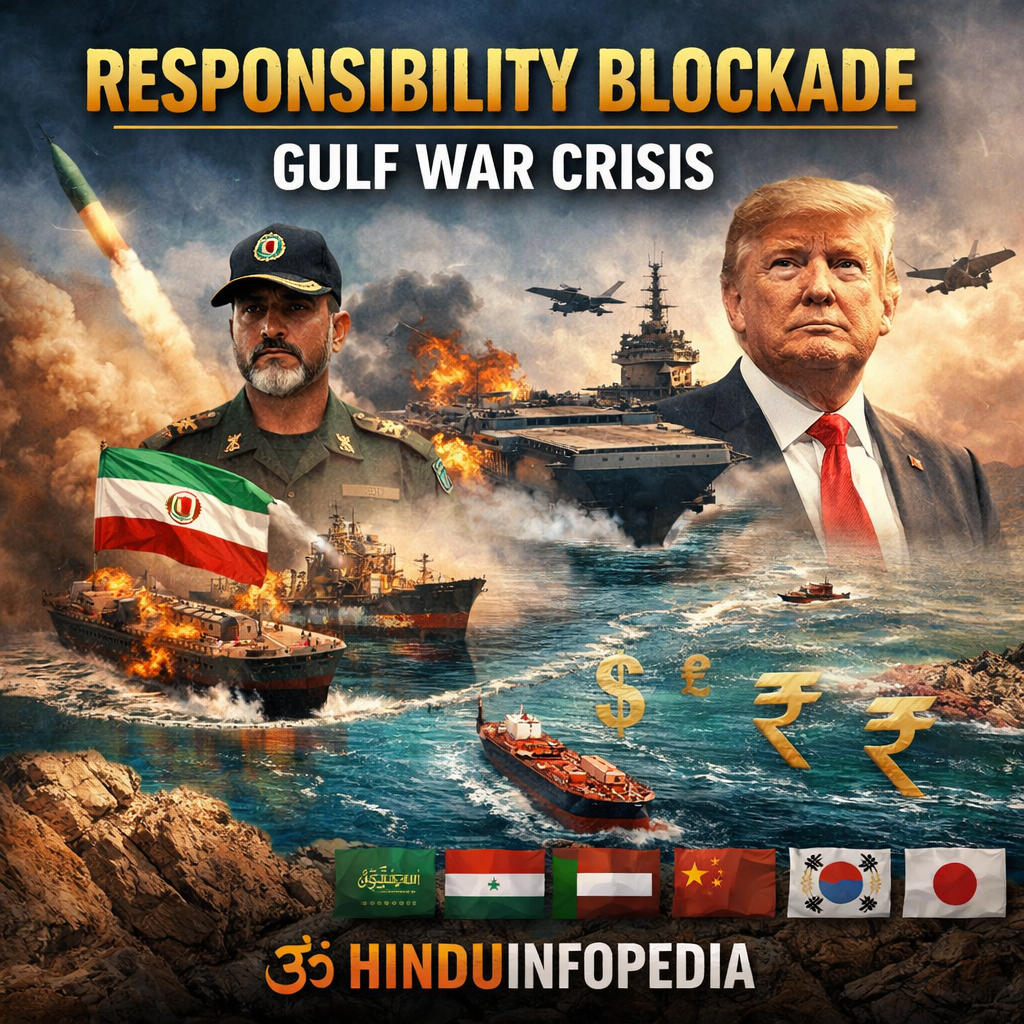
Gulf War Responsibility Blockade in the ongoing Hormuz crisis reveals how blame is evaded even as the world pays the price. The narrow strait has become far more than a physical chokepoint — it is now a theatre where every major actor points fingers while the global economy absorbs layered disruptions. Oil flows reduced to a trickle, fertiliser chains strained, helium shortages threatening chip fabrication, and aluminium and plastics spiking in cost — all trace back to the same 21 nautical miles. Yet accountability remains blocked.
The Gulf War Responsibility Blockade operates on multiple levels. The disturbing seas, made far more volatile by the US submarine torpedo sinking of the Iranian frigate IRIS Dena in the Indian Ocean on March 4, 2026, prompted London-based reinsurers to rapidly cancel war-risk coverage and demand triple the usual premiums. Shipowners, facing both the physical threat of Iranian attacks and the sudden absence of affordable insurance, simply stopped moving vessels — creating a de facto closure far more effective than any single actor could enforce alone.
Iran capitalises on this paralysis through repeated threats and selective attacks on vessels, framing its actions as legitimate resistance to external aggression. The United States, having initiated the chain of escalation that provoked the response, treats the resulting chaos as Iran’s sole fault while wielding selective naval escorts and sanctions waivers as leverage.
The Gulf monarchies, hosts to US bases meant to secure the flow, now watch their own export-dependent economies — where oil and gas routed through Hormuz account for the vast majority of their revenues and over 70% of total exports in many cases — suffer without clear agency. Meanwhile, import-dependent nations from India and China to South Korea and Japan face higher energy bills, disrupted supply chains, and inflationary pressures without a seat at the decision table.
The Iranian Closure as Calculated Leverage
Iran has turned the Strait of Hormuz into its primary asymmetric weapon. Since the escalation triggered by US-Israeli strikes on 28 February 2026, tanker traffic has dropped dramatically — from over 100 vessels daily to just a trickle, with many days seeing only a handful of transits or near-zero commercial movement. Iranian forces have conducted multiple attacks on merchant ships and issued repeated warnings that effectively deter most commercial traffic.
Iranian leadership has vowed to keep the strait blocked until demands are met. Adding to the pressure, Tehran has begun selectively demanding informal transit fees of up to $2 million per voyage from certain vessels in exchange for safe passage. This ad-hoc “pay-to-pass” arrangement allows Iran to extract direct revenue even as overall trade collapses.
This is not random disruption. By allowing selective passage to vessels that comply — whether through political alignment, payment, or other concessions — while clamping down on others, Iran creates precisely the kind of unpredictability that amplifies economic pain. The
Gulf War Responsibility Blockade here is deliberate: Iran accepts significant domestic costs (lost export revenues) in exchange for powerful global leverage, betting that the pain inflicted on energy-importing nations will force external powers to negotiate on Tehran’s terms.
Washington’s Role in the Escalation Chain
The United States bears upstream responsibility for the sequence that led to the closure. Joint US-Israeli strikes on Iranian targets on 28 February 2026 triggered Iran’s retaliation in the strait. Pentagon planning reportedly underestimated Iran’s willingness to impose this cost. Although the US is a net energy exporter and faces limited direct domestic pain from higher global oil prices, it maintains a massive military presence across the Gulf — not primarily to protect its own commercial imports, but to guarantee the smooth flow of oil priced in dollars. This arrangement underpins the petrodollar system: Gulf monarchies sell oil in USD and recycle the surpluses into US assets and weapons in exchange for security guarantees. The current disruption exposes the fragility of this bargain, allowing Washington to treat the Hormuz chaos as manageable collateral while using naval presence and selective sanctions waivers to reward or punish allies.
Gulf Monarchies: Hosts Without Control
The Gulf states find themselves in an acute existential bind. Their economies remain heavily dependent on hydrocarbon exports routed through Hormuz, yet hosting US military infrastructure did not prevent the current paralysis. The Gulf War Responsibility Blockade exposes the asymmetry: bases meant to guarantee security now sit amid a war zone that strangles the very trade they were supposed to protect.
For decades, the Gulf monarchies allowed deep US influence over their security decisions. They actively supported efforts to isolate and throttle Iran — the region’s lone Shia-majority country — whose rulers had long opposed American control over Iranian oil, a pattern visible since the 1953 coup and intensified after the 1979 revolution. While the Gulf states flourished under this arrangement, they helped enforce sanctions and containment that kept Iran economically constrained. Today, the same alignment leaves them watching helplessly as their own export-dependent economies suffer prolonged disruption.
Saudi Arabia, UAE, and others watch as their smelting capacity, petrochemical exports, and sulphur byproducts — critical for global fertilisers and industry — face prolonged disruption. Their limited ability to bypass the strait or influence either Iran’s actions or US strategy leaves them as collateral victims in a conflict they did not start but cannot easily end.
Global South and Asia: Paying Without Voice
Nations like India (with high exposure to Gulf oil and LPG), China, Japan, and South Korea confront the downstream consequences without meaningful input into the decisions that triggered them. The Gulf War Responsibility Blockade here is structural: great-power contestation in West Asia imposes costs on the Global South, which is then lectured about “rules-based order” while bearing the inflation, supply shortages, and industrial slowdowns.
Semiconductor fabs in Taiwan and South Korea face helium constraints atop energy shocks. Indian households and industries feel LPG and fertiliser ripples. African and South Asian food importers see compounded fertiliser-driven price spikes amid the disruption of roughly one-third of global seaborne fertiliser trade. Yet these populations have no veto over the initial strikes or the blockade response.
The Deeper Philosophical Blockade
The Gulf War Responsibility Blockade ultimately reflects a deeper failure in the West Asia conflict: no actor fully owns the consequences of its choices. Iran weaponises geography. The US weaponises escalation thresholds and selective access. Gulf monarchies, having long aligned with Washington to contain Iran, now find their own prosperity tied to a security arrangement that has backfired. External powers watch their supply chains fracture. Each narrative isolates blame on the other side, blocking any shared accounting that might open pathways to de-escalation.
This pattern echoes earlier themes in the series — where ethical, nuclear, and narrative pretexts mask raw power calculations, and economic chokeholds serve leverage rather than resolution. The same 21 nautical miles that disrupted oil, food, and industrial chains now also blocks honest attribution of responsibility.
Responsibility Evasion Matrix
| Actor | Primary Action | Responsibility Evaded |
| Iran | Kinetic Blockade & “Transit Fees” | Economic devastation of neutral neighbors. |
| USA | Pre-emptive Strikes & Naval Escorts | Triggering the escalation chain. |
| Gulf States | Defensive Alignment | Failure of the “Security for Oil” bargain. |
Feature Image: Click here to view the image.
Glossary of Terms
- Gulf War Responsibility Blockade: The layered evasion of accountability by major actors in the 2026 Strait of Hormuz crisis, where physical disruption of shipping, insurance collapse, selective attacks, and narrative blame-shifting combine to paralyse global trade while no party fully owns the economic consequences inflicted on neutral nations.
- Strait of Hormuz: Narrow 21-nautical-mile waterway between Iran and Oman through which roughly 20% of global oil and significant LNG volumes transit; became the central chokepoint in the 2026 Iran war after Iranian closure and attacks in response to US-Israeli strikes. [](grok_render_citation_card_json={“cardIds”:[“691c4b”]})
- IRIS Dena: Iranian Navy frigate sunk by a US Navy submarine torpedo in the Indian Ocean on 4 March 2026, an incident that heightened maritime risks and contributed to reinsurers cancelling war-risk coverage for vessels near the Gulf. [](grok_render_citation_card_json={“cardIds”:[“c31a5e”]})
- Petrodollar system: Long-standing arrangement in which Gulf monarchies sell oil in US dollars and recycle surpluses into American assets and weapons purchases in exchange for US security guarantees.
- Global South: Collective term for developing and emerging economies, particularly in Asia, Africa, and Latin America, that often bear downstream costs of great-power conflicts in West Asia without influence over the decisions triggering them.
#Hormuz #GulfWar #Iran #OilCrisis #GlobalTrade #EnergyCrisis #Geopolitics #Blockade #SupplyChain #HinduinfoPedia
भारत / GB
Relevant Links
Previous Blog
- https://hinduinfopedia.com/war-zone-in-hormuz-a-reckoning/
https://hinduinfopedia.in/?p=25537 - https://hinduinfopedia.com/hormuz-world-war-ladder-a-reckoning-of-west-asias-endless-war-2/
https://hinduinfopedia.in/?p=25545 - https://hinduinfopedia.com/west-asia-war-ethics-a-reckoning-of-west-asias-endless-war-3/
https://hinduinfopedia.in/?p=25550 - https://hinduinfopedia.com/west-asia-war-economics-a-reckoning-of-west-asias-endless-war-4/
https://hinduinfopedia.in/?p=25557 - https://hinduinfopedia.com/nuclear-pretext-of-west-asia-war-a-reckoning-of-west-asias-endless-war-5/
https://hinduinfopedia.in/?p=25588 - https://hinduinfopedia.com/nuclear-hypocrisy-of-usa-a-reckoning-of-west-asias-endless-war-6/
https://hinduinfopedia.in/?p=25593 - https://hinduinfopedia.com/ummah-delusion-during-war-a-reckoning-of-west-asias-endless-war-7/
https://hinduinfopedia.in/?p=25614 - https://hinduinfopedia.com/western-narrative-war-a-reckoning-of-west-asias-endless-war-8/
https://hinduinfopedia.in/?p=25650 - https://hinduinfopedia.com/global-south-war-narrative-a-reckoning-of-west-asias-endless-war-9/
https://hinduinfopedia.in/?p=25680 - https://hinduinfopedia.com/israel-survival-logic-a-reckoning-of-west-asias-endless-war-10/
https://hinduinfopedia.in/?p=25755 - https://hinduinfopedia.com/chokehold-oil-economics-a-reckoning-of-west-asias-endless-war-11/
https://hinduinfopedia.in/?p=25763 - https://hinduinfopedia.com/chokehold-food-security-a-reckoning-of-west-asias-endless-war-12/
https://hinduinfopedia.in/?p=25786 - https://hinduinfopedia.com/chokehold-industrial-chain-a-reckoning-of-west-asias-endless-war-13/
https://hinduinfopedia.in/?p=25816
FOR BLOGS ON US IMPERIAL MINDSET / OIL MOTIVE / DESTABILIZATION DOCTRINE
- Destabilization Doctrine: How America’s Foreign Policy Boomerang Is Striking Home
- Regime Change Playbook: A Manual for Color Revolution Operations
- America, Independence, 1776 to Modern Hegemony — US Hypocrisy Doctrine (via Great Deception)
- Target India: Action Phase — Doctrine in Motion
- Activation of Destabilization Doctrine: The India Deployment Begins
- Rupee Rebellion / De-dollarization (cross-reference via .org)
FOR BLOGS ON IRAN / RAKTBEEJ / DUMP TRUCK RESILIENCE
- Great Deception and Global Civilizational Warfare — five-stage playbook applies directly to Iran’s regenerative resistance
- Islamist Boomerang Effect — When Pakistan’s Cross-Border Strikes Vindicate India’s Doctrine — dump truck principle applied to Pakistan, parallel to Iran
- Demographic Reality Exposed: How High-Fertility Clusters Reshape Democracies — Raktbeej demographic dimension
FOR BLOGS ON GULF MONARCHIES / UMMAH DELUSION / SHIA-SUNNI DIVIDE
- Gulf States Refugee Policy: Why the Wealthy Arabs Said No to Palestinians — Gulf self-preservation over Ummah solidarity, directly applicable
- Palestinian Refugees: Why No Muslim Country Will Take Them — Ummah as myth
- Black September Jordan: The Forgotten War That Changed the Arab World — Sunni-Shia and Arab political fractures
- Lebanon Civil War: From Paris of the Middle East to Hezbollah State — Gulf-Iran-Hezbollah triangle
FOR BLOGS ON UN / RULE-BASED ORDER / NEW COLONIAL ORDER
- When Dictatorships Vote on Democracy — The UN Legitimacy Crisis
- Anti-Israel Obsession — The UN’s Statistical Evidence of Institutional Bias
- New York Declaration Deconstructed — September 2025’s Theatre of Absurd
- New York Declaration Proponents — Hypocrisy and Legal Theater
- New York Declaration Perspectives — History, Media, and Theatrical Mechanics
FOR BLOGS ON MEDIA / SELECTIVE OUTRAGE / MANUFACTURED NARRATIVE
- How Media Manipulation Works: The Global Template
- Media as Manipulator In Unrest: The False Causality Matrix
- Muslim Brotherhood France: Intelligence Report Media Ignored
FOR BLOGS ON INDIA’S NEUTRALITY / UPI / STRATEGIC AUTONOMY
- Unrest From Bangladesh to Nepal: Is India the Real Target?
- Narrative of Unrest: When Neighbors Become Examples
- Rahul’s Gen Z Call — Activation of Destabilization Doctrine
- Money Trail: Analyzing Financial Networks Behind Nepal’s Protests
FOR BLOGS ON ISRAEL / PALESTINE / DECAPITATION TEMPLATE
- October 7th Vindication: Egypt’s Prophetic Wall
- Two-State Delusion Exposed — Netanyahu’s 99-9 Vote
- Right of Return to Palestine: The Strategy Behind 75 Years of Refugees
- Egypt Gaza Wall: The Hidden Truth 57 Muslim Nations
FOR BLOGS ON NUCLEAR HYPOCRISY / MANUFACTURED EXTREMISM
- Islamist Boomerang Effect
- Destabilization Doctrine — How America’s Foreign Policy Boomerang Is Striking Home
FOR BLOGS ON RAKTBEEJ AND DAGDHABEEJ / PHILOSOPHICAL RESOLUTION THREAD
- Raktbeej And Starfish Thesis: The 1,400-Year Organism That No Modern Framework Can Contain (Part II)
- Raktbeej Thesis: The Ancient Diagnostic That Explains What No Modern Framework Can
- Gaza and the Starfish: Why Every Cut Creates
Follow us:
- English YouTube: https://www.youtube.com/@Hinduofficialstation
- Hindi YouTube: https://www.youtube.com/@HinduinfopediaIn
- X: https://x.com/HinduInfopedia
- Instagram: https://www.instagram.com/hinduinfopedia/
- Facebook: https://www.facebook.com/Hinduinfopediaofficial
- Threads: https://www.threads.com/@hinduinfopedia
[…] भारत / GB […]
[…] https://hinduinfopedia.com/gulf-war-responsibility-blockade-a-reckoning-of-west-asias-endless-war-14… and https://hinduinfopedia.in/?p=25854 […]
[…] Gulf War Responsibility Blockade: A Reckoning of West Asia’s Endless War (14) […]
[…] https://hinduinfopedia.com/gulf-war-responsibility-blockade-a-reckoning-of-west-asias-endless-war-14… and https://hinduinfopedia.in/?p=25854 […]
[…] Gulf War Responsibility Blockade: A Reckoning of West Asia’s Endless War (14) […]
[…] https://hinduinfopedia.com/gulf-war-responsibility-blockade-a-reckoning-of-west-asias-endless-war-14… and https://hinduinfopedia.in/?p=25854 […]
[…] […]
[…] https://hinduinfopedia.com/gulf-war-responsibility-blockade-a-reckoning-of-west-asias-endless-war-14… and https://hinduinfopedia.in/?p=25854 […]
[…] https://hinduinfopedia.com/gulf-war-responsibility-blockade-a-reckoning-of-west-asias-endless-war-14… and https://hinduinfopedia.in/?p=25854 […]
[…] https://hinduinfopedia.com/gulf-war-responsibility-blockade-a-reckoning-of-west-asias-endless-war-14… and https://hinduinfopedia.in/?p=25854 […]
[…] […]
[…] https://hinduinfopedia.com/gulf-war-responsibility-blockade-a-reckoning-of-west-asias-endless-war-14… and https://hinduinfopedia.in/?p=25854 […]
[…] https://hinduinfopedia.com/gulf-war-responsibility-blockade-a-reckoning-of-west-asias-endless-war-14… and https://hinduinfopedia.in/?p=25854 […]
[…] https://hinduinfopedia.com/gulf-war-responsibility-blockade-a-reckoning-of-west-asias-endless-war-14… and https://hinduinfopedia.in/?p=25854 […]
[…] https://hinduinfopedia.com/gulf-war-responsibility-blockade-a-reckoning-of-west-asias-endless-war-14… and https://hinduinfopedia.in/?p=25854 […]
[…] https://hinduinfopedia.com/gulf-war-responsibility-blockade-a-reckoning-of-west-asias-endless-war-14… and https://hinduinfopedia.in/?p=25854 […]
[…] https://hinduinfopedia.com/gulf-war-responsibility-blockade-a-reckoning-of-west-asias-endless-war-14… and https://hinduinfopedia.in/?p=25854 […]
[…] https://hinduinfopedia.com/gulf-war-responsibility-blockade-a-reckoning-of-west-asias-endless-war-14… and https://hinduinfopedia.in/?p=25854 […]
[…] https://hinduinfopedia.com/gulf-war-responsibility-blockade-a-reckoning-of-west-asias-endless-war-14… and https://hinduinfopedia.in/?p=25854 […]
[…] Responsibility Blockade: A Reckoning of West Asia’s Endless War (14) https://hinduinfopedia.com/gulf-war-responsibility-blockade-a-reckoning-of-west-asias-endless-war-14… […]
[…] […]
[…] own behaviour in 2026 meets the definition as fully or more fully than Iran’s. The Responsibility Blockade — the mechanism by which Washington assigns consequences to others — has been turned by the […]
[…] American Hormuz toll, and described the entire operation as profitable piracy to a cheering crowd. The Responsibility Blockade — the mechanism by which Washington assigns consequences to others for behaviours it practices […]
[…] लाभ देने वाली समुद्री लूट बताया। दायित्व अवरोध — वह प्रक्रिया जिसमें वाशिंगटन अपने […]
[…] Read […]