

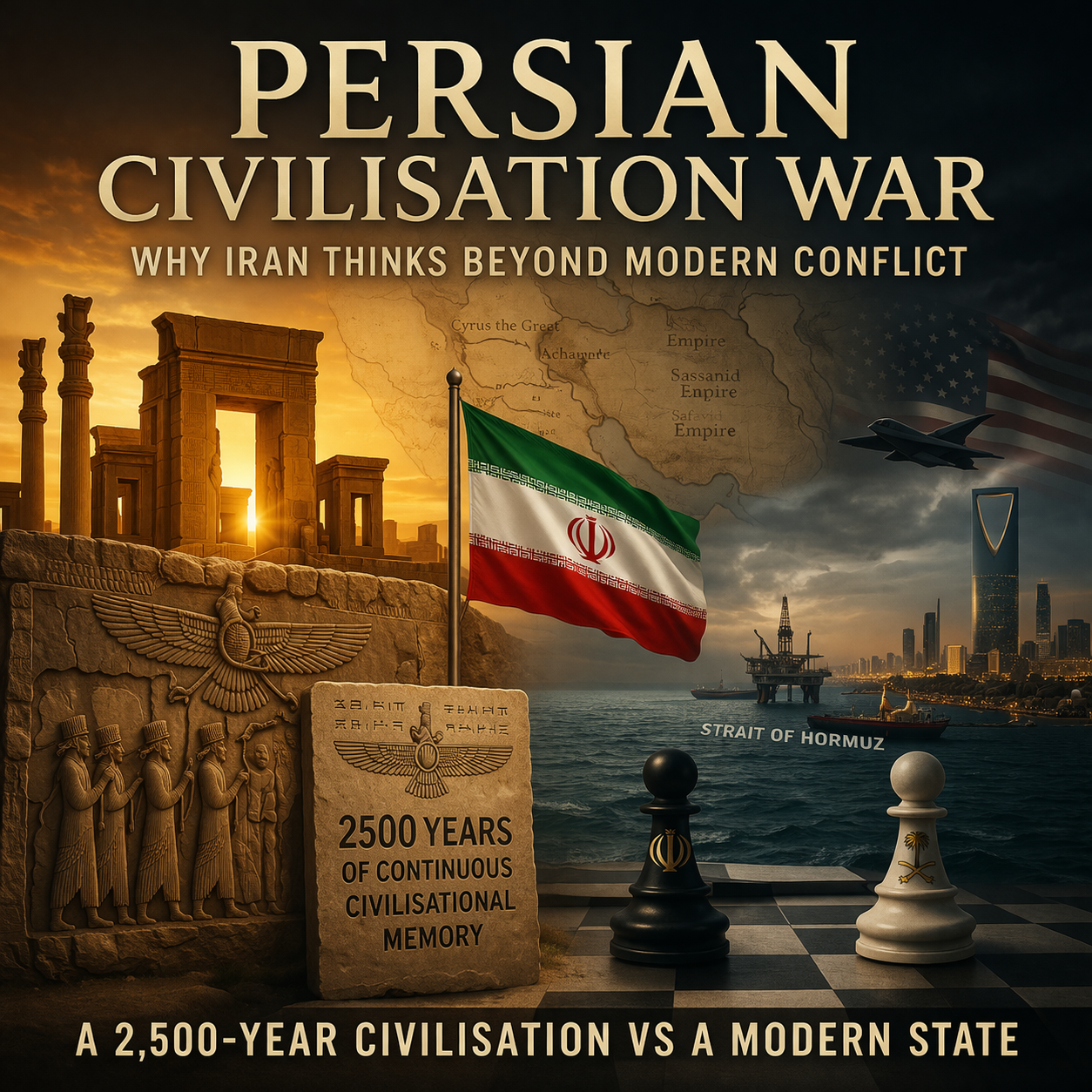
Persian Civilisation War: A Reckoning of West Asia’s Endless War (21)
Part 21 of the West Asia’s Endless War Series on hinduinfopedia.com
भारत / GB
Iran Is Not an Arab Country Playing an Arab Game — It Is a 2,500-Year Civilisation Playing Its Own
Hormuz Blocked Root Cause Analysis: Persian Civilisation War
This series has traced how the Hormuz crisis is driven by economics, theology, and imperial rivalry — from the petrodollar architecture that made Saudi Arabia America’s anchor, to the Shia-Sunni war roots that make the Saudi-Iran conflict irresolvable through diplomacy. What has not yet been named is the deeper layer beneath the theology: Iran’s civilisational identity. Grasping this requires understanding that Iran enters every confrontation carrying 2,500 years of imperial memory that no Gulf monarchy can match — and that this memory shapes Iranian strategy in ways that Western and Arab analysts routinely misread. The current blog analyses how Persian Civilisation War is at display at the strait of Hormuz.
The Persian Civilisation War Behind the Hormuz Crisis
Persian Civilisation War: the conflict in West Asia is not only a Shia-Sunni theological contest, not only a competition for oil dominance, and not only a proxy battlefield for American and Russian power. At its deepest layer, it is a Persian Civilisation War — a confrontation between Iran’s multi-millennial sense of itself and a regional order that was built without it, around it, and deliberately against it. To understand why Iran behaves as it does — why it absorbs punishment, refuses to capitulate, and thinks in decades while its adversaries think in election cycles — this civilisational depth must be understood not as metaphor but as architecture. It is the foundation beneath every Iranian strategic decision.
Two Thousand Five Hundred Years of Memory: What No Gulf Monarchy Possesses
Most analyses of West Asia treat Iran as an Islamic state. That framing is accurate but incomplete, because Iran is home to one of the world’s oldest continuous major civilisations, with historical and urban settlements dating back to the 5th millennium BC. The Achaemenid Empire — established by Cyrus the Great around 550 BC — was the largest empire the world had yet seen, stretching from the Aegean coast to the Indus River. The empire of Cyrus the Great was the largest the world had ever seen, and his son Cambyses continued this expansionist policy by conquering Egypt. The Sassanid Empire that followed — lasting from 224 to 651 CE — was called one of the Two Eyes of the World alongside Rome. It is considered by the Iranian people a highlight of their civilisation, a period when Persian culture reached its height in art, governance, and intellectual achievement. Then came the Safavids in the 16th century, reunifying Iran and establishing Shia Islam as the official religion of the state.
Three great empires. Two and a half thousand years of continuous civilisational memory. From the Medes who unified the Iranian tribes, to the Achaemenids who established the world’s first superpower, and the Safavids who solidified Iran’s Shia identity — each dynasty played a pivotal role in defining Iran’s national and cultural identity. Saudi Arabia, by contrast, is a modern political entity in civilisational-state continuity terms whose pre-Islamic Arabian heritage cannot be compared to this in depth or continuity. This is not a point about superiority. It is a point about the weight of self-understanding that Iran brings to every confrontation. An Iranian leadership that has absorbed decades of sanctions, military strikes, and regime-change efforts is doing so with the psychological ballast of a civilisation that has been occupied, conquered, and written off before — and has outlasted every power that declared it finished.
The Arab Conquest as a Living Wound in the Persian Civilisation War
In 637 CE, Arab armies of the Rashidun Caliphate destroyed the Sassanid forces at the Battle of al-Qadisiyyah. The Sassanid capital of Ctesiphon fell in March 637 after a siege of three months. By 651 CE, the last Sassanid ruler was dead and Persia had been absorbed into the Arab Islamic empire. The desecration of Zoroastrian temples and the execution of nobles shattered Persian identity at its institutional level. The greatest empire of the ancient world had been overrun in less than two decades.
Western analysts treat this as ancient history. Iranian political culture does not. The Arab conquest occupies a specific position in the Persian civilisational psyche — experienced not as a completed historical event but as a live wound whose aftermath still shapes the present. Iran, despite its conquest by the armies of Islam, retained its own Persian language and much of its culture — a fact Iranian identity treats not as fortunate survival but as an act of civilisational will. Farsi endured when Arabic replaced the native tongues of Egypt, Syria, Iraq, and North Africa. Persian literature, philosophy, and administrative culture were not absorbed into Arab civilisation — they absorbed the Arab conquerors. Farsi became a key factor in preserving the continuity of Persian civilisation even during periods when the country was ruled by dynasties of Turkic or Mongol origin — it is the language that proves to be one of the most enduring links between ancient Persia and modern Iran.
This memory is operating software in Iran’s strategic culture.
This continuity is not symbolic but institutional. It is transmitted through education, clerical authority, and state ideology, and operationalised by bodies like the IRGC. Concepts such as “forward defence” convert historical memory into strategic doctrine, linking inherited civilisational identity with calibrated modern behaviour in diplomacy, conflict, and regional positioning.
When Iran faces Arab pressure today — from Saudi Arabia’s funding of anti-Shia sectarianism, from Gulf state alignment with Washington, from the wider Arab world’s framing of Iran as a regional aggressor — it is processed through a civilisational framework that positions Arab states not as civilisational peers but as a force that once, briefly, held imperial power over Persia. The humiliation was real. The recovery was total. Iranian political culture draws from that sequence constantly.
The Persian Civilisation War and the Language That Refused to Die
The survival of Farsi is the single most important fact about Iranian civilisational identity — and the most underappreciated by outside analysts. Every major territory conquered by the 7th-century Arab armies eventually adopted Arabic as its primary language. Egypt, with millennia of its own civilisational heritage, became Arabic-speaking. Syria, Iraq, North Africa: the same pattern. Iran did not. Although Arabization was a common element of the early Muslim conquests, it did not have as significant an impact in Iran as elsewhere, as the Iranian populace persisted in maintaining their language and culture, albeit with adaptations.
The poet Ferdowsi composed the Shahnameh — the Book of Kings — between 977 and 1010 CE: an epic retelling of Persian history from mythological origins to the Arab conquest, written entirely in Farsi with deliberate exclusion of Arabic vocabulary. Following Ferdowsi, there was a renaissance in Persian literature, with poets such as Omar Khayyam and Rumi remaining famous worldwide to this day. Farsi as a living carrier of civilisational memory means that Iranian political culture has a direct communication channel with its own pre-Islamic past. An educated Iranian reads Ferdowsi and Hafez in the original — and those texts pre-assume a Persian identity that is distinct from and prior to Arab-Islamic identity. Saudi Arabia has no equivalent. The House of Saud derives its legitimacy from Islam and from custodianship of the holy sites. Strip those away and there is no pre-Islamic Arabian imperial heritage to sustain identity. Their ability to sustain power is reinforced by long-standing strategic alignment with United States, which has provided internal security guarantees and external stabilisation during periods of regional volatility. On the other hand, strip Islam from Iranian identity and two and a half millennia of civilisational narrative remains, in its own language. This asymmetry of civilisational depth is a permanent structural feature of the Persian Civilisation War.
Persian Civilisation War: The Chess Metaphor Is Not a Metaphor
Chess was refined into its recognisable strategic form by the Sassanid Persian Empire. It was Persia that codified chess’s language, symbolism, and intellectual framework: the shah (king), the rokh (rook), and shatranj, the ancestor of the modern game. That this civilisation’s signature intellectual contribution to the world is a game of strategic patience and positional advantage — not a game of speed or overwhelming force — is Not coincidental. It maps precisely onto how Iran has conducted the Persian Civilisation War across four decades of sanctions, proxy conflict, and open confrontation.
This pattern is structurally reinforced rather than instinctive. Iran’s post-1979 state architecture embeds long-horizon thinking through ideological framing, decentralised proxy networks, and a sanctions-adapted economy, ensuring that civilisational memory is continuously translated into operational state behaviour rather than remaining a passive historical reference. Persian political culture treats negotiations and conflicts as prolonged contests of endurance, where patience can exhaust opponents — winning through attrition and time rather than through decisive battles. For decades, Iran has faced a sanctions regime constructed by the United States that cut the country off from international financial markets, frozen its assets, throttled its oil revenues, and excluded it from the global trading system — and this exclusion produced its own strategic logic. A country expelled from the global order has every incentive to threaten that order’s foundations rather than seek readmission on humiliating terms. Iran’s targeting of energy infrastructure, its pressure on the Strait of Hormuz, its strikes on Gulf ports, banks, and technology companies are not improvised desperation. They are a systematic campaign four decades in the making.
From the Iran-Iraq War emerged what Iranian officials described as “forward defence”: Iran would confront threats beyond its borders so that wars would not take place on Iranian soil. Hezbollah in Lebanon, militias in Iraq, the Houthis in Yemen — none of these are strategic accidents. They are pieces positioned on a board over decades. Tehran has been preparing for this confrontation for nearly four decades, since the Islamic Revolutionary Guard Corps was bloodied in the Iran-Iraq War and began developing a coherent doctrine of asymmetric deterrence. No Gulf monarchy, none of them founded within living memory, thinks in these time horizons. This civilisational depth gives Iran a patience that no adversary built on quarterly results and election cycles can match.
Persian Civilisation War: Why the Current Confrontation Follows an Ancient Pattern
The Persian Civilisation War means that Iran does not experience the current US-Israeli military campaign as an existential novelty. It experiences it as an episode — the latest in a sequence that includes Alexander, the Arab armies, the Mongols, the British, the Americans backing the Shah, Saddam Hussein’s US-supported invasion, and now this. Each time, the outside power expected that sufficient military force would produce political submission. Each time, the civilisational depth proved more durable than the attacking force’s willingness to sustain the campaign.
This is why the standard tools of coercive diplomacy consistently underperform against Iran. After the first Trump administration withdrew from the JCPOA and launched its maximum pressure campaign in 2018, Tehran initially avoided major counter-escalation for nearly a year, hoping other signatories could preserve the agreement. When that failed, Iran began a measured, incremental response — expanding enrichment, reducing compliance step by step, maintaining the option of negotiation while building leverage. That is not weakness. That is the chess player sacrificing pawns to control the board. This is a conflict still being fought by the rules Persia wrote for the game. The Arab world never unified against it successfully. The Americans have not yet understood what they are actually confronting.
The next blog in this series is Why Iran Will Not Blink: A Reckoning of West Asia’s Endless War (22) — which takes this civilisational argument and translates it into present operational logic. What does 2,500 years of Persian memory actually produce in an Iran whose nuclear facilities have been bombed, whose commanders have been killed, and whose economy has been throttled? It produces a strategic culture that has learned to treat each defeat as a positioning move — and to outlast every empire that thought it had delivered the final blow.
Feature Image: Click here to view the image.
Videos
[…] भारत / GB […]
[…] https://hinduinfopedia.com/persian-civilisation-war-a-reckoning-of-west-asias-endless-war-21/ and https://hinduinfopedia.in/?p=26043 […]
[…] https://hinduinfopedia.com/persian-civilisation-war-a-reckoning-of-west-asias-endless-war-21/ and https://hinduinfopedia.in/?p=26043 […]
[…] https://hinduinfopedia.com/persian-civilisation-war-a-reckoning-of-west-asias-endless-war-21/ and https://hinduinfopedia.in/?p=26043 […]
[…] https://hinduinfopedia.com/persian-civilisation-war-a-reckoning-of-west-asias-endless-war-21/ and https://hinduinfopedia.in/?p=26043 […]
[…] https://hinduinfopedia.com/persian-civilisation-war-a-reckoning-of-west-asias-endless-war-21/ and https://hinduinfopedia.in/?p=26043 […]
[…] track record that demonstrates sustained resistance is both possible and strategically productive. The civilisational framework established in Blog 21 is not background philosophy at this moment. It is the operational explanation for why a state that […]
[…] https://hinduinfopedia.com/persian-civilisation-war-a-reckoning-of-west-asias-endless-war-21/ and https://hinduinfopedia.in/?p=26043 […]
[…] https://hinduinfopedia.com/persian-civilisation-war-a-reckoning-of-west-asias-endless-war-21/ and https://hinduinfopedia.in/?p=26043 […]
[…] https://hinduinfopedia.com/persian-civilisation-war-a-reckoning-of-west-asias-endless-war-21/ and https://hinduinfopedia.in/?p=26043 […]
[…] https://hinduinfopedia.com/persian-civilisation-war-a-reckoning-of-west-asias-endless-war-21/ and https://hinduinfopedia.in/?p=26043 […]
[…] Persian Civilisation War: A Reckoning of West Asia’s Endless War (21) https://hinduinfopedia.com/persian-civilisation-war-a-reckoning-of-west-asias-endless-war-21/ […]
[…] is not defiance. It is the Political Clock Reckoning stated from the other side of the equation. The civilisational framework this series established in Blog 21 — 2,500 years of Persian strategic patience, the chess game operating on a timescale no electoral […]
[…] what the Gulf actually was in 1976 — two years after the petrodollar deal. The United Arab Emirates had unified only in 1971 — a loose federation of tribal sheikhdoms that many analysts expected to fragment within a […]
[…] […]
[…] Read […]
[…] calculation of the strategically constrained, not the conviction of the theologically converted. Blog 21 (Persian Civilisation War) established Iran as a civilisational state. Blog 63 (Iran’s Revolutionary Doctrine) examines […]
[…] the jihadist maximalist framework, and uses a distinct constitutional architecture. The series has consistently treated Iran as a civilisational state — Blog 21 (Persian Civilisation War) established this. Blog 64 examines what that civilisational state’s founding document […]
[…] of Islamic governance over Western liberal democracy and over Sunni monarchy simultaneously. Blog 21 (Persian Civilisation War) established Iran as a civilisational state. The Velayat-e Faqih system’s legitimacy claim […]